Akṣaya | The Imperishable Day
Significance of Akshaya Tritiya: Imperishable
What the name actually claims, why the day requires no elected hour and the one thing that status does not waive, the narratives it carries, and why giving rather than buying is the practice faithful to it.
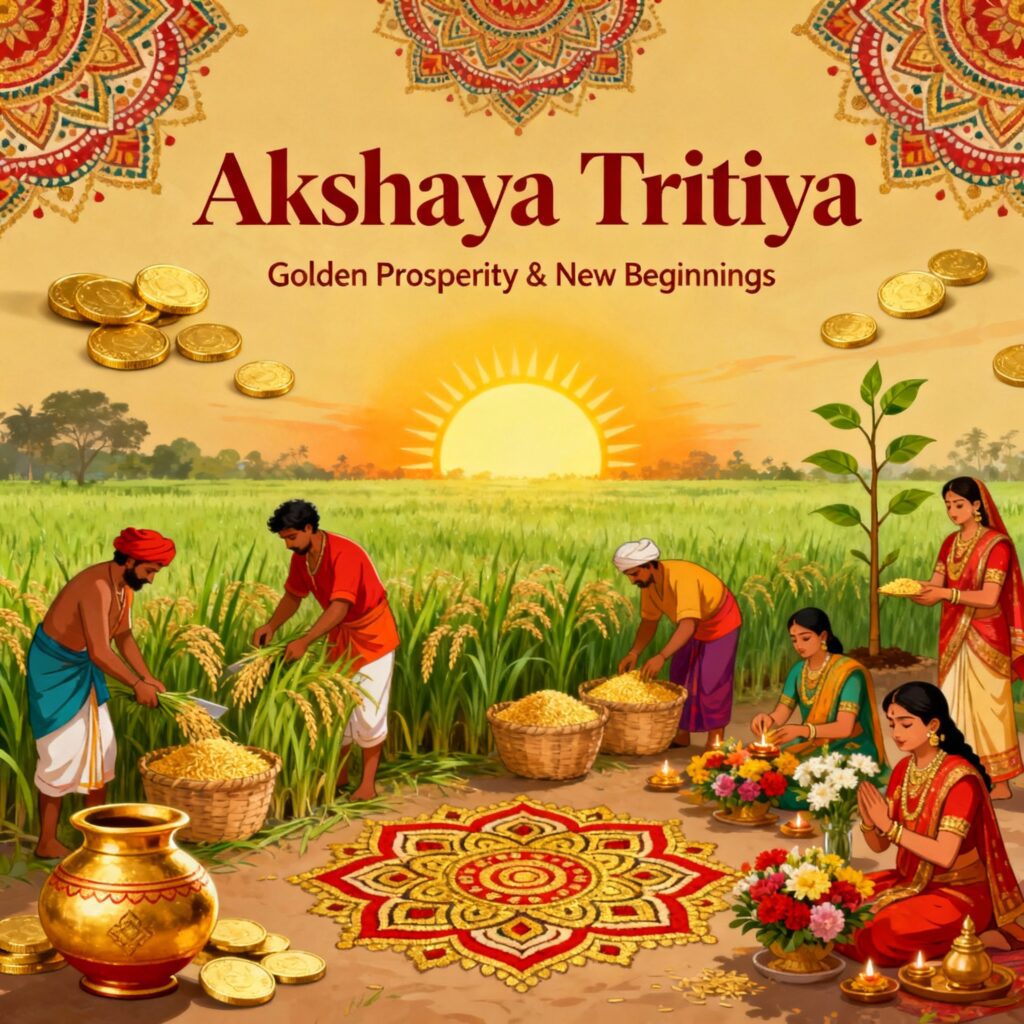
The lamp lit and the offerings set out for the worship kept on the imperishable day.
The significance of Akshaya Tritiya is declared in its name. Akṣaya means the imperishable, the inexhaustible, that which does not wear away; Tṛtīyā names the third Tithi of the bright fortnight of Vaiśākha, which places the day in late April or early May according to the year. Together they name a day on which, the tradition holds, what is undertaken does not erode but endures, a day when the ordinary wearing-away to which all things are subject stands, for a sacred interval, suspended. It is counted among the most auspicious days in the entire year, and among a very small number that require no elected hour at all.
In recent decades the day has come, in much popular awareness, to mean an occasion for buying gold, urged along by jewelers for whom the date is a trading season. This is a genuine impoverishment. The purchase of gold is at most an outer echo of what the day concerns, and to take the echo for the thing is to lose it. What follows sets out what the name claims, the technical status the day holds in the science of timing, the one important limit on that status which almost no account mentions, and the practice that is actually faithful to the day.
A Day Named for What Does Not Decay
The word Akṣaya belongs to a family of terms built on the idea of decay and its negation, and its near relative Akṣara, the imperishable, is among the great names the tradition gives to ultimate reality: the changeless ground that neither grows nor diminishes because it stands outside the flow of time. To name a day Akṣaya is to gesture, in the title itself, at the deepest metaphysics the tradition holds, toward that which does not pass.
This is the depth concealed in a name most people never examine. The undiminishing abundance the day promises is, at its highest, not a swelling of goods but a nearness to the imperishable order of things. Its auspiciousness for worldly undertakings is real, and this account will treat it seriously, but it is a reflection in the world of passing things of a higher imperishability that the name quietly indicates to anyone willing to look past the metal.
The gold the day invites us to buy will tarnish and pass. The day is named for what does not. The gold is a pointer; the imperishable is the point.
Two Kinds of Wealth
The error in the gold-buying reduction is that it conflates two orders of wealth. Gold, however durable among material things, is perishable in the way that matters: it can be lost, stolen, spent, and is certainly left behind at death. To call it imperishable is loose speech, for nothing material answers to the word. The wealth the day genuinely concerns is of another order: the merit of righteous action, which the tradition holds to endure and to multiply across a life and beyond it, and, deeper still, the imperishable reality the Veda names as the Self.
None of which makes the buying of gold forbidden or foolish. Understood rightly it is a small symbolic act, an invocation of prosperity into the household, the enduring metal standing as a token of the lasting abundance the day offers. The fault lies only in mistaking the token for the treasure. Held in its proper place, as a gesture of devotion rather than an end, the custom is harmless and even fitting. Taken for the whole of the day, it keeps the shell and discards the kernel.
Abūjha Muhūrta: The Day That Needs No Election
Akshaya Tritiya holds a rare technical status in the science of auspicious timing, and it has a name. It is an Abūjha Muhūrta, also called Svayaṃsiddha, a self-established or self-auspicious day: one whose auspiciousness is so complete that the whole of it is favorable and no separate hour need be computed from the Pañcāṅga. On an ordinary day one must identify the propitious window among the less favorable hours. On this day the tradition holds that there is nothing to identify, because there is nothing to avoid.
Such days are very few. In the reckoning best known from the western regions they number three and a half, the Sāḍhe Tīn Muhūrta: Gudi Padwa on the first Tithi of Caitra, Akshaya Tritiya, Vijayadaśamī at the close of Navarātri, and as the half, Balipratipadā at Dīpāvalī. Vasanta Pañcamī and Prabodhinī Ekādaśī are treated similarly in a number of traditions. That Akshaya Tritiya stands among so small a company is the measure of its standing.
Beneath this lies a conception of time foreign to the modern view. Where we tend to treat time as a uniform and empty medium, one hour indistinguishable from the next, the tradition holds that time has texture, that particular moments carry a concentrated quality supporting particular kinds of action, and that to act in accord with the quality of a moment is to align oneself with a larger order. On this understanding Akshaya Tritiya is not a date agreed upon and then treated as special. It is a concentration of conditions that was recognized rather than invented, and the whole apparatus of Muhūrta exists because the tradition takes that claim literally.
What the Self-Auspicious Status Does Not Waive
Here is the qualification that almost no popular account carries, and it matters most precisely to the families most likely to rely on the day. The Abūjha status waives the examination of the Pañcāṅga. It does not waive the condition of Guru and Śukra.
For a marriage the tradition requires that Jupiter and Venus both be visible, that is, not in Asta, not so close to the Sun as to be lost in its light. Guru signifies Dharma and the husband, Śukra the wife and the conjugal bond, and a graha invisible through proximity to the Sun is held not to be present in the sense the rite requires. This bar operates independently of the day’s own character, and in some years it falls squarely across Akshaya Tritiya, with the result that there is no usable wedding window on the imperishable day at all. It has happened in living memory more than once, and each time a number of families discovered it late.
Two further points belong beside it. Tārā Bala and Candra Bala, computed from the birth Nakṣatras of the particular bride and groom, remain a matter for the couple rather than the calendar, and a careful officiant checks them even here. And it is worth noticing that Vaiśākha is itself one of the four lunar months the Śāstra names as proper for Vivāha, so the day does not stand as an exception to the marriage calendar but sits comfortably inside it. What the Abūjha status offers, in other words, is a genuine and considerable convenience, not an exemption from the whole of the discipline. The rules governing which months are open and why the two grahas can close a window without warning are set out in the account of electing the Vivāha Muhūrta. A single enquiry before the date is fixed settles it.
The Beginnings the Day Favors
Because the whole of the day is held favorable, it has long been the chosen occasion for undertakings whose value lies in their endurance. A marriage begun on it, a household first entered, a venture opened, a course of study or of practice taken up, a foundation laid: each is held to draw on the day’s quality of the undiminishing, so that what begins on the imperishable day begins under the sign of lasting. The reasoning is consistent with everything else about the day. A beginning is the most fragile moment of any enterprise, the point at which it most needs the support of a favorable time, and this day offers that support without reservation.
The Vivāha holds the first place among these, marriage being among the most enduring of human undertakings and the one most fittingly begun under a sign of permanence. The first entry into a new dwelling, the Gṛha Praveśa, has a similar fitness, as does the quieter class of beginnings: the first worship offered at a new altar, the start of a child’s learning, the taking up of a vow. Where the day falls on a Monday with the Moon in Rohiṇī, the tradition regards it as more auspicious still.
The Narratives the Day Carries
A striking density of beginnings is assigned to this single Tithi, and each carries the same teaching. It is held to be the appearance day of Paraśurāma, the sixth Avatāra, who arose to restore the right order when it had been overturned. It is held to be the day on which Vyāsa began the dictation of the Mahābhārata to Gaṇapati, so that the largest work in the literature of the world was commenced on the day named for what does not diminish. It is held to be the day of the descent of Gaṅgā to the earth, and in the reckoning of the ages the day on which the Tretā Yuga began.
Two narratives speak most directly to the day’s practice. The first is Sudāmā, the impoverished friend of Kṛṣṇa, who came bearing the only gift his poverty allowed, a small handful of parched rice he was too ashamed to offer, and whom Kṛṣṇa received with such love that without a word of request his destitution was turned to abundance. The teaching is the day’s own: a small thing given in pure devotion, at the right moment and in the right spirit, returns not merely repaid but multiplied.
The second is the Akṣaya Pātra, the inexhaustible vessel granted by Sūrya to Yudhiṣṭhira during the exile of the Pāṇḍavas, which never ran empty until Draupadī had eaten last. It is an image of providence sustaining those who hold to Dharma under hardship, and it is worth noting where the vessel’s inexhaustibility stops: at the moment the household has been fed. Not a limitless hoard, but a sufficiency that never fails. The stories agree with the name and with each other. What is undertaken on this day, in the right spirit, lasts.
Dāna: The Giving That Increases
The practice most faithful to the day is not buying but giving. Dāna, charitable giving, stands foremost among its observances, and it rests on a paradox the tradition never tires of stating: that wealth is increased by being given rather than hoarded, that the open hand gains what the closed hand loses. On a day named for the imperishable, the giving away of perishable goods is held to be the surest means of acquiring the wealth that does not decay.
The forms are plain. The gift of food, of water vessels against the coming heat, of clothing, of shade and shelter, of support to the learned and to those in need. The spirit is constant: generosity offered without expectation of return, as an act aligned with Dharma, which the tradition holds to transmute transient things into lasting merit. The day is also kept through worship, a special Pūjā offered to the powers of abundance and grace, the recitation of the sacred names, and quiet reflection on what the name proclaims. For a household wishing the fuller form, the dedicated worship of prosperity is set out in the account of the Laxmi Pūjā, and the fire offering that some families keep alongside it in the broader account of Pūjās and Homas.
The Day Within the Year
Akshaya Tritiya falls in the bright half of Vaiśākha, as the heat of the Indian year builds toward its height, which explains why so many of its customs carry the practical kindness of the season inside the sacred act: the gift of water vessels, of cooling food, of shade. The placement is not incidental. A festival of inexhaustible abundance set at the threshold of the hardest season joins the metaphysical meaning to a human one. To give most freely just as scarcity approaches is to enact, in small, the generosity the day proclaims.
The Jain tradition keeps the day as well, and for a reason that agrees with everything above. It is observed as the day on which Ṛṣabhadeva, the first Tīrthaṅkara, broke a year-long fast with sugarcane juice offered to him by a householder, and it remains the day on which the year-long Varṣītapa is concluded. Two traditions, independently, mark the same Tithi as the day on which sustenance arrives to one who had done without.
Among the observances of the Hindu year, this one belongs to that smaller group concerned less with a particular Devatā’s story than with a quality of time itself. Where most festivals commemorate an event, Akshaya Tritiya celebrates a condition, the suspension of decay, and asks to be kept not by spectacle but by action aligned with that condition: a gift given, a worship offered, a worthy thing begun. Kept so, it needs no elaborate staging to carry its full weight, which is one reason it travels so easily.
Keeping the Day in Europe
A family in Europe loses nothing of the day by keeping it far from Bhārata. The self-auspicious quality is a matter of the Tithi, not of geography. A gift made, a worship offered, a venture begun, a marriage solemnized: each carries its full meaning in Vienna as anywhere, and the day’s Abūjha character is particularly welcome to a household abroad, since it offers a window of unqualified auspiciousness where the arrangement of a computed hour would otherwise be difficult across distance and time zones.
Two practical notes for keeping it in Europe. The Tithi begins and ends at a moment, and which civil day it governs depends on the Tithi current at sunrise where you are standing, so a European household should read the day from a Pañcāṅga computed for its own location rather than from an Indian calendar application. And the Guru and Śukra question set out above still applies, so a family intending a marriage on the day should have that single point checked before anything is booked. Beyond those two, the day asks nothing that a household in Europe cannot give it.
What is given in the right spirit, at a sacred time, does not diminish but endures. That is the whole secret of the imperishable day.
akṣaraṃ brahma paramaṃ
svabhāvo’dhyātmam ucyate
“The supreme imperishable is Brahman; its own nature is called the innermost Self.”
BHAGAVAD GĪTĀ 8.3
The verse names what the day points toward. The supreme imperishable, the Akṣara, is the changeless reality at the summit of the tradition, and the day bearing its kindred name is a yearly reminder of it, given in the gentler language of abundance. A handful of parched rice offered in love became boundless wealth. A vessel fed the righteous in exile until the last of them had eaten. A single Tithi is held to suspend the ordinary wearing-away of things. The teaching beneath all three is one, and the gold merchants have no part in it. The metal will tarnish and pass. The merit of a generous act, and the remembrance of the imperishable Self, will not.
Primary sources: the Bhagavad Gītā, chapter 8, on the Akṣara; the Vana Parva of the Mahābhārata for the Akṣaya Pātra; and the Purāṇic and Smṛti literature for the narratives assigned to the Tithi. Texts and stotras are gathered at Sanskrit Documents. Tithi timings must be computed for the place of observance rather than taken from a calendar prepared for another longitude.
© 2026 AUSTRIAVIENNAPUJA.COM · SANĀTANA DHARMA IN EUROPE
Preserving authentic Vedic transmission across the European continent