
Hindu Priest in Austria & Europe | Vedic Ceremonies, Puja, Homam & Astrology by Pandit Sahadev
Homam | Sacred Vedic Fire Ritual for Spiritual Transformation
Homa in Europe
Understanding Hindu Puja | Vedic and Tantric Traditions
Puja in Europe

Hindu Wedding Seva | Sacred Union Ceremonies
Hindu Wedding Seva in Europe
Vedic Astrology | Cosmic Timing and Spiritual Guidance
Vedic Astrology in Europe

Related Articles
Top 10 Hindu Wedding Destinations in Europe | Authentic Venues & Sacred Ceremonies
Kundli Matching for Hindu Marriages in Austria
Vastu Tips for Home | Complete Guide
Hindu Wedding Rituals | Complete Guide to Sacred Marriage Ceremonies and Traditions
Sanatana Dharma | Why It Is a Way of Life, Not a Religion?
Samskaras and Ceremonies in Vedic Hindu Tradition
How to Plan an Authentic Hindu Wedding in Croatia | Complete Guide
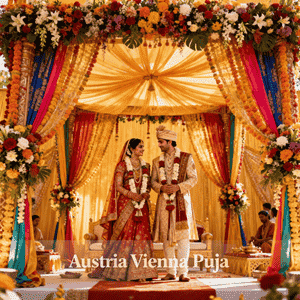
A Hindu Pandit in Austria holds the office of the Ṛtvij, the Vedic officiant whose function is the operative custodianship of Mantra, Yajña, and Saṃskāra. This is not a ceremonial role in the decorative sense. The Pandit bears the formally transmitted Mantra-Adhikāra, the Śāstrically recognised right and capacity to conduct Vedic and Āgamic rites with full operative validity. Through the Saṅkalpa he situates each rite within its precise cosmic and geographical coordinate.
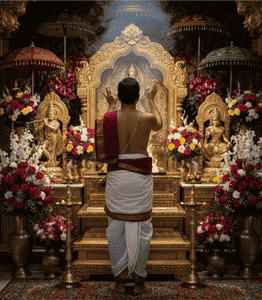
Through the Mantra he conveys the Yajamāna’s intention into the field of the invoked Devatā. Through the Deśa-Kāla framework he ensures that rites performed in Vienna, across Austria, and throughout Europe retain the same Śāstric force they carry in Bhārata. The six principal domains of seva are Pūjā, Homa, Vivāha Saṃskāra, the sixteen Gṛhya Saṃskāras, Jyotiṣa consultation, and Muhūrta selection.
The Gṛhya Sūtras of Āśvalāyana, Pāraskara, and Āpastamba codify sixteen Saṃskāras that mark the Jīva’s passage through embodied life, from Garbhādhāna at the threshold of conception to Antyeṣṭi at the threshold of death. All sixteen are conducted in Austria and across the European Deśa. Among the most frequently performed are Nāmakaraṇa (the Mantra-empowered naming of the newborn), Annaprāśana (the first food offering), Cūḍākaraṇa (the sacred hair-cutting rite), Upanayana (the sacred thread ceremony), and Vivāha (the Vedic marriage).
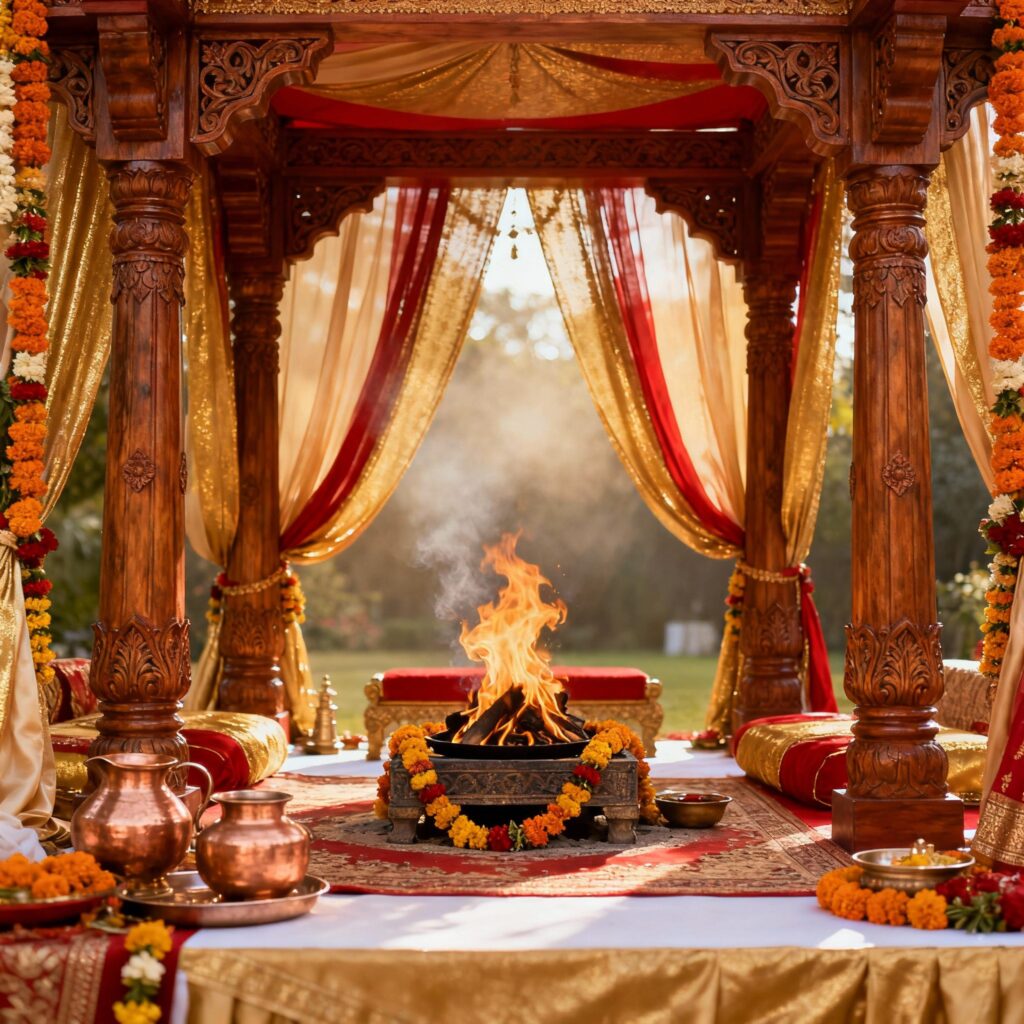
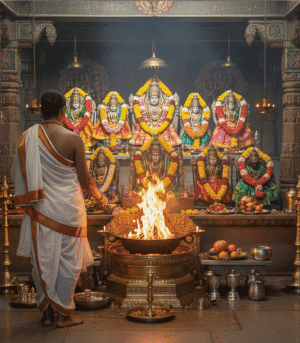
Beyond the Saṃskāras, the Homa rites include Gaṇapati Homa, Mahāmṛtyuñjaya Homa, Navagraha Homa, Lakṣmī Homa, and Pitṛ-Homa. Gṛha Praveśa and Vāstu Śānti are conducted for new homes and premises. Each rite is performed with the complete Saṅkalpa, the correct Sāmagrī, and the Mantra sequences prescribed in the relevant Gṛhya Paddhati. A full overview of the Saṃskāra framework is available in the dedicated exposition of Saṃskāras and ceremonies in the Hindu tradition at Samskaras
Deśa-Kāla is the Śāstric doctrine governing the adaptation of Vedic rites to place and time. The classical tradition addresses this through the Saṅkalpa formula, which situates every rite within the Vedic cosmographic coordinate of Jambū-Dvīpe, the totality of the known terrestrial world. When a rite is performed in Vienna, the Khaṇḍa is declared as Yūropa-Khaṇḍe and the city follows in its Sanskritised form. The Devatās invoked are not geographically bounded; Agni burns as Agni wherever a properly constructed Kuṇḍa is kindled by Mantra.
Gaṅgā-jala carried in the Kalaśa establishes Prāṇic continuity with the sacred rivers of Bhārata. The Kṣetra-Devatā of the European land is honoured at the opening of the Saṅkalpa, establishing the operative consent of the local field. Where the rite is conducted by a priest of full Mantra-Adhikāra and daily Ācāra, the Śāstric validity is complete. The absence of the Bhārata environment is compensated by the intensification of internal Śuddhi and Mantric precision, both of which lie within the capacity of a properly qualified Ṛtvij.
Jyotiṣa is the sixth Vedāṅga, the eye of the Veda, whose primary purpose is the precise determination of Kāla for the performance of Yajña. The Vedāṅga Jyotiṣa establishes that not all moments carry equal operative quality. The Pañcāṅga, the five-limbed Vedic almanac comprising Tithi, Vāra, Nakṣatra, Yoga, and Karaṇa, is the instrument through which the Jyotiṣi identifies the temporal field most suited to each undertaking. A Vivāha Muhūrta selected through this discipline embeds the union in a temporal current that supports its Dharmic completion.
A Gṛha Praveśa Muhūrta aligns the household’s first inhabitation with the most receptive Kāla available. Beyond Muhūrta, the Janma Kuṇḍalī reading maps the Jīva’s Prārabdha Karma across the operative temporal architecture of the Viṃśottarī Daśā system, identifying the periods of greatest Karmic intensity and prescribing the appropriate Upāya in Mantra, Ratna, Dāna, or Homa. The Jyotiṣa consultations offered by the Hindu Pandit in Austria follow the Bṛhat Parāśara Horā Śāstra as the primary doctrinal authority. Full details of the Vedic astrology guidance are available at Vedic Astrology