
Antyeṣṭi | The Final Saṃskāra
Antyeṣṭi and Śrāddha: The Vedic Last Rites
On the final sacrament and the rites of ancestral fidelity: how the tradition accompanies the departed, how it holds the bereaved through the days that follow, and how the bond with those who came before is kept.
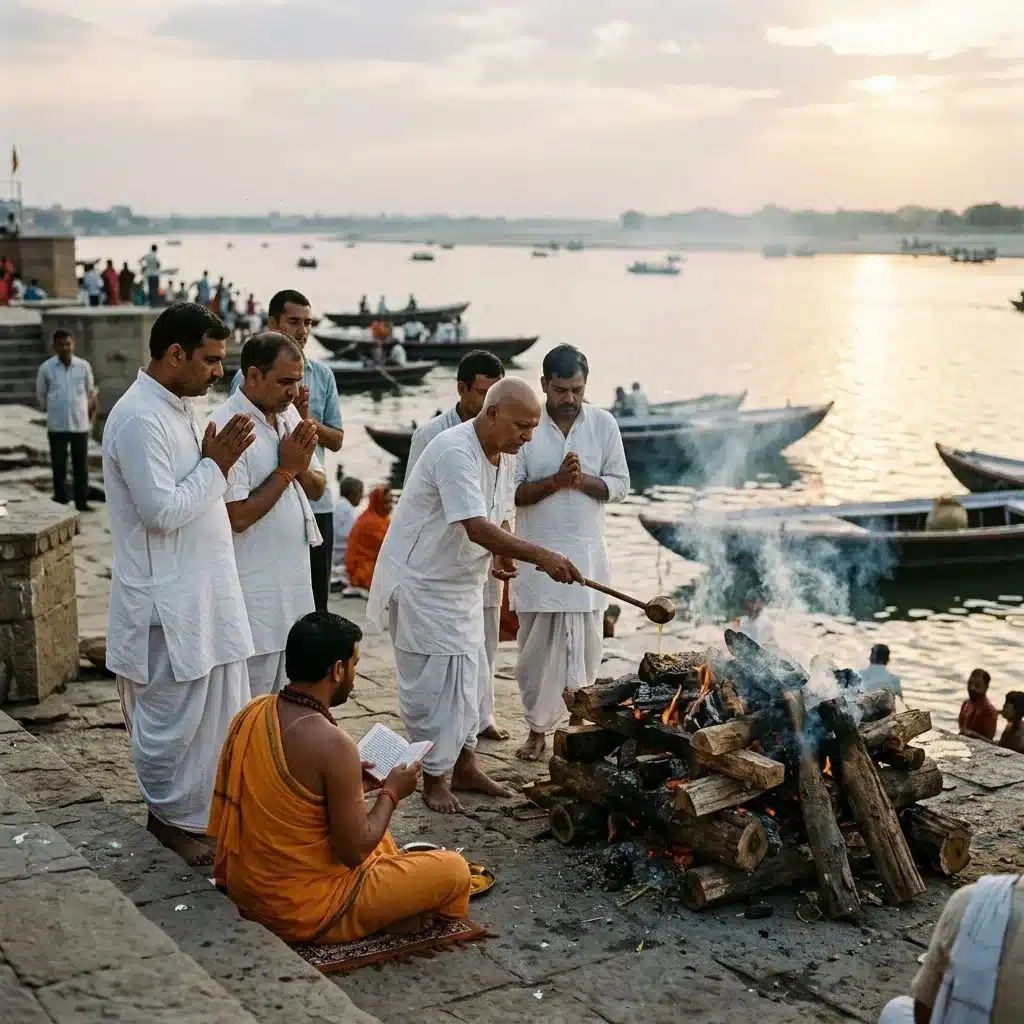
The final offering: consigning the physical vessel to Agni and honoring the continuity of the Jīva.
Written by Pandit Sahadev, Vedic priest and pandit in charge of ceremonies at Radha Govinda Math, Traiskirchen
The final passage of the embodied soul is governed by two rites: Antyeṣṭi, the last offering, and Śrāddha, the rites of ancestral fidelity that follow it. Within Sanātana Dharma, death is understood not as annihilation but as a passage. The Śāstras recognize the disorientation of grief and do not leave the bereaved without an anchor; they provide a structured and compassionate framework by which the departed is accompanied and the living are given something to do with their sorrow.
These observances are the tradition’s answer to the helplessness that death imposes. They are not gestures of farewell alone. They are understood as assisting the subtle body in its release from earthly bindings and its passage toward the realm of the ancestors, and to perform them is to discharge the deepest of the obligations a person owes to those who gave them life.
Death as Passage, Not Ending
The doctrinal foundation of these rites rests on the conviction that death is the setting down of a temporary vessel, and that the conscious entity, the Jīva, continues. The Bhagavad Gītā gives this its most enduring articulation, spoken precisely to dispel the despair of loss, and it is often the first thing a priest offers a grieving household.
vāsāṃsi jīrṇāni yathā vihāya
navāni gṛhṇāti naro ‘parāṇi
“As a person sets aside worn-out garments and takes up new ones, so the embodied self sets aside worn-out bodies and passes on to others that are new.”
BHAGAVAD GĪTĀ 2.22
This teaching is not intended to diminish sorrow. Grief is the natural consequence of love and attachment, and the tradition nowhere asks the bereaved to feel less. What the verse does is redirect the object of that grief: the weeping is for a parting, real and painful, rather than for an extinction. The rites that follow are the tangible actions the living may take to accompany the departed through the passage, and in the doing of them the household finds its footing again.
Unstructured grief has nowhere to go. The tradition gives the mourner a task, and the task itself becomes the path through the days.
Antyeṣṭi: Consigning the Vessel to Agni
Antyeṣṭi is the last of the sixteen Saṃskāras, and its inclusion among them says something important. The disposal of the body is not treated as a practical necessity to be got through but as a sacrament, the final purification of the elements that composed the earthly form. What was gathered from the elements at birth is returned to them at the close.
At the center of the funeral stands Agni, the same sacred fire that witnessed the naming of the child and the vows of the marriage. In cremation the body itself becomes the final offering made into those flames, so that a life whose thresholds were each marked before the fire is concluded before it also. The rite is carried by the chief mourner, guided throughout by a priest who keeps the sequence and the recitation in order, so that the family is not left to manage ritual complexity at the hour when they are least able to.
Aśauca: The Architecture of Mourning
Cremation does not conclude the family’s obligations. What follows is a regulated period the tradition calls Aśauca, during which the household withdraws from ordinary worldly engagement. This is easily misread as a period of imposed impurity or punishment. It is closer to a sanctioned withdrawal: the family is formally excused from the world’s demands at exactly the moment when meeting them would be unbearable, and is given instead a small daily discipline, the offering of water and of rice, that occupies the hands and orders the days.
There is real wisdom in this, and modern grief counsel has arrived at something similar by another road. Unstructured mourning tends to collapse inward. By prescribing a task, performed at set times, directed toward the one who has been lost, the tradition converts helplessness into service. The mourner is not merely enduring; they are doing something for their dead, and that distinction carries many families through the first weeks.
From Preta to Pitṛ: The Sapiṇḍīkaraṇa
In the understanding the tradition preserves, the departed consciousness passes first into an intermediate and unsettled condition known as Preta: no longer of the earthly household, not yet gathered into the ancestral company. The daily offerings of the mourning period are directed toward this passage, and they culminate on the twelfth or thirteenth day in the rite called Sapiṇḍīkaraṇa.
This is the turning point of the whole sequence. Through the rite the departed is understood to be released from the unsettled state and joined to the Pitṛs, the ancestors. The change in the family’s relationship to them is total: the one who has died ceases to be an object of mourning and becomes a presence to be honored. It is, in the tradition’s own image, a homecoming, and one accomplished through the devotion of the living. Something of the weight lifts on that day, and families who have kept the rite often describe exactly that.
Śrāddha: The Bond That Continues
Once the departed has been gathered to the ancestors, the relationship shifts from mourning to remembrance, and this is where Śrāddha and Tarpaṇa begin. These are recurring rites of fidelity, kept on the lunar anniversary of the death and during the ancestral fortnight of Pitṛ Pakṣa. Water and sesame are offered with Śraddhā, the faith from which the rite takes its name, and the lineage is thereby sustained.
It would be a mistake to read this as a morbid preoccupation with the dead. It is closer to the opposite: an insistence that those who came before are not permitted to fade into obscurity, that they remain named, remembered, and honored by the generations they brought into being. The annual observance and its practical keeping are treated in the account of the Pitṛ Pūjā rituals. What the tradition asks is not grief without end but gratitude that does not lapse.
Keeping These Rites in Europe
For families settled in Europe, distance from the sacred rivers of Bhārata often produces a particular anxiety: the fear that a rite kept in Vienna or Lisbon somehow reaches less far than one kept at a ghat on the Ganga. The tradition’s own position is clear enough. The reach of Agni and the working of Karma are not bounded by modern borders, and the offerings made here are made in earnest and received as such.
What carries the rite is not the soil it is kept on but the care with which it is kept: the correct sequence, the recitation in its proper form, and the sincerity of the household performing it. Where a family cannot travel, the rites hold. Where a family engages a priest who keeps his own daily discipline and knows the sequence properly, the burden of ritual complexity is lifted from them at a time when they have little capacity for it, which is much of what a priest is for in these days. The formation and lineage behind such an officiant are described in the account of the Vedic lineage of Pandit Sahadev.
A practical word for households in Europe. Local regulations govern cremation and the handling of ashes, and these vary considerably from country to country; they are best confirmed with the relevant authority and the funeral director, and this page offers general information rather than legal guidance. Within those constraints the essential shape of the rite is almost always achievable, and an experienced priest will know what is possible in a given city and what adjustments the circumstances ask for.
What the Tradition Offers the Bereaved
Set beside the bare fact of loss, what this body of rites offers is not an explanation but a structure. It does not tell the grieving that their sorrow is misplaced, nor promise that the pain will be brief. It gives them, instead, a sequence of things to do, in order, with meaning attached to each, at the precise period when the mind can hold very little and is grateful to be told what comes next.
And it gives them a long horizon. The dead are not consigned to the past on the day of the funeral; they are carried forward, named each year, offered water and remembrance for as long as the line continues. A household that keeps these rites is a household in which no one is finally lost. That is the quiet gift beneath the whole architecture, and it is why the tradition has held to it so carefully across so many centuries.
We do not abandon our dead. We accompany them through the passage, and then we remember them, year upon year, so that the line remains unbroken.
The understanding described here rests on the funerary and ancestral literature of the tradition: the Garuḍa Purāṇa on the passage of the Jīva, the Manusmṛti with Medhātithi’s commentary on ancestral obligation and Aśauca, and the Bhagavad Gītā for the verse cited above, with the texts gathered at Sanskrit Documents and scholarship on Vedic funerary rites available through the Oxford Centre for Hindu Studies.
© 2026 AUSTRIAVIENNAPUJA.COM · SANĀTANA DHARMA IN EUROPE
Preserving authentic Vedic transmission across the European continent