
Sanātana Dharma | The Eternal Way
Sanātana Dharma: A Way of Life, Not a Religion
On the old claim that this is a way of life rather than a religion, and why the tradition makes it: a path with no founder, no single creed, and no corner of life left outside its care.
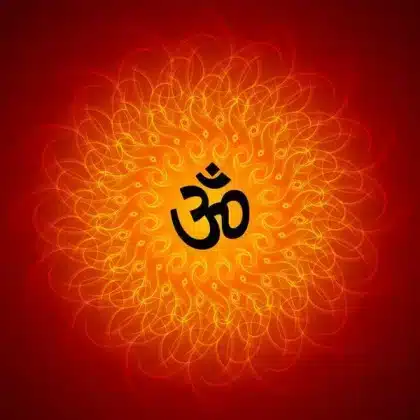
Oṃ, the syllable the Māṇḍūkya Upaniṣad declares to be all that is.
Written by Pandit Sahadev, Vedic priest and pandit in charge of ceremonies at Radha Govinda Math, Traiskirchen
It is often said that Sanātana Dharma is a way of life, not a religion, and the phrase is so familiar that its real meaning is easily missed, taken for a slogan or a bit of polite self-promotion. It is neither. It is a careful description, and it rests on some plain facts about the tradition that genuinely set it apart from what the word religion usually names. The claim is not that this path is better than the religions, nor a criticism of them; the great faiths are what they are, and describe themselves in their own terms. The claim is simply that this tradition is built differently, and that the word religion, which fits the others well enough, does not quite fit it, and understanding why is a good way to understand what it actually is.
What does the word religion usually carry with it? Most often: a founder who received a revelation and gathered a community; a creed that marks the believer off from the unbeliever; a membership one is inside or outside of; and a sacred sphere set apart from the ordinary business of life. These are not faults; they are simply features, and they describe a great many traditions well. The point worth seeing is that Sanātana Dharma has almost none of them, and that its absence of them is not an oversight but the shape of the thing.
A Tradition With No Beginning
Start with the most striking absence: there is no founder. The great religions can be traced to a person and very often to a moment, a revelation, a ministry, a life around which everything else gathered. Sanātana Dharma has no such figure and no such founding moment. Its deepest scripture, the Veda, is not held to be anyone’s composition at all, not a human’s and not even, in the usual sense, a god’s, but an eternal truth that wise seers heard and passed on. The very name reflects this: sanātana means the eternal, the beginningless, that which has always been extending forward without a start.
This single fact reorders everything. A founded faith looks back to its origin and measures itself against the founder’s revelation. A tradition that claims no beginning has nothing to look back to in that way; it understands itself not as the legacy of an event but as the ongoing human attempt to live in accord with an order older than any teaching, the order of the cosmos itself. It did not start; it has simply always been the name for living in tune with the way things are. That is a different kind of thing from a religion in the ordinary sense, and the difference is the root of all the others.
A founded faith looks back to its origin. A tradition with no beginning looks only to the order of things it has always tried to live by.
The Name Itself
The two words repay a closer look. Sanātana means the eternal and beginningless, that which stretches without interruption from before memory into the open future. Dharma comes from a root meaning to hold or to sustain, and names the principle that upholds, both the order that holds the cosmos together and the conduct that holds a human life true. Put together, the name does not mean a religion at all, in the sense of a particular faith among others. It means something closer to the eternal sustaining order, and the way of living in accord with it.
This is why those who know the tradition often resist the label. To call it a religion is to file it alongside the founded faiths as one more member of that category, when its own self-understanding is that it names something prior to and wider than any single faith: the order of things itself, and the art of living rightly within it. Dharma, in this sense, is not a moral code imposed from outside but the grain of reality as it bears on human conduct, and to follow it is less to belong to a religion than to try to live truly. The deeper grounding of this idea, the order called Ṛta and the law that works it out, is set out in the companion reflection on why we follow Dharma Śāstra.
Many Roads, One Ground
Then there is the matter of creed, and here the difference is just as marked. A religion in the usual sense has a defined doctrine, a line between orthodoxy and heresy, beliefs one must hold to be counted in. Sanātana Dharma has nothing of the kind. It contains, within itself and without contradiction, schools of thought that disagree about the deepest questions: about whether the self is finally one with the divine or eternally distinct from it, about whether ultimate reality is personal or beyond personality, about the very existence and nature of God. These are not rival sects condemning one another as heretics; they are honored schools of a single tradition, debated by great teachers who revered the same scriptures and pointed toward the same liberation.
In a creedal religion, positions that far apart would mark separate faiths. Within this tradition they are chapters of one long conversation. The reason is a principle stated at the very root of the Veda, that truth is one, though the wise call it by many names. Where that is a founding conviction rather than a grudging tolerance, disagreement about how to describe the one truth is not a threat to be policed but a richness to be expected. A tradition built this way is not a creed with a boundary; it is a shared ground, the Veda and the order it discloses, within which an extraordinary range of seeking is welcomed. That is not how a religion in the narrow sense is built, and it is one of the clearest marks of the difference.
No Part of Life Left Out
Perhaps the plainest sense in which this is a way of life is that it leaves no part of life outside itself. The tradition maps the whole human span into stages, the years of learning, the years of the householder raising a family and carrying the world’s work, the years of gradual withdrawal, and the final years of release, and it gives each its own shape and purpose, so that no season of a life falls outside the Dharmic order. There is no point in a life that the tradition treats as merely secular, none that it leaves unattended.
The same holds within a single ordinary day. The tradition speaks of daily offerings that touch every dimension of a person’s life: study and learning, the relationship to the divine, the debt to one’s ancestors, the care owed to all living things, and the hospitality owed to other people. Taken together, these mean that an ordinary day is not secular time with a little worship added at the edges, but a whole life held within a sacred order from waking to sleep. This is the literal meaning of a way of life: not a set of beliefs kept privately while the rest of life runs on worldly terms, but an order that runs through the whole of living. The rites that mark the stages of a life are treated more fully in the account of the Saṃskāras of the tradition.
Recognition, Not Salvation
There is one more difference, and it lies at the deepest level, in what the tradition holds to be the final goal. Many faiths understand their highest hope as salvation: the saving of the soul by the grace of a divine other, with whom the soul remains, even in its blessedness, distinct. The Vedic tradition’s highest aim is described differently. It speaks of liberation as a recognition: the waking-up of the self to the fact that, in its deepest nature, it was never separate from the ultimate reality at all. The great sayings of the Upaniṣads are not pleas to be saved but declarations of identity, that the innermost self and the ultimate ground are, in the end, one.
This is said not to diminish the faiths that understand the goal as salvation, which describe their own hope truly in their own terms, but to mark how different this tradition’s hope is. Where salvation is something granted to the soul from outside, this liberation is the discovery of what the soul most deeply already is. A tradition whose final word is not you shall be saved but you already are what you seek, only wake to it is making a claim of a different order, and it shapes everything beneath it: the stages of life, the daily offerings, the long discipline, all become the slow clearing of the eyes for a recognition rather than the earning of a reward. That, more than anything, is why the tradition resists being filed simply as one religion among others.
Living It Far From Home
If this is a way of life and not a creed bound to one land, then it should be livable anywhere, and the tradition holds that it is. Its universal duties, honesty, non-injury, purity, restraint, generosity, compassion, bind a person in Vienna exactly as they bind one anywhere; the stages of life, the daily offerings, the rites that mark a life’s turnings can all be kept in the European setting through a qualified officiant. The order it aligns with is not Indian or European but cosmic, the same order under which the sun rises over the Alps as over any river of the homeland. A family living this way in Austria is not keeping a foreign religion; it is living in accord with an order it holds to be everywhere, and that, the tradition would say, is precisely what a way of life, as opposed to a local religion, makes possible.
So the old phrase turns out to be exact. This is a way of life and not a religion, not as a boast, but as a description of a tradition with no founder to look back to, no single creed to enforce, no membership to police, and no corner of living left outside its care, a tradition that understands itself as the eternal art of living in tune with the way things are. Named rightly, it is less something one believes than something one lives, which is all the old phrase was ever trying to say.
It is less something one believes than something one lives: the eternal art of being in tune with the way things are.
ekaṃ sad viprā bahudhā vadanti
“Truth is one; the wise call it by many names.”
ṚGVEDA 1.164.46
No single line captures the tradition’s character better than this one. Truth is one, it says, but the wise speak of it in many ways, and that conviction, set at the very root of the Veda, is why the tradition could hold within itself so many schools, so many names for the divine, so wide a range of seeking, without ever needing to declare one of them the only truth and the rest heresy. A path founded on the belief that the one truth wears many names was never going to be a creed with a boundary. It was always going to be something larger and looser and older: a way of living, open to all who would walk it, toward a truth that no single name exhausts. That is what is meant, in the end, by calling Sanātana Dharma a way of life and not a religion.
The understanding described here rests on the Vedic and philosophical literature of the tradition; the verse is from the Ṛgveda, with the texts gathered at Sanskrit Documents and scholarship on the philosophical schools available through the Oxford Centre for Hindu Studies and the Stanford Encyclopedia of Philosophy.
© 2026 AUSTRIAVIENNAPUJA.COM · SANĀTANA DHARMA IN EUROPE
Preserving authentic Vedic transmission across the European continent