
Kubera | The Keeper of the Treasury
Kubera Pūjā: The Treasurer of the Gods
On the worship of the lord of wealth, understood through the one fact most often forgotten about him: that he guards the treasury of the gods, but owns none of it. His worship asks us to hold wealth the same way.

The Kubera Yantra: every row, column, and diagonal sums to 72.
Written by Pandit Sahadev, Vedic priest and pandit in charge of ceremonies at Radha Govinda Math, Traiskirchen
There is a detail about Kubera, the deity of wealth, that quietly overturns most of what is assumed about his worship. He is not, in the tradition, the owner of riches. He is their treasurer: the keeper of the gods’ treasury, charged with guarding what is not his and distributing it according to a law higher than his own wish. To grasp this one fact is to understand Kubera Pūjā rightly, and to see why it is so often misunderstood. The rite is frequently approached as a way of summoning wealth, a transaction in which the right offering produces the desired return. The tradition’s own understanding is both deeper and more demanding: that to worship Kubera is to align oneself with the way he himself holds wealth, as something kept in trust, ordered, and rightly passed on, rather than seized and hoarded.
This is not a small correction. It changes what the worship is for. A petition to a generous deity asks him to give; an alignment with a treasurer asks to be made fit to hold. The first treats wealth as a prize; the second treats it as a responsibility. The tradition has always meant Kubera Pūjā in the second sense, and the worship makes far more sense, and asks far more of the worshipper, once that is understood.
The Keeper of the North
Kubera is among the oldest of the wealth-figures of the tradition, named in the early texts as the lord of the yakṣas, a class of beings associated with the hidden riches of the earth: the veins of metal in the rock, the waters underground, the fertility latent in the soil. He is the guardian of the north among the deities who keep the eight directions, and the north, in the tradition’s scheme, is the quarter of stability and of the earth’s enduring capacity to hold and to yield. His most honored name, Vaiśravaṇa, and his fabled mountain city of treasures belong to a figure understood less as a giver of gifts than as a custodian of what the earth has stored up.
Already in this old picture the essential note is struck. Kubera is associated not with the spending of wealth but with its keeping: the careful holding of what is precious, in its right place, against its right use. Where Laxmi, the goddess of fortune, is movement and grace, Kubera is steadiness and structure, the treasury and the strongroom rather than the flowing stream. To worship him is to turn toward this steady, custodial aspect of abundance, the part of it that is about holding rightly rather than acquiring more.
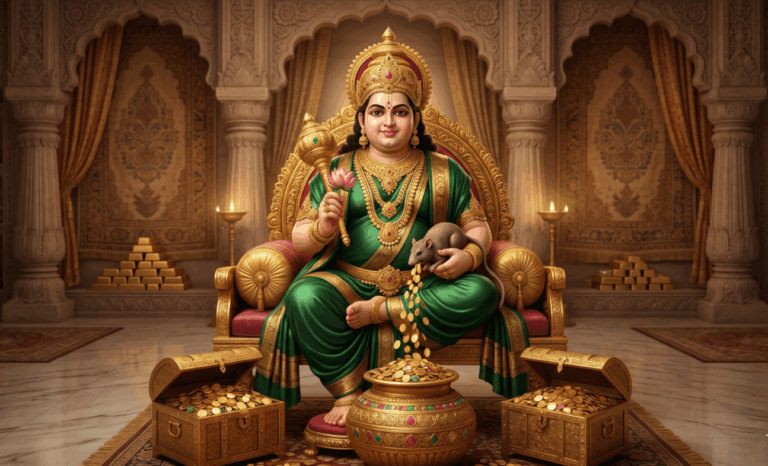
A treasurer does not own the wealth he guards. He holds it, orders it, and passes it on. Kubera Pūjā asks us to hold wealth the same way.
A Treasurer, Not an Owner
This is the heart of the matter, and it deserves to be dwelt on. A treasurer holds wealth that belongs to another. He does not spend it on a whim, nor regard it as his to keep; he guards it, keeps it in order, and disburses it according to a purpose larger than himself. The tradition holds that Kubera relates to the wealth of the cosmos in exactly this way, and that the worshipper who approaches him sincerely is asking to be brought into the same relationship: to become, in his own life, a steward rather than an owner of whatever wealth passes through his hands.
This reframes everything. The householder who worships Kubera with understanding is not asking to be made rich in the sense of accumulating a hoard. He is asking to be made a good keeper of what comes to him: to receive it through honest means, to hold it without anxiety or greed, to use it to sustain his family and his duties, and to return a fair portion of it to the world through generosity and the support of good things. Wealth, in this light, is not a possession to be amassed but a current to be rightly channeled, and the worship of Kubera is the asking to become a clear channel rather than a stagnant pool. This is a far older and far worthier idea than the modern reduction of the rite to a money-summoning ritual, and it is the tradition’s own.
The Two Hands of Abundance
Kubera is rarely worshipped alone. The tradition most often joins him with Laxmi, the goddess of fortune and grace, and the pairing is deliberate and instructive. The two are understood as the two hands of a single reality. Laxmi is the quality of wealth, its grace, its beauty, its capacity to bless and to elevate those it touches; Kubera is its keeping, its structure, its stable holding and right ordering over time. Worship the one without the other, the tradition gently warns, and abundance comes out of balance: grace without structure arrives brilliantly and slips away unheld; structure without grace accumulates into the joyless hoard of the miser.
This is why the combined worship of Laxmi and Kubera, kept especially on the night of Dīvālī, is so beloved. It asks for abundance whole: both the grace that makes wealth a blessing and the steadiness that lets it be held and used well. The fuller account of the worship of the goddess of fortune is given in the treatment of the Laxmi Pūjā for prosperity. Together the two deities describe a complete and dignified idea of wealth: graceful, well kept, and rightly used, which is a very different thing from wealth merely piled up.
What the Worship Actually Asks
The rite itself unfolds as the welcoming and honoring of a distinguished guest, in the manner the tradition gives to all its worship: the deity is invited into an image or a sacred diagram, offered a seat, water, light, fragrance, and food, and addressed with his sacred names and the prayers proper to him. Where a fire offering is made, the offerings are given into the flame, which the tradition holds to be the carrier of what is offered toward the divine; the understanding of fire in this role is set out in the meditation on the Vedic Homa. The mantras and sacred names of Kubera, including the well-known recitation of his hundred and eight names, are offered as the worship’s heart, and the sequence of offerings by which any divine guest is received is set out in the account of Hindu Puja.
It is worth being plain about what this worship is understood to do, and what it is not. It is not, in the serious tradition, a mechanism that produces money in proportion to the correctness of the ritual; abundance is not a coin dispensed by a machine, and any teacher who promises wealth as the guaranteed output of a rite has left the tradition’s own understanding behind. What the worship is held to do is subtler and truer: it is the conscious turning of one’s whole relationship with wealth toward right order, the asking to be made a fit keeper of what one is given, and the placing of one’s working life within the frame of duty and gratitude rather than grasping. Performed in that spirit, the worship works on the worshipper, on how he earns, holds, and gives, which is exactly where, in the tradition’s view, the real change must happen.
The One the Tradition Will Receive
Because the worship is an alignment rather than a transaction, the tradition is unusually clear about who is fit to undertake it, and the conditions it names are moral, not ritual. Three are spoken of again and again. The first is honest earning: the tradition holds that the blessing it speaks of flows only through wealth that has been justly come by, and not through what is gained by harm or deceit. The second is generosity: a settled habit of giving a fair share of what one has to good and needful ends, so that one is already a channel and not a dam before one ever approaches the rite. The third is a disciplined and decent daily life, the ordinary uprightness that makes a person, in the tradition’s image, a clean vessel able to hold what is poured into it.
There is great honesty in this. The tradition does not pretend that a ritual can make a grasping or dishonest life prosperous in any way worth having. It says, rather, that the worship of the treasurer is fitly undertaken by one who already lives, in small measure, as a good treasurer lives: earning rightly, holding lightly, giving freely. To such a person the worship is the deepening and consecration of a relationship to wealth already rightly begun. The condition is not a barrier the tradition erects to keep people out; it is its honest account of what kind of person the worship can actually help.
Keeping the Rite in Europe
A family in Europe can keep Kubera Pūjā in full. The worship asks nothing of geography: the deity is welcomed, honored, and addressed by his names, and where a fire offering is made it is made in a contained sacred fire suited to a European home, with attention to the practical matters of ventilation and the rules of the building. The combined worship of Laxmi and Kubera on the Dīvālī night is kept in Vienna as warmly as anywhere, and asks only the same honest preparation of the worshipper that it asks everywhere. The wider understanding of a Dharma that travels with its people, losing nothing for being far from its homeland, is set out in the reflection on Sanātana Dharma as a way of life.
What matters, in Europe as anywhere, is not the splendor of the offering but the disposition of the one who offers. The treasurer of the gods is approached fitly by one who has resolved to be a good treasurer of his own portion: honest in earning it, calm in holding it, generous in passing it on. To such a household the worship of Kubera is not the chasing of riches but the consecration of a right relationship with whatever wealth its life is given to keep.
Wealth is not a prize to be won but a trust to be kept. To worship the treasurer is to ask to be made a good keeper of one’s own.
dhanaṃ dhānyaṃ paśūn bahūn
yaśo dehi śriyaṃ dehi, kubera tvāṃ namāmy aham
“Grant abundance, grant nourishment, grant honor and grace; O Kubera, I bow to you.”
A TRADITIONAL PRAYER TO KUBERA
The old prayer asks for many things, abundance, nourishment, honor, grace, but it ends, tellingly, in a bow. It does not demand; it reveres, and asks. That posture is the whole of Kubera Pūjā. The worshipper comes not as a customer to a dispenser of riches but as one who bows before the keeper of a treasury larger than himself, asking to be brought into right relationship with the wealth that flows through the world. What the treasurer gives, the tradition holds, he gives to those prepared to hold it well, to steward it without greed, and to return a worthy share of it to the order that makes all abundance possible. That is the secret hidden in plain sight in the worship: that the riches worth asking for are given to those already learning to hold them rightly.
The understanding described here rests on the Purāṇic and devotional literature of the tradition; the prayers and names of Kubera are gathered at Sanskrit Documents, with scholarship on the deities and on wealth in the Dharma tradition available through the Oxford Centre for Hindu Studies.
© 2026 AUSTRIAVIENNAPUJA.COM · SANĀTANA DHARMA IN EUROPE
Preserving authentic Vedic transmission across the European continent