Saṃskāra | The Refining of a Life
What the Word Saṃskāra Actually Means
All sixteen named and set in order, the difference between a rite that marks a passage and one that works upon it, and an honest account of why the Sanskrit sources do not agree on the number.
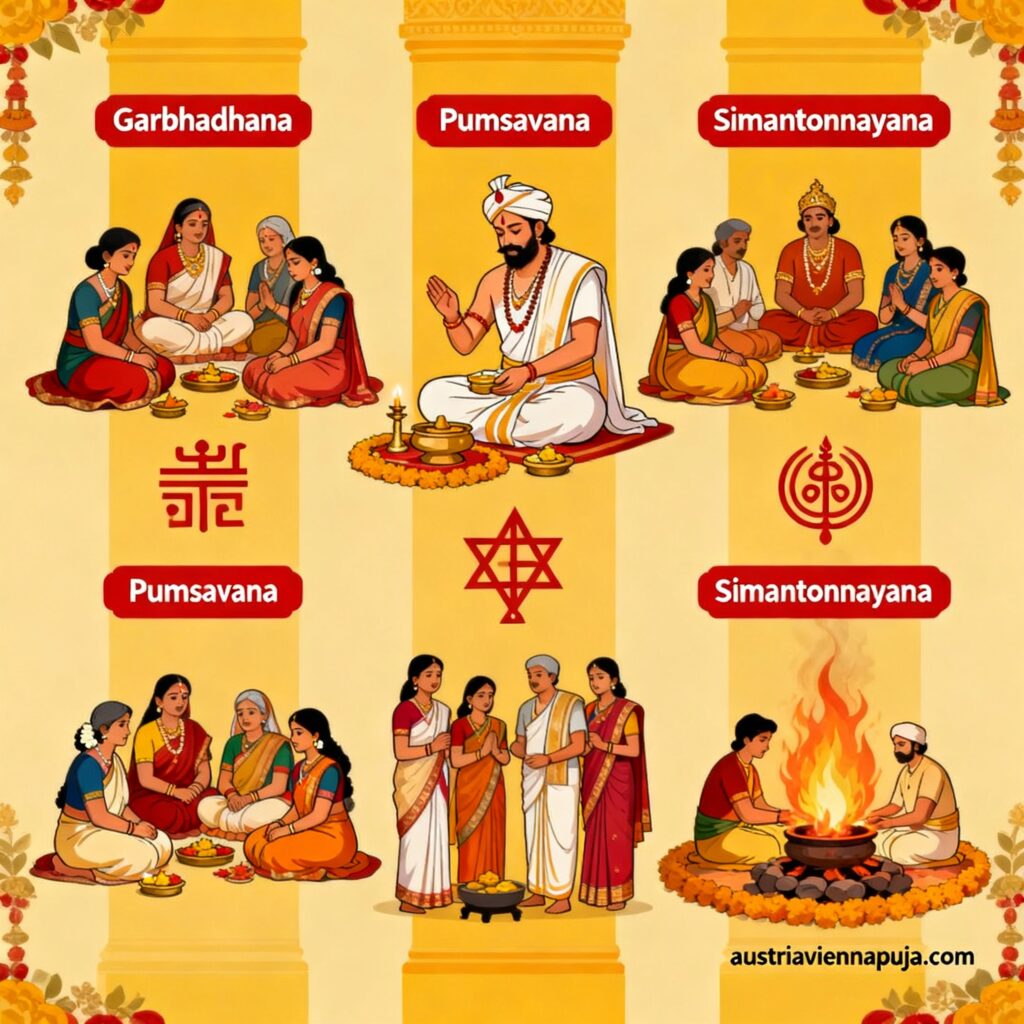
Sixteen consecrations, from before birth to after death, each kept at the household fire.
There is a word at the root of all this and it repays a moment’s attention. Saṃskāra is built from sam, together or completely, and the root kṛ, to make: to form, to put together well, to refine. It is the same formation that gives Sanskrit its own name, saṃskṛta, the refined or perfected tongue, as against prākṛta, the natural and unworked. A Saṃskāra is therefore not first of all a ceremony. It is a refining: an act meant to take something and help it become more fully what it is meant to be.
When the tradition gives this name to the great passages of a human life it makes a quiet but far-reaching claim, that a life is not merely to be lived but to be formed, attended to and worked upon at each of its turnings. The Saṃskāras in Hindu tradition are counted as sixteen, running from before conception to after death. This page names all sixteen, sets them in their order, and is honest about the one thing most accounts leave out, which is that the number itself is a later tidying of a much less tidy inheritance.
A ceremony marks; a Saṃskāra works
A ceremony in the ordinary sense marks something that has already happened. A graduation marks a degree already earned, a birthday a year already lived. The thing is done and the observance notes it. A Saṃskāra is understood to do something rather than merely observe it. It is performed at the passage rather than after it, to accomplish part of what the passage consists of: to consecrate, to purify, to turn the person rightly toward what comes next. The tradition holds that a threshold crossed with the rite is not the same as one allowed to slip by, and that the act leaves its mark on the one who undergoes it.
You need not adopt any elaborate metaphysics to feel the force of this. We all know that some thresholds are diminished when nobody pauses over them and dignified when someone does. The tradition takes that instinct and gives it an architecture, identifying the great turnings and consecrating each, so that growing up and growing old are accompanied rather than simply endured. That is what raises a Saṃskāra above a ceremony, and it is the thread running through all sixteen.
A ceremony marks a passage that has happened. A Saṃskāra is performed at the passage itself, and is held to work upon the one who passes through.
Sixteen is a count, not the count
Before the list, the honest qualification, because it is rarely made and it strengthens rather than weakens the tradition. The figure of sixteen, the ṣoḍaśa saṃskāra, is a systematization of the Smṛti period rather than a number the Gṛhya Sūtras themselves hand down. The Sūtras differ among themselves on which observances to include and in what order. The Gautama Dharma Sūtra enumerates forty Saṃskāras alongside eight qualities of the soul, a very different reckoning. Others give closer to a dozen. Regional practice varies further, and several of the sixteen have fallen out of ordinary use in most communities.
Naming this openly matters for two reasons. It is simply true, and a family that later encounters a different list should not conclude that someone has been careless. And it clarifies what the tradition is actually doing: not administering a fixed checklist of sixteen procedures, but treating the whole arc of a life as a work of formation and marking whichever of its turnings a given lineage has held worth marking. The sixteen below are the standard enumeration, the one a family will meet in practice.
The three before birth
Garbhādhāna, the placing of the seed, consecrates conception itself, treating the beginning of a life as an act to be undertaken with intention rather than left to chance. Puṃsavana is performed in the third or fourth month of pregnancy for the health and vigor of the developing child. Sīmantonnayana, the parting of the hair, comes later in the pregnancy and asks protection for mother and child through to the birth, and it is in substance the tradition’s blessing of an expectant mother.
One point is owed plainly. The older texts frame Puṃsavana as a rite for the obtaining of a son, in the manner of their period. The enduring intention beneath that framing, and the one the rite properly carries today, is the wellbeing of the coming child whoever it turns out to be. Saying so is more honest than either quietly editing the sources or repeating a social preference the tradition has no need to keep.
The four of birth and infancy
Jātakarma, the birth rite, is performed at the arrival itself: the child is welcomed with honey and clarified butter touched to the lips and with words spoken into its ear, the family’s first address to its newest member. Nāmakaraṇa, the giving of the name, follows on the eleventh or twelfth day, and the tradition treats it with great seriousness as the first thing a person is given, the name chosen with attention to the Nakṣatra under which the child was born. Its own full account is given in the treatment of the Nāmakaraṇa.
Niṣkramaṇa, the going out, is the child’s first formal passage beyond the house, carried out to be shown the sun and the world in the third or fourth month. Annaprāśana, the first feeding, blesses the child’s first solid food, generally in the sixth month, and marks the shift from being nourished by the mother alone to being nourished by the earth. It is treated at length in the account of the Annaprāśana.
The three of childhood
Cūḍākaraṇa, the first ceremonial cutting of the hair, is kept in the first, third or fifth year and closes the chapter of infancy. Karṇavedha, the piercing of the ears, is kept for sons and daughters alike. Vidyārambha, the beginning of learning, is the child’s first formal contact with letters, traditionally by tracing them in rice or sand, kept under the grace of Sarasvatī.
It is worth noticing what these three have in common with the ones before them. The tradition does not consecrate only the grand occasions. It stops at a first haircut, a first mouthful of rice, a first step outside the door. The implication is gentle and rather moving: no part of a life is too ordinary to be worth blessing, and the passage from before birth to after death is treated as one sustained work deserving attention at every stage.
The four of study
Upanayana, the leading near, is the weightiest of the childhood rites: the initiation that entrusts a young person to a teacher, confers the sacred thread, and opens the right to receive the Veda and to undertake the Gāyatrī. The one so initiated is called dvija, twice-born, the second birth being the birth into study. Vedārambha begins the study itself. Keśānta, also called Godāna, marks the first shaving of the beard and the passage into young adulthood. Samāvartana is the ceremonial homecoming that closes the student years and releases the young person into the householder’s life.
The classical texts describe Upanayana within the social order of their time and as belonging to particular communities, and the honest thing is to say so rather than pretend otherwise. What the observance is for, however, is something any family recognizes: the formal beginning of a disciplined education and the placing of a child, with blessing, under the care of one who will teach them. The rite as it is kept today is set out in the account of the Upanayana.
The two great thresholds
Two Saṃskāras stand above the rest in weight and face each other across the span of a life. Vivāha, marriage, is the most elaborate of all, itself a sequence of consecrated acts, the Pāṇigrahaṇa and the Lāja Homa and the Saptapadī among them, and it opens the householder’s years. In the older reckoning those years are the central season of a life, the one that sustains the other three, which is why the rite that begins them carries such gravity.
Antyeṣṭi, the last offering, stands at the far threshold. The tradition treats death not as the end of the one who has died but as a passage, and surrounds it with the same care it gave the first, so that a life is escorted out as attentively as it was welcomed in; the Śrāddha offerings that follow extend that care through the year and beyond. It is treated in the account of the Antyeṣṭi and Śrāddha rites. That the sixteen begin before conception and end after death tells you how the tradition understands a human life: as a whole arc, worth attending from its first threshold to its last.
Which are actually kept, and why that is not a failure
In practice no family keeps all sixteen, and none has for a long time. Nāmakaraṇa, Annaprāśana, Cūḍākaraṇa, Upanayana where a family holds it, Vivāha and Antyeṣṭi are the ones most households observe. Garbhādhāna and Puṃsavana are rarely performed as formal rites outside orthodox lineages. Vedārambha, Keśānta and Samāvartana belong to a pattern of residential study with a teacher that no longer exists in most lives, and where they are kept they are kept symbolically.
This is worth stating because families sometimes arrive with the anxiety that they are doing the tradition badly. They are not. The Gṛhya Sūtras themselves record variation, communities have always kept a working selection, and a household that observes six well is doing something the tradition entirely recognizes. What would be a loss is the opposite condition, a life through which no threshold is marked at all, which is the drift of modern life rather than a choice anyone makes deliberately.
Keeping them in Europe
A family making its life in Europe can keep the Saṃskāras in full, and the reason is structural rather than a concession. These are Gṛhya rites, domestic rites, tied from the beginning to the household fire and the gathered family rather than to a temple or a territory. What makes one whole is the qualified officiant, the correctly spoken Mantra with its accent intact, the consecrated fire, and the intention declared in the Saṅkalpa, which names the exact ground and hour of performance and so draws that ground into the rite. All four travel. A Nāmakaraṇa kept in Vienna is entire.
What does change is the arrangement, and it is worth being practical. An indoor fire in a European flat needs ventilation and the building’s rules considered in advance. Some materials are not reliably available locally and are better brought or ordered ahead. And where half the room has not seen the rite before, whether a second generation raised here or a partner new to the tradition, the officiant’s explanation as each stage comes is not a courtesy but part of the work, since the tradition enjoins the understanding of a rite as well as its keeping. A child raised far from Bhārata need miss none of this: welcomed at birth, named, its growing-up marked, its marriage consecrated, and in the fullness of time its passage out accompanied, each with the observance the tradition has always given.
No part of a life is too ordinary to be worth blessing. The sixteen are the tradition’s refusal to let a life pass unattended.
paśyema śaradaḥ śataṃ jīvema śaradaḥ śatam
śṛṇuyāma śaradaḥ śatam
May we see a hundred autumns, may we live a hundred autumns, may we hear a hundred autumns.
ṚGVEDA 7.66.16 · THE HUNDRED AUTUMNS
Among the oldest blessings the Veda gives, and notice what it asks for. Not wealth, not power, not success, but to see and to live and to hear across a hundred autumns: a long life fully inhabited, with the faculties intact and the world still coming in. That is the whole tradition of consecrations gathered into one line. The sixteen exist so that such a life may be lived not as an undifferentiated stretch of years but as a shaped passage, attended at each of its turnings from the welcome at birth to the farewell at its close. To keep them, even six of them, even well, is to take the old blessing seriously: to wish a life not merely long but whole, and to mark its thresholds with the care that wish deserves.
On the domestic rites in their textual form, the Pāraskara Gṛhya Sūtra; with primary texts gathered at Sanskrit Documents and scholarship on the life-cycle rites through the Oxford Centre for Hindu Studies.
© 2026 AUSTRIAVIENNAPUJA.COM · SANĀTANA DHARMA IN EUROPE
Preserving authentic Vedic transmission across the European continent