
Sandhyā and the Turnings of the Day
The Verse, the Junction, and the Obligation
What the verse actually says, on what ground the rite binds, who is entitled to keep it, and how its hours are reckoned under a northern sky.
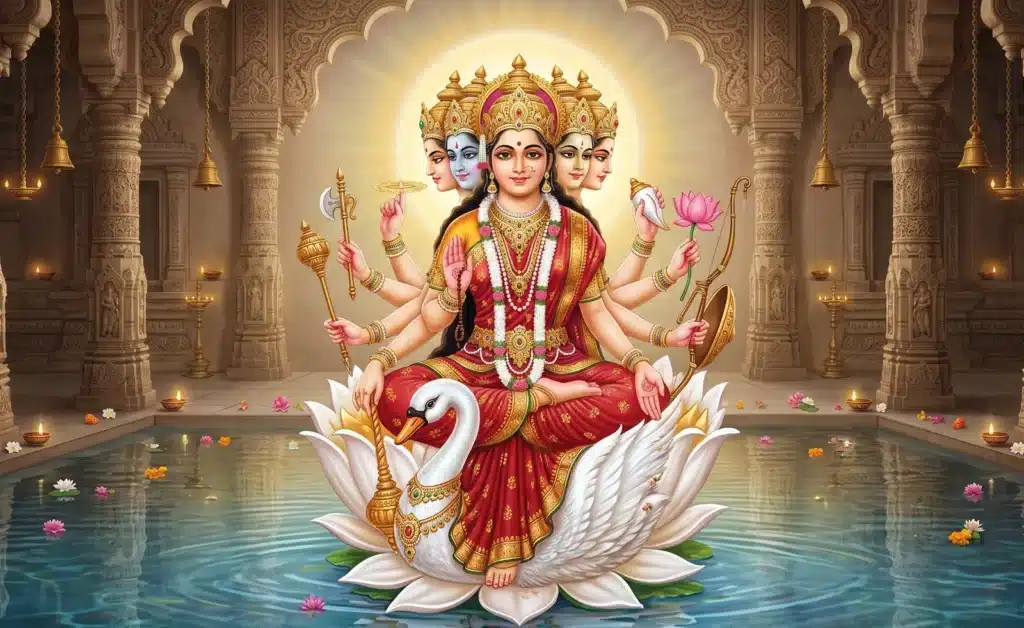
Gāyatrī Devī, the meter personified, contemplated at the first of the three junctions.
Written by Pandit Sahadev, Vedic priest and pandit in charge of ceremonies at Radha Govinda Math, Traiskirchen
The Gāyatrī Mantra and the rite of Sandhyāvandanam in which it is set are the oldest daily observance the Vedic tradition has kept without interruption. A great deal is written about both, and much of it is imprecise in ways that matter. The verse is regularly named wrongly, its addressee is confused with the visible sun, its obligation is described as though it earned merit, and its hours are given as fixed clock times that hold nowhere on earth. What follows sets out the doctrinal position with the precision the subject deserves. The procedure itself, act by act, belongs to a separate exposition and is not repeated here.
Which mantra is this, exactly?
Strictly, the verse is the Sāvitrī. It is Ṛgveda 3.62.10, seen by Viśvāmitra, and it is addressed to Savitṛ. It is composed in the Gāyatrī meter, a meter of three lines of eight syllables each, and the tradition calls the verse Gāyatrī by the name of its meter. The usage is universal and there is no reason to abandon it, but knowing that it is a metonymy clears up several confusions at once. Gāyatrī names a meter, the goddess who is that meter, and by extension this particular verse. Many verses stand in the Gāyatrī meter. Only one is called the Gāyatrī without qualification, which is a measure of how the tradition ranks it.
The second point of precision concerns whom the verse addresses. Savitṛ is not Sūrya. The Ṛgveda distinguishes them, and the distinction is not decorative. Sūrya is the visible orb. Savitṛ is named from the root meaning to impel, to rouse, to set in motion, and the tradition understands him as the intelligence that impels rather than the disc that shines. This is why the rite is not solar worship in the sense a comparative historian might mean. The practitioner faces the light, but what he meditates upon is the impelling power that stands behind it, and the verse asks that power to act upon him in exactly the way it acts upon everything else.
Third, the mantra as it is spoken in the rite is longer than the Ṛgvedic verse. The praṇava and the three Vyāhṛtis that open it, bhūḥ, bhuvaḥ and suvaḥ, are not part of Ṛgveda 3.62.10. They are prefixed under a separate prescription, and the Taittirīya literature treats the Vyāhṛtis as the three worlds uttered as sound before the verse proper begins. Some traditions add four further Vyāhṛtis and a concluding Śiras in certain contexts. The verse of the Saṃhitā and the mantra of the rite are therefore related but not identical, and a reader who has only met the short form has not met the form that is actually recited.
oṃ bhūr bhuvaḥ suvaḥ ।
tat savitur vareṇyaṃ bhargo devasya dhīmahi ।
dhiyo yo naḥ pracodayāt ॥
Ṛgveda 3.62.10 · with the praṇava and Vyāhṛtis
What does the verse actually ask for?
One thing, and it is not what popular treatments usually report. The meditative clause is straightforward: we meditate upon that desirable radiance of the god Savitṛ. The petition follows, and everything turns on a single word. Dhiyo yo naḥ pracodayāt. May he impel our dhī.
Dhī is not knowledge in the sense of accumulated information, and it is not devotion. It is the discerning faculty, the power by which a person tells what is so from what merely seems so, and what should be done from what should not. The verse asks that this faculty be set in motion. It does not ask for wealth, for health, for the removal of enemies, for long life or for liberation, though the tradition has plenty of mantras that do ask for those things and does not disparage them. The most revered verse in the entire corpus asks for clear seeing and stops there.
This bears directly on a class of popular claim worth naming plainly. Sandhyāvandanam is regularly advertised as a remedy: a set count of repetitions to resolve a planetary affliction, a fixed number of days to secure prosperity, a Gāyatrī practice undertaken for a stated worldly result. These promises are folk accretion, not Śāstra, and the reason is structural rather than a matter of taste. As the next section sets out, the rite belongs to a category of action that the Śāstra explicitly holds to yield no stated fruit. A verse that asks only that discernment be quickened cannot honestly be sold as a device for obtaining something else.
Why three junctions and not one?
The word Sandhyā means a joint or a meeting place. It names the seam where one division of the day meets the next, and the rite takes its name from the moment rather than from the act. There are three such seams: the meeting of night and day, the meeting of forenoon and afternoon at the sun’s highest point, and the meeting of day and night. The tradition holds these to be the receptive moments of the day, when the transition is under way and neither state has settled.
There is also a plain observation underneath the metaphysics, and it does not need any esoteric premise to be felt. The turnings of the day are exactly when a person is most likely to be carried along without noticing: out of sleep and into the morning, out of work and into the evening. To halt at each seam and face the light is to refuse to be moved unconsciously through one’s own day three times over. The tradition would say that this is the discipline of attention which the verse itself petitions for, practiced at the hours when attention is hardest to hold.
The verse asks that discernment be impelled. The rite that carries it is placed at the three hours of the day when a person is least likely to be discerning anything at all.
Who is the deity at each junction?
This is muddled in most accounts, and the classical Dhyāna verses of the rite are quite specific. The presiding form is one goddess in three aspects, contemplated differently at each junction, and each aspect is bound to a Veda, a presiding god, a color, a mount and a stage of life.
At dawn she is Gāyatrī, contemplated as a maiden, red in color, associated with Brahmā, with the swan as her vehicle and the Ṛgveda as her Veda. At midday she is Sāvitrī, contemplated as a woman in her prime, white, associated with Rudra, with the bull as her vehicle and the Yajurveda as hers. At dusk she is Sarasvatī, contemplated as aged, dark, associated with Viṣṇu, with Garuḍa as her vehicle and the Sāmaveda as hers. The three aspects follow the arc of a single day and, by the tradition’s own reading, the arc of a life within it.
The correction matters because it shows the rite to be a single structure rather than three repetitions of one act. A practitioner who keeps only the morning Sandhyā has not kept a third of the observance. He has kept the maiden and let the rest of the figure go unmet.
On what ground is the rite obligatory?
Sandhyāvandanam is Nitya karma, perpetual and obligatory action, and it is the clearest instance of that category in the whole of the domestic law. The Śāstra attaches no promised result to it. That absence is not an oversight. It is the defining mark of the class.
The consequence is asymmetric and it is the single most misunderstood point in this whole subject. Because no fruit is stated, performing the rite generates no particular merit to be banked. Omitting it, however, incurs Pratyavāya, a demerit arising from the omission itself. Nitya karma is therefore not a way of accumulating credit. It is the maintenance of a standing condition, and its neglect is a subtraction rather than a foregone addition. The Smṛti goes further and holds that one who has abandoned the Sandhyā is, for as long as the neglect stands, disqualified from other Vedic acts, which is a considerably harder position than any modern framing of the rite as a beneficial habit.
There is something steadying in this once it is grasped. A practice kept for the good feeling it produces is kept only while the feeling lasts. A practice kept because it is obligatory survives the mornings when nothing whatever is felt, and those mornings are the majority. The broader logic of why an obligation of this kind binds at all is set out in the account of why we follow Dharma Śāstra.
Who is entitled to keep it?
Sandhyāvandanam is not a general devotional practice available to anyone who wishes to adopt it. It is bound to Adhikāra, qualification, and the qualification is conferred by Upanayana. The initiation transmits the Gāyatrī from teacher to student and confers the standing to recite it in the rite. Before Upanayana there is no Adhikāra for the Sandhyā, and the obligation begins at the moment the initiation confers it. This is one reason the Upanayana is treated with the weight the Gṛhya literature gives it, and the sequence in which it stands is set out in the exposition of the sixteen Saṃskāras.
The question of whether women hold this Adhikāra is genuinely contested within the tradition and should not be presented as settled in either direction. The older literature attests Upanayana for women and preserves a distinction between the Brahmavādinī, who undertook Vedic study, and the Sadyovadhū, for whom the rite was performed formally before marriage. Later Smṛti narrowed the practice considerably. Contemporary sampradāyas differ, and a number of established lineages now perform the initiation for daughters. A household that wishes to decide the question well should take it to its own Ācārya or family Purohita, who will answer from the specific tradition it belongs to rather than from a general position, and it is worth saying that anyone who answers it instantly and without reference to a lineage is not answering from the Śāstra.
When exactly does a Sandhyā fall?
Not at a clock time, and this is where most practitioners go wrong without ever suspecting it. The junctions are astronomical events, and the Śāstra defines them relative to the sun and stars rather than to any hour.
The morning period opens at aruṇodaya, the reddening that precedes sunrise, commonly reckoned at some four ghaṭikās before the disc appears, which is roughly an hour and a half. The tradition then grades the performance by where within that window it falls. Kept while the stars are still visible, before the sky has lightened, it is uttama, the best. Kept after the stars have gone but before the sun has risen, it is madhyama, middling. Kept after sunrise it is adhama, inferior, though still performed. The evening Sandhyā is graded on the reverse principle: best while the sun is still above the horizon or just setting, middling until the stars appear, inferior thereafter. Manu describes the same two poles directly, prescribing that the morning recitation be made standing until the sun appears and the evening seated until the stars are clearly seen.
Two things follow. First, the grades exist because the tradition anticipated imperfect keeping and preferred a late Sandhyā to none, which is a far more humane structure than a simple valid or invalid rule. Second, and more practically, the hour of every one of these events moves throughout the year, in some places by a great deal. A person who keeps his Sandhyā at a fixed clock time is keeping it correctly for perhaps a few weeks of the year and at the wrong moment for the rest.
What is the Arghya for?
The offering of water thrown upward toward the sun, the Arghya, rests on an account preserved in the Taittirīya Āraṇyaka. At the junctions of dawn and dusk the sun is set upon by the Mandeha Rākṣasas, and the water offered upward by practitioners on earth, charged by the recitation of the Sāvitrī, becomes a thunderbolt that scatters them and allows the sun to hold its course.
It is worth being honest about how the tradition itself receives this. It is not usually read as a report of hostile organisms in the upper atmosphere. It is read as the tradition’s way of saying that the daily maintenance of order is contested and that the practitioner has a real part in it. What the Mandehas name is unmistakable to anyone who keeps the rite at dawn: the inertia, dullness and unwillingness that press hardest at exactly that hour. The image sets the practitioner as a participant in the keeping of the order rather than a spectator of it, which is a considerable claim to make about a handful of water, and the tradition makes it deliberately.
Why does the procedure differ between families?
Because there is no single Sandhyāvandanam. The rite is transmitted through the Śākhā, the branch of the Veda a family preserves, and the branches differ. A Ṛgvedin’s Sandhyā, an Āpastamba Yajurvedin’s and a Sāmavedin’s diverge in the mantras used for Mārjana, in the number of Arghyas offered at each junction, in the presence or absence of certain sequences, and in the exact form of the concluding salutation. Each is complete within its own transmission.
This is why a printed manual bought at random is a poor instrument for learning the rite, and why the older tradition transmitted it face to face at the Upanayana rather than through a text. The version a household should keep is the version belonging to its own branch, and establishing which that is precedes learning anything else. The sequence proper to a given transmission, taken act by act, is treated in the complete guide to Sandhyā Vandanam.
What is done when it lapses?
Something specific, which is a relief to anyone who has let the practice slip and assumed the matter closed. The Śāstra provides for lapse rather than merely condemning it: what was missed is made good through further Japa of the Gāyatrī, and where the neglect has been long, the measure is fixed by one’s Ācārya rather than guessed at. The provisions themselves, for lateness, for a missed junction and for genuine constraint, are set out in the Sandhyā Vandanam guide.
The logic is the same one that runs through the whole of Prāyaścitta. The tradition holds an exacting standard and simultaneously keeps the way back permanently open, and it does so because a standard with no route of return would simply be abandoned by everyone who once failed it. What a neglected Sandhyā asks for is the Sandhyā itself, kept again and kept more fully; nothing else is demanded, and nothing is lost for good.
How is Sandhyā reckoned at Vienna’s latitude?
This is the question that actually troubles households in Europe, and it is almost never addressed. The doctrinal answer is simple and the practical answer is not. The rite is bound to the sun, so it travels wherever the sun does, and the junctions are kept by the local sun at the place where the practitioner stands. What changes at a northern latitude is not the validity of the rite but the arithmetic of finding it.
Three specifics are worth having. First, solar noon in Vienna is not twelve o’clock. The city lies east of the meridian that governs its time zone, which puts true solar noon near five minutes before twelve by the winter clock and near five minutes before one by the summer clock, shifting by up to a quarter hour across the year as the equation of time runs. A Mādhyāhnika kept at midday by the clock in July is close to an hour early. The junction is the sun’s transit, not the hour.
Second, the span between the morning and evening junctions swings enormously. At around forty eight degrees north the day runs to roughly sixteen hours near midsummer and contracts to about eight near midwinter. In June the two Sandhyās stand nearly sixteen hours apart, and in December barely eight. No fixed pair of times can serve both. A household keeping the rite here needs local sunrise and sunset figures for the actual date, which any almanac or Pañcāṅga computed for the location will supply.
Third, the traditional markers themselves become difficult at this latitude, and this deserves saying rather than glossing over. Around the summer solstice the northern sky never darkens completely, so the criterion of stars clearly visible, which Manu gives for the evening, is not straightforwardly available for several weeks. Conversely in late December sunrise falls near a quarter to eight and sunset near four in the afternoon, which places both junctions squarely inside a working day. These are not failures of piety. They are astronomical facts of the place, and the Śāstra has a category for exactly this situation: the provisions of exigency, which license a bounded adaptation while the constraint holds and expect the ordinary practice to resume when it lifts. Judging which adaptations are genuine exigency and which are merely convenience is precisely the office of a qualified priest standing in a living transmission, and it is not a judgment a manual can make for a household.
With the local figures in hand, the rite is entire. The sun crosses its meridian over the Danube with the same fidelity it keeps over any other river, and the radiance the Sāvitrī contemplates is not diminished by the latitude from which it is addressed.
A verse asking only for clear seeing, set at the three hours when seeing clearly is hardest, kept by whoever holds the right to speak it, at whatever hour the local sun appoints.
pūrvāṃ sandhyāṃ japaṃs tiṣṭhet sāvitrīm arkadarśanāt ।
paścimāṃ tu samāsīnaḥ samyag ṛkṣavibhāvanāt ॥
At the morning junction let him stand, reciting the Sāvitrī until the sun appears; at the evening, seated, until the stars are clearly seen.
Manusmṛti 2.101
Notice what the verse uses as its clock. Not an hour, not a watch, not a bell, but the appearance of the sun and the appearance of the stars. The rite is timed by the sky itself, which is why it required no instrument to keep and why it can be kept anywhere the sky is visible. A household in Vienna consulting sunrise figures for its own date and coordinates is doing exactly what the verse asks, in the only form the asking now takes.
For further study: on the Sāvitrī, Ṛgveda 3.62.10; on the obligation, the grades of timeliness and the remedy for lapse, the Manusmṛti with the commentary of Medhātithi; on the Vyāhṛtis and the Arghya, the Taittirīya Āraṇyaka; with primary texts at Sanskrit Documents and scholarship through the Oxford Centre for Hindu Studies.
© 2026 AUSTRIAVIENNAPUJA.COM · SANĀTANA DHARMA IN EUROPE
Preserving authentic Vedic transmission across the European continent