
Sandhyā Vandanam · The Daily Rite
What Is Done, in the Order It Is Done
A walk through the rite act by act, from the first sip of water to the closing bow, with the counts, the mantras that mark each stage, and the provisions for a day that will not allow it.
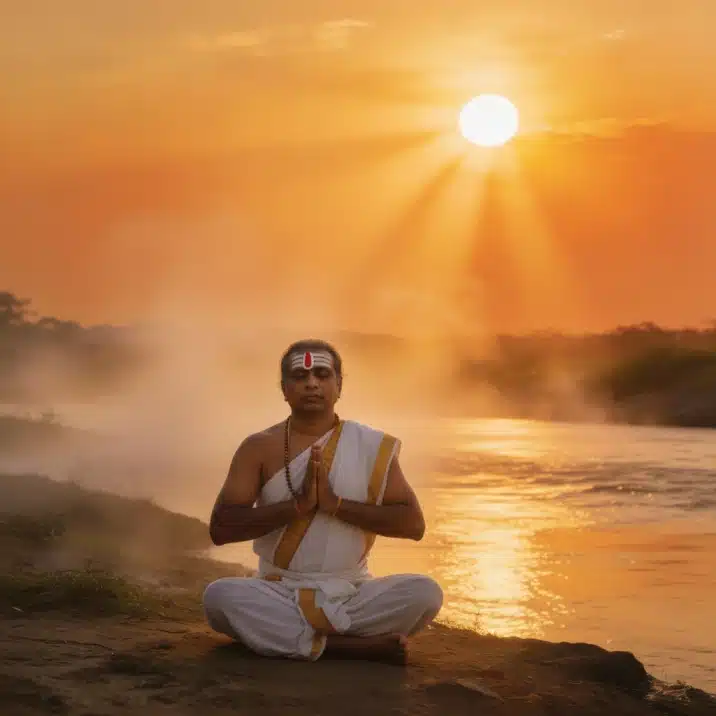
The Arghya, offered standing and facing the sun at the morning junction.
Written by Pandit Sahadev, Vedic priest and pandit in charge of ceremonies at Radha Govinda Math, Traiskirchen
This guide takes Sandhyā Vandanam step by step, in the order the acts are performed, and stays on the ground throughout. Why the rite binds, what the verse asks for, and how its hours are reckoned are treated separately in the account of the Gāyatrī Mantra and the Sandhyā, and none of that is repeated here. What follows is the sequence.
Two things to establish before starting. The rite is bound to Adhikāra, and the Adhikāra is conferred by Upanayana, which transmits the Gāyatrī from teacher to student along with the standing to recite it. The rite is not a general devotional practice to be adopted at will, and the initiation that opens it stands in the sequence set out in the exposition of the sixteen Saṃskāras.
And the details vary genuinely by transmission. A Ṛgvedin’s rite, an Āpastamba or Bodhāyana Yajurvedin’s, and a Sāmavedin’s differ in the mantras used at several stages, in the number of Arghyas, and in the presence of certain acts altogether. Each is complete within its own branch. What is given below is the shared skeleton that every form keeps, with the common Smārta usage named where a specific mantra is helpful. The exact words and counts proper to a household come from its own teacher, and where this guide and that teaching differ, the teaching governs.
Before you begin
A few things are settled before the first act, and getting them right removes most of the small uncertainties that make people hesitant to start.
Water and vessel. Clean fresh water in a small vessel, with a spoon or a second small cup for taking it. In a European household ordinary clean water serves throughout, for the sipping and for the offering alike.
Seat and direction. A mat or seat that is not bare floor. Facing east at the morning and midday junctions, west at the evening one. The morning rite is kept standing and the evening one seated, following the older prescription, with the midday rite standing for the Arghya at least.
The pavitra. A ring of darbha grass worn on the ring finger of the right hand where the transmission calls for it. Where darbha is not available in Europe, ask your own Ācārya what he permits rather than improvising.
The yajñopavīta. The sacred thread has three positions and they are not interchangeable. Upavīta, over the left shoulder and under the right arm, is the ordinary position and the one held throughout the Sandhyā. Nivīta, hanging round the neck, belongs to certain human observances. Prācīnāvīta, over the right shoulder and under the left arm, belongs to rites for the ancestors and is taken up only where those are performed. A practitioner who does not know which position he is in at a given moment does not yet know the rite.
Ācamana, and how much water
Ācamana opens the rite. Water is taken into the cupped right hand and sipped three times, once each with the names Acyutāya namaḥ, Anantāya namaḥ, Govindāya namaḥ in the common Smārta usage.
The quantity has a classical measure and it is worth knowing, because most people take either far too much or a token that does not count. The water should be enough to submerge a single grain and no more, taken from the base of the thumb, and it should reach the heart. A mouthful is wrong. A wetting of the lips is also wrong.
In most transmissions the three sips are followed by touching parts of the face and body with the remaining names of Viṣṇu, the lips, the nostrils, the eyes, the ears, the shoulders and the head, each with its name. This is the arrival: the deliberate crossing from ordinary time into the time of the rite. Ācamana recurs several times later in the sequence, at each transition between stages, and the same measure applies every time.
Prāṇāyāma and the mantra spoken within it
This is where most descriptions of the rite become useless, because they say “a few rounds of regulated breathing” and stop. The breathing is not the content. The content is the mantra recited inwardly while the breath is held.
The full form recited within each round consists of the praṇava, then the seven Vyāhṛtis each preceded by Om, then the Gāyatrī entire, then the Śiras, the closing formula beginning āpo jyotī raso’mṛtaṃ brahma and ending bhūrbhuvassuvarom. This composite is longer than the Gāyatrī as ordinarily spoken and is specific to the prāṇāyāma.
The breath moves through Pūraka, the drawing in, Kumbhaka, the holding, and Recaka, the release. The classical proportion is one, four and two, but the count is set by capacity and no one should force it. Three rounds is the usual number for the Sandhyā, though transmissions differ and some prescribe more. The purpose is to gather the attention before anything else is undertaken, and a strained retention defeats it entirely.
Saṅkalpa
The Saṅkalpa is the formal declaration of what is about to be done, and it is not a preamble that can be skipped. It names the cosmological frame, then narrows: the year within the sixty-year cycle, the ayana, the season, the month, the fortnight, the tithi, the weekday, and then the place. Then the intention itself, that this Prātaḥ, Mādhyāhnika or Sāyaṃ Sandhyā is being performed as an obligatory daily act.
The naming of place is the part that matters for a household outside Bhārata, and it is simpler than people fear. The Saṅkalpa names the ground where the practitioner actually stands. The classical formula gives the position relative to landmass and hemisphere, and a practitioner in Europe states his own location within that frame rather than reciting a location he is not in. The declaration draws the ground into the rite, which is precisely how the rite becomes valid where it is performed. Ask your own teacher for the wording proper to your transmission; do not invent it.
Almost every difficulty a beginner has with this rite comes from having learned the names of the acts without ever being told what is said inside them.
Mārjana, prāśana, and the second sprinkling
Three closely linked acts follow, and they are usually collapsed into one in popular accounts, which is why practitioners so often perform only the first.
Mārjana is the sprinkling of water over the head and the sense organs with the āpo hi ṣṭhā verses, the three verses to the waters from the tenth maṇḍala of the Ṛgveda. Water is taken and touched to the crown, the eyes, the ears, the nostrils, the shoulders, the heart. The senses are the doors through which the day accumulates on a person, and this clears them before the central work.
Prāśana follows, and it is an act of expiation rather than of cleansing. Water is sipped with a mantra that differs by junction: in common usage the morning form begins sūryaśca mā manyuśca, and the evening form agniśca mā manyuśca, each asking that the offense committed by mind, speech, hand, foot, stomach and organ be dissolved. This is the point in the rite where the previous half day is set down. It is a distinct act with its own mantra and it is not optional.
A second Mārjana then repeats the sprinkling, in most transmissions with the dadhikrāvṇo verse. The sequence is deliberate: one cleanses, one expiates, one cleanses again, and only then approaches the offering.
Aghamarṣaṇa
Aghamarṣaṇa, the effacing of what is done amiss, is one of the acts most often dropped by practitioners who learned the rite from a summary, and it is present in nearly every transmission.
Water is taken into the right hand and held near the nostrils or before the face while the aghamarṣaṇa hymn is recited, the ṛtaṃ ca satyaṃ ca sequence from the closing portion of the Ṛgveda. The recitation completed, the water is cast away over the left shoulder or to the left side, without looking at it.
The gesture is unusually direct for a rite otherwise composed of measured acts, and that is the point of it. What has been drawn out is discarded rather than set down carefully, and the practitioner does not turn to watch it go. Where Prāśana dissolves, Aghamarṣaṇa expels.
Arghya, and what to do when you are late
The Arghya is the visible center of the outward rite. Standing, water is taken in both cupped hands, raised to the level of the face or above, the Gāyatrī is spoken over it, and it is released forward and upward toward the sun.
The count varies by transmission. Three at dawn and three at dusk is the common pattern, with a smaller number at the midday junction. Take the number from your own teaching rather than from a general figure.
Then the provision that almost nobody is told, and the one that resolves the most common anxiety about this rite. Where the Sandhyā is performed after its proper hour, an additional Arghya is offered as Prāyaścitta for the lateness. One extra offering, made with the Gāyatrī, and the delay is answered. The tradition anticipated late performance and built the remedy into the sequence, which tells you plainly how it expected the rite to be kept by ordinary people with ordinary obligations. A late Sandhyā correctly expiated is a kept Sandhyā.
Many transmissions place a circumambulation of oneself directly after the Arghya, turning once in place with a brief mantra to the sun. Where it is taught, it belongs here.
Āvāhana and Nyāsa
Before the recitation proper, the goddess is invited and the mantra is placed on the body.
Gāyatrī Āvāhana is the formal invitation, with the Dhyāna verse proper to the junction, since the form contemplated differs at dawn, midday and dusk. Ṛṣyādi Nyāsa follows: the seer of the mantra is touched to the head, the meter to the mouth, the deity to the heart, each with its name, because the tradition holds that one does not speak a mantra without knowing through whom it came, in what meter it stands, and whom it addresses. Where the transmission includes them, Kara Nyāsa and Aṅga Nyāsa place the syllables on the fingers and the limbs.
This stage takes under a minute and it is the difference between reciting a verse and taking up an inheritance. The line through which the Gāyatrī reached a particular household is described in the account of the Vedic lineage a priest stands within.
Japa: the counts and how they are kept
The Japa of the Gāyatrī is the heart of the rite, and the classical counts are graded rather than fixed.
One thousand and eight is uttama, the best. One hundred and eight is madhyama, the middling count, and it is what most householders keep. Twenty eight is adhama, the least, and it remains a valid performance. Ten is given in several transmissions as the floor below which the rite should not be reduced, so that the practice is not broken on the hardest day. Understand the grades as the tradition intends them: not as a target and a set of failures, but as a scale designed so that something is always keepable.
On the method of counting, popular accounts usually get this wrong. Gāyatrī Japa is counted in most transmissions on the joints of the fingers of the right hand, in a prescribed circuit, rather than on a mālā, and the hand is kept covered with a cloth or beneath the upper garment while counting. Where a mālā is used it is of rudrākṣa or of crystal and likewise kept covered. The recitation itself is inward or barely voiced, not audible to anyone else.
On quantity against attention, the tradition is clear that the count is a discipline and not a score. A hundred and eight repetitions run through with the mind entirely elsewhere is a lesser performance than twenty eight held with attention. The count exists to hold the practitioner in place long enough for attention to settle, which is a different thing from the count being the point.
Upasthāna
Upasthāna is the standing salutation to the sun that follows the Japa, and the hymn differs by junction. In many Yajurvedic transmissions the morning uses the mitrasya carṣaṇīdhṛtaḥ verse, the midday the ā satyena rajasā vartamānaḥ, and the evening the imaṃ me varuṇa. Other branches use other hymns and the difference is not a defect in either.
Where the earlier stages were inward, this is outward: the practitioner stands as a whole person and salutes the light. Most transmissions follow it with a salutation to the deities of the directions and to the celestial bodies, turning to each in order.
Abhivādana: naming yourself correctly
The Abhivādana closes the rite, and it has a fixed structure that is worth setting out because many people perform it without knowing what they are declaring.
The formula names, in order: the Pravara, the specific seers of one’s line, usually three or five of them and named individually; the Gotra, the family’s descent from a particular Ṛṣi; the Sūtra, the Gṛhya manual the family follows; the Śākhā, the branch of the Veda it preserves; and then one’s own name, followed by the formula of self-presentation.
A householder who cannot state these five particulars should establish them before anything else, because they govern more than this rite. They determine which Gṛhya Sūtra orders the family’s Saṃskāras, which form of the Sandhyā belongs to it, and what is declared in every Saṅkalpa it ever makes. They are recoverable from elders, from family records, or through the household’s Purohita. The rite ends by naming the self before the light, and a person who cannot complete that naming is missing something larger than a formula.
Where Tarpaṇa sits
Tarpaṇa, the offering of water to satisfy the gods, the seers and the ancestors, is related to the Sandhyā and is not part of it in every transmission. Where it is kept daily, Deva and Ṛṣi Tarpaṇa commonly follow the Sandhyā rather than sitting inside it.
The point to hold is the thread position. Deva Tarpaṇa is offered in Upavīta, over the fingertips. Ṛṣi Tarpaṇa in Nivīta, over the side of the hand. Pitṛ Tarpaṇa in Prācīnāvīta, over the space between thumb and index finger, facing south. These are not interchangeable, and Pitṛ Tarpaṇa in particular is governed by rules about who performs it and when, which a household should take from its own Ācārya rather than from any written guide.
Keeping it when the day will not allow it
The rite is Nitya karma, obligatory and daily, which is why the tradition worked out so carefully what to do when it is not kept. The reasoning behind that kind of obligation is set out in the account of why we follow Dharma Śāstra. Three provisions matter in practice.
For lateness, the additional Arghya described above. The rite is performed at the hour it can be performed, with the extra offering, and it counts.
For a missed junction, additional Japa at the following one, in a measure proportioned to what was missed. A longer neglect is made good by a correspondingly extended course of recitation, and where the lapse has run to months or years the measure is set by one’s Ācārya rather than assumed. The remedy for a neglected Sandhyā is more Sandhyā. There is no other tariff and nothing is permanently forfeited.
For genuine constraint, the abbreviated form. Where travel, illness or the shape of a working day makes the full sequence impossible, most transmissions permit a short form: Ācamana, Prāṇāyāma, Saṅkalpa, Arghya, ten repetitions of the Gāyatrī, and Abhivādana. That is not the rite as it should be kept and no one should let it become the ordinary practice, but it is the rite, and it holds the thread on a day that would otherwise break it. Which reductions are genuine constraint and which are convenience is a judgment worth putting to a qualified priest, and it is not one a written guide can make for a household.
The shape of the whole
Set out plainly, the sequence runs: Ācamana, Prāṇāyāma, Saṅkalpa, Mārjana, Prāśana, second Mārjana, Aghamarṣaṇa, Arghya with the additional offering if late, Āvāhana and Nyāsa, Japa, Upasthāna, salutation to the directions, Abhivādana, and the concluding dedication. Ācamana recurs between several of these as a transition and is not counted separately each time.
Fourteen acts sounds formidable written down and takes fifteen minutes to perform once learned, less in the short form. The sequence has an internal logic that becomes obvious with practice: one arrives, gathers the breath, declares the intention, cleanses, expiates, discards, offers, receives the mantra properly, recites it, salutes, and names oneself. Learn the acts in order and they stop being fourteen things. They become one motion, kept three times a day, with the verse at the center of it.
Every act in the sequence is a frame around one verse. Learn the frame well enough and it disappears, and what is left is the verse, and the light it is spoken toward.
oṃkārapūrvikās tisro mahāvyāhṛtayo’vyayāḥ ।
tripadā caiva sāvitrī vijñeyaṃ brahmaṇo mukham ॥
The three great Vyāhṛtis, imperishable and preceded by the syllable Om, together with the three-footed Sāvitrī, are to be known as the mouth of Brahman.
Manusmṛti 2.78
The verse describes exactly the composite recited inside the Prāṇāyāma, and it is worth noticing that the Smṛti troubled to specify the construction. It did so because the parts are not decorative. The syllable, the Vyāhṛtis and the three-footed verse form one instrument, and a practitioner who learns them as separate items to be got through has assembled the pieces without knowing what he has assembled. Learn the sequence as a sequence, and the acts hold together on their own.
For further study: on the Sāvitrī and the mantras of Mārjana and Aghamarṣaṇa, the Ṛgveda; on the composition of the Prāṇāyāma mantra and the hours of the rite, the Manusmṛti; with the Sandhyā texts of the several branches gathered at Sanskrit Documents and scholarship on Vedic daily practice through the Oxford Centre for Hindu Studies.
© 2026 AUSTRIAVIENNAPUJA.COM · SANĀTANA DHARMA IN EUROPE
Preserving authentic Vedic transmission across the European continent