Vivāha | Vows Walked, Not Only Spoken
Hindu Wedding Rituals: The Vivāha Ceremony
On the rituals of a Hindu wedding, understood through what they share in common: a marriage that makes its promises not in words alone but in joined hands, in rice given to the fire, and in seven steps walked together.
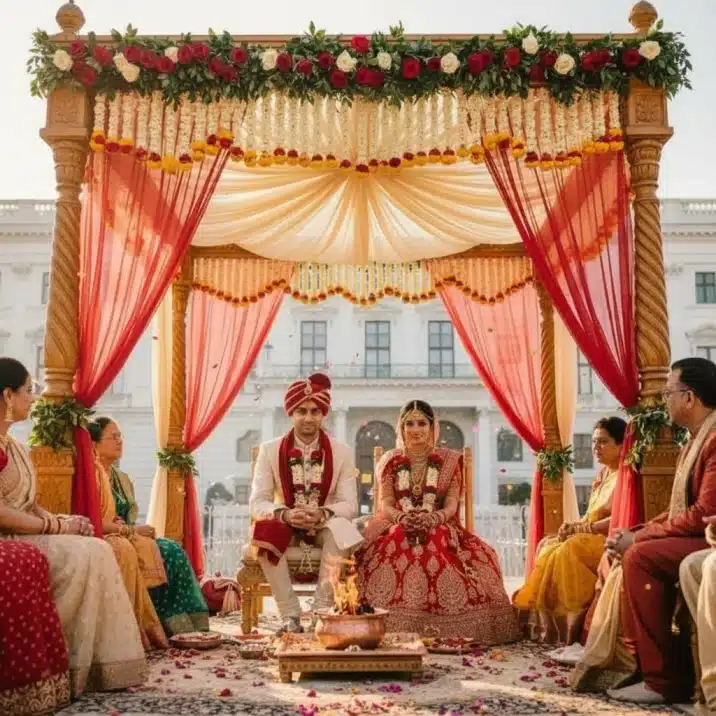
A Hindu wedding is unusual among ceremonies in how little of it is talk. There are words, ancient ones, recited throughout; but the promises at the heart of a Vivāha are made not by saying them but by doing them. Two people do not merely declare that they will share food and strength and companionship; they walk seven steps together and let a fire witness it. The whole of the Hindu wedding rituals turns on this: each gesture is also a vow, and the marriage is made by acts performed rather than by sentences spoken. To understand the ceremony is to learn to read those gestures, and to see that nothing in it is merely decorative.
The wedding rite, the Vivāha Saṃskāra, is the most elaborate of all the consecrations of a Hindu life, and it unfolds as a sequence of distinct acts, each with its own meaning, building toward the moment the tradition regards as the making of the marriage. What follows walks that sequence in order, from the days before the fire is lit to the new couple’s first entry into their home.
Before the Fire Is Lit
The wedding does not begin at the ceremony. In the days before, the two households prepare the bride and groom through rites of their own. Turmeric paste is applied to their skin by their families, an old auspicious substance long used in the tradition’s preparatory bathing, traditionally regarded as cooling and cleansing and lending a glow before the wedding day. The bride’s hands and feet are adorned with intricate patterns of henna, a beautification with its own quiet meditation in it, the long stillness of the application a kind of settling before the day to come. And the women of both families gather to sing, filling the household with the old songs of marriage and joy.
These are not idle preliminaries. The tradition holds that the days before a great rite should lift the spirit of a household and prepare the two at its centre, and the turmeric, the henna, and the singing all serve that lifting. They turn the ordinary house, for a few days, into a place readying itself for something sacred, and they prepare the bride and groom, in body and in mood, to come to the fire calm, glad, and ready. By the time the wedding day arrives, the households have already been turned toward it.
Nothing in the ceremony is merely decorative. Each gesture is a promise made visible, a vow enacted rather than spoken.
The Pavilion and the Fire
The ceremony is held beneath a mandap, a pavilion raised for the occasion, its four posts standing for the four directions, so that the couple are married within an ordered and consecrated space rather than merely a pretty one. At its centre is kindled the fire, the Agni, which is the still heart of the whole rite. In the Vedic tradition fire is the witness of every sacred act, the one who carries what is offered toward the divine and stands as the divine’s presence at the rite. Every vow of the wedding is made before this fire, and that is what gives the promises their weight: they are not spoken only to the gathered family but made in the presence of the witness the tradition holds most sacred.
This is worth pausing on, because it explains why a Hindu wedding centres on a flame rather than on an altar or a register. The couple’s promises are understood to be received by the fire and carried beyond the room, so that what is pledged in the wedding is pledged to the cosmos and not only to the witnesses present. The understanding of fire as the witness and carrier of every offering is developed in the meditation on the Vedic Homa. Around this fire the rest of the ceremony unfolds.
The Giving and the Taking of the Hand
An early and tender act of the ceremony is the one in which the bride’s father joins her hand to the groom’s and, pouring water over their joined hands, entrusts her to him. The tradition calls this the giving of the daughter, and the older language framed it, in the manner of its age, as a kind of gift or transfer. Read with the discernment its own teachers commend, what endures in it is not a notion of property changing hands but something more moving: a father, at the threshold of his daughter’s new life, formally and with blessing entrusting her wellbeing to the one she has chosen, and asking the gathered powers to watch over her. Many families today understand and conduct it in just this spirit, as an act of trust and blessing rather than of giving-away.
Upon this follows the taking of the hand, in which the groom clasps the bride’s hand while the ancient verses of the great wedding hymn are recited over the two of them. This joining of hands is the first of the wedding’s bodily vows: a promise of partnership made not by saying it but by the simple, eloquent act of one hand taking another and not letting go. From this moment the two stand joined before the fire, and the rest of the rite builds upon this first clasp.
The Rice Into the Fire
Next comes an act in which the bride’s family places parched rice into her hands, and she offers it into the fire while the groom’s hands rest beneath hers. It is a small gesture, easily passed over by an onlooker, but its meaning is lovely and exact. The rice is the transformed gift of the earth, the harvest made ready; by offering it to the fire, the bride performs her first act as a partner in what will be the couple’s shared work, the keeping of a sacred household. And the groom’s hands beneath hers say, without a word, that this work will be done together: her offering is his, his support is hers, from the very first handful.
This is the wedding’s quiet picture of a marriage: not two people facing each other, but two people facing the same fire, hands joined, offering together. The shared act precedes the seven steps and prepares for them, and it carries in miniature the whole idea the steps will then complete, that the life being begun is a life held in common.
The Seven Steps
At the heart of the whole ceremony are the seven steps, the saptapadī, and in the tradition’s understanding this is the moment the marriage is made. The couple take seven steps together beside the fire, and with each step a blessing is spoken: the first for nourishment, the second for strength, the third for prosperity, the fourth for happiness, the fifth for the wellbeing of family and children, the sixth for the right rhythm of the seasons of a shared life, and the seventh for friendship and lifelong companionship. Seven things a marriage is for, walked rather than recited, each step a vow taken with the feet.
It is the seventh step that carries the deepest weight, for its blessing is companionship, and with its completion, the tradition holds, the two are no longer merely a couple who have performed the preceding rites together but companions for life, bound now in a way the earlier acts had only prepared. The ancient texts are explicit that it is the seventh step that completes the marriage. There is great wisdom in placing companionship last and highest. Nourishment, strength, prosperity, and the rest are the goods of a married life; but friendship is named as its summit, the thing the other six are finally for. A Hindu marriage is sealed, in the end, on a promise of lifelong friendship, walked out in seven steps before the fire.
After the Seventh Step
A few further acts seal what the seven steps have made. The groom touches the bride’s heart and speaks an old verse taking her heart into his keeping and his into hers; the two are shown the unmoving pole star, with the wish that their marriage be as fixed and steadfast as that one still point in the turning sky; and the mark of vermilion is placed in the parting of the bride’s hair, the visible sign, long worn in the tradition, that she is now a married woman. Each is a small, eloquent gesture, and each adds its word to the vow the steps have spoken.
The wedding does not quite end at the fire. It closes, a little later, with the bride’s first entry into her new home, crossing the threshold with the right foot, welcomed as the household’s grace and prosperity coming in, and with the kindling of the couple’s own household fire from the wedding flame, so that the witness of the seven steps becomes the living centre of the home they will make. That entry has its own fuller account in the treatment of the Gṛha Praveśa, the welcoming of a home. With it, the wedding’s work is complete: two people have become a household, and a new fire has been lit.
A Hindu Wedding in Europe
A Vivāha conducted in Europe loses nothing of its substance. The fire is kindled, the hands are joined, the rice is offered, the seven steps are walked, and the ancient verses are spoken, exactly as they would be anywhere, for the rite lives in these acts and the words that accompany them, not in the country it is held in. Couples increasingly choose to marry in the beautiful settings the European landscape offers, the gardens and halls and historic venues of Austria and beyond, while keeping the ceremony itself wholly intact; the fuller picture of the rite and its meaning is set out in the account of the Vivāha Pūjā, and the practicalities of a wedding in this part of the world in the account of a Hindu wedding in Austria.
One practical note belongs here. In the tradition’s own understanding the marriage is made by the seven steps before the fire; the civil registration of the marriage with the local authorities is a separate matter, handled according to the law of the country, and the two are best arranged alongside each other so that a couple is married both in the eyes of their tradition and in the eyes of the state. Civil requirements vary by country and change from time to time, so they should be confirmed with the relevant authority rather than assumed; this is general information and not legal advice. With that attended to, a couple can walk the seven steps in Vienna as truly as anywhere, and begin their shared life with the full blessing the tradition has always given.
A Hindu marriage is sealed not on a word but on seven steps, and the last of them is a promise of lifelong friendship.
sam añjantu viśve devāḥ
sam āpo hṛdayāni nau
“May all the gods unite our two hearts; may the waters join them as one.”
ṚGVEDA 10.85.47 · THE WEDDING HYMN
The great wedding hymn of the Veda, recited through the ceremony, ends not by binding two people by contract but by asking that their two hearts be made one, joined by all the gods and by the very waters of life. That is the wish beneath all the rituals: the joined hands, the shared offering, the seven steps walked together are each a way of enacting, in the body and before the fire, the union the hymn prays for in the heart. A Hindu wedding makes that union not by declaring it but by doing it, step after step, until two who came to the fire as separate people leave it joined, the gods and the fire as their witnesses.
The understanding described here rests on the marriage literature of the tradition; the verses are from the wedding hymn of the Ṛgveda, with the Gṛhya texts gathered at Sanskrit Documents and scholarship on the Vedic marriage rite available through the Oxford Centre for Hindu Studies.
© 2026 AUSTRIAVIENNAPUJA.COM · SANĀTANA DHARMA IN EUROPE
Preserving authentic Vedic transmission across the European continent