
Śrī and the Invitation to Remain
What Śrī Means, and the Conditions of Her Staying
Why the hymn asks for the one who does not depart, what the household must actually do to make that asking credible, and the days on which her worship falls.
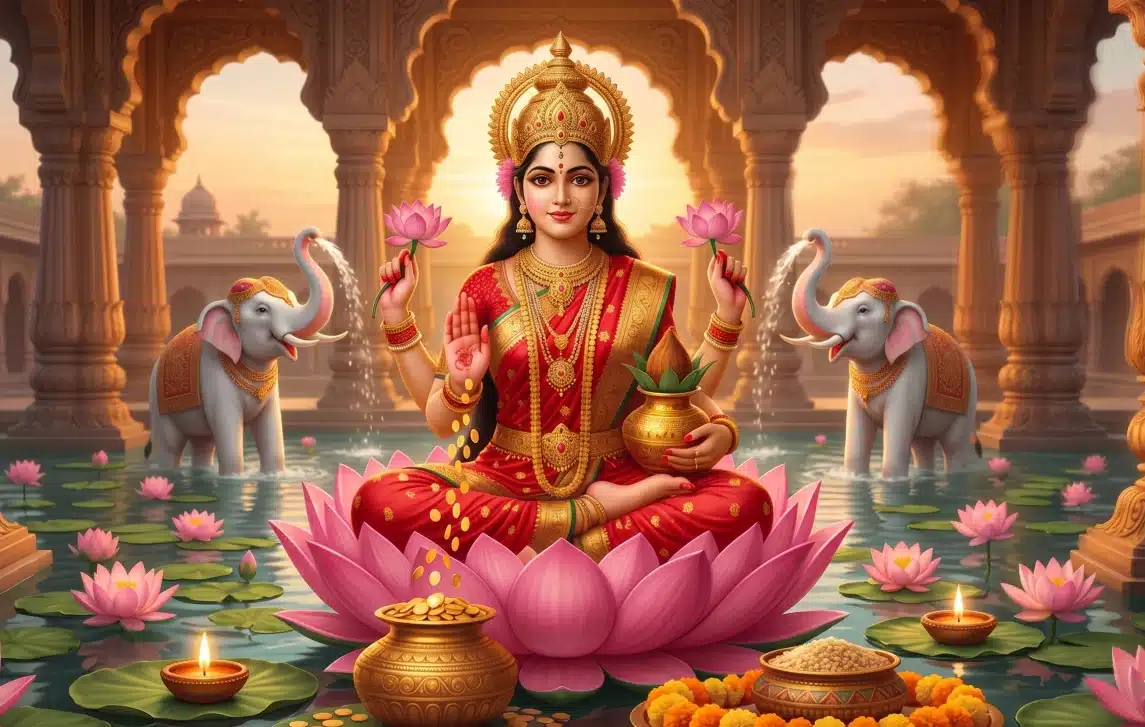
Gaja Laxmi upon the lotus, the elephants pouring the waters of abundance.
Written by Pandit Sahadev, Vedic priest and pandit in charge of ceremonies at Radha Govinda Math, Traiskirchen
An authentic Laxmi Puja addresses something the tradition never treats as unworthy: the need for sustenance, stability and relief from the pressure of scarcity. Wanting a life free of that pressure is not scolded in the Sanātana Dharma. It is taken seriously enough to be given a formal rite.
What the tradition does insist on is a shift in what is being asked for. The hymn at the center of this worship does not ask her to come. It asks her not to leave, which is a different request with different conditions attached, and those conditions are the real subject of this account.
Śrī is not currency
She is the goddess of Śrī, and the word is considerably wider than wealth. It means radiance, auspiciousness, grace, the visible glow of something thriving. A well-kept house has Śrī. A family living in accord has Śrī. A field heavy with harvest, a mind at peace, a life carried with dignity: all Śrī.
Money is a legitimate expression of it and one expression among several. To worship her only for money is to ask for a fraction while the whole is on offer. This is why a modest household rooted in Dharma may carry a great deal of Śrī while a large estate acquired by deceit carries none, and why the tradition never treats the size of a fortune as evidence of anything.
She is also, in the Vaiṣṇava frame in which the Śrī Sūkta invokes her, the consort of Viṣṇu and inseparable from him, so that she is not a dispensing power standing alone but the aspect of the sustaining principle by which what exists is held and nourished. Her presence at his side is the reason the tradition treats prosperity as a matter of sustenance rather than accumulation.
The lotus and what it teaches
She stands on the Padma, holds it, and is named by it, and the symbol carries the doctrine.
The lotus is rooted in the mud at the floor of a pond and draws its nourishment from exactly that stagnant matter, and the flower it sends up opens clean. Water will not cling to the petals. Nothing of the mire shows in the blossom.
That is the prescribed relation to prosperity. The world of commerce and capital is the mud, and the tradition does not ask anyone to leave it. The danger it names is being stained by it, through grasping and the small compromises that accumulate. The lotus performs the difficult thing: it takes from the mud without taking on the mud. She stands on the flower that manages it.
We do not catch her with offerings. We make a house she is willing to occupy, and ask her to stay in it.
Where she came from
Her origin account is the Samudra Manthana, the churning of the ocean, told in the Viṣṇu Purāṇa, the Bhāgavata and the Mahābhārata. The Devas and Asuras churned the sea of milk with Mount Mandara as the staff and the serpent Vāsuki as the rope, seeking the nectar of immortality.
What the churning produced first was not nectar but poison, which Śiva drank. Then came a succession of treasures, the wish-granting cow, the celestial horse, the elephant Airāvata, the tree of the heavens. Laxmi rose from the waters seated on a lotus, and of everyone assembled she chose Viṣṇu.
Two things in that account are worth keeping. She emerges from effort rather than being simply given, and the effort was a joint one that produced poison before it produced anything good. And she chooses. Nobody is granted her; she selects where she goes, which is the whole premise of a rite that asks rather than compels.
Jyeṣṭhā, and why the elder is sent out first
The churning produced something else before it produced her, and the tradition is candid about it. Jyeṣṭhā, the elder, also called Alakṣmī, rose from the ocean first. She is misfortune, squalor, discord and want, and she is Laxmi’s older sister rather than an unrelated opposing force.
The relation matters. It is why the Śrī Sūkta does not simply invite Laxmi but explicitly asks that hunger, thirst, dirt and want be driven out, naming the elder sister and requesting her removal before the younger is asked to enter. The two are held to be unable to occupy the same place, so the making of room is not preparatory courtesy but the substance of the rite.
This is the doctrinal ground for everything the household does before the ceremony. Cleaning is not tidiness for a guest. It is the expulsion of the elder sister from the corners where she settles, and the tradition holds that she settles precisely in the places a household has stopped looking at.
Cañcalā: the restless one
The Purāṇas call her Cañcalā, the restless, the one who does not settle. She moves. She is drawn to some households and leaves others, and the leaving is as characteristic of her as the coming.
Anyone who has watched a family fortune rise over two generations and collapse in the third has seen the pattern the word describes. The tradition does not treat this as bad luck. It treats it as her nature meeting a household’s character, and it holds that what she departs from is ethical rot rather than misfortune.
Everything about the rite follows from this. If she were static, worship would be about acquisition. Because she is restless, worship is about retention, and retention depends on the kind of place the house is rather than on what is offered on the day.
The Śrī Sūkta and what it asks
The Śrī Sūkta is her principal Vedic hymn, and its textual position should be stated accurately. It is a khila, a supplementary hymn appended to the Ṛgveda rather than part of the Saṃhitā proper, preserved among the Khilāni that follow the fifth maṇḍala. It is ancient and it is authoritative in her worship, and it is not a Saṃhitā hymn, and saying both is more useful than blurring either.
Its method is indirect and worth noticing. The hymn addresses Agni throughout, not Laxmi, asking the fire as Jātavedas to bring her. She is invoked through an intermediary, which is why the fire is the seat of her worship in the fuller rite.
And the word the whole hymn turns on is anapagāminī, she who does not go away. The petition is specific. Not a windfall that arrives and disperses, but the settled kind that holds a family across generations. It asks for permanence, and permanence is the thing a household’s conduct can actually affect.
The eight forms
The Aṣṭa Lakṣmī exist so that Śrī cannot be collapsed into money. To worship her fully is to invoke all eight, on the understanding that a balance is useless without health and health hollow without sense.
Ādi Lakṣmī, the primordial, the fullness from which the rest proceed. Dhana Lakṣmī, wealth in the ordinary sense, respected and kept in proportion. Dhānya Lakṣmī, the wealth of grain, that a house is never short of food. Gaja Lakṣmī, the wealth of standing and of mobility, the form shown flanked by elephants.
Santāna Lakṣmī, the wealth of children able to carry the line. Vīra Lakṣmī, the wealth of courage and endurance. Vijaya Lakṣmī, the wealth of succeeding in what is rightly undertaken. Vidyā Lakṣmī, the wealth of learning and of the arts. Lists vary slightly by transmission, and the principle does not: the request is for a whole life rather than for liquidity.
What the household actually does
Because her staying depends on the house rather than the offering, most of the work is the family’s and almost none of it costs anything.
The house is cleaned properly beforehand, storerooms and corners included, for the reason given above. Debts are settled where they can be settled. Quarrels within the family are composed, because a house at war with itself is not one she remains in, and the Śāstra says so directly rather than by implication.
The altar is set toward the northeast where the home allows, with fresh flowers, lamps, and a lotus where one can be had. Offerings are made cleanly rather than lavishly, since attention is what is received. And on the day the household gives something away, food, money or time, to someone who needs it, because the tradition is consistent that the open hand draws her and the closed one drives her off. The sequence by which a divine guest is formally received is set out in the account of Hindu Pūjā.
A family in a small European apartment can meet every one of these conditions as completely as a household in a large house, which is the point of listing them.
Her days in the year
Friday is her day of the week, and the weekly observance is the simplest form of her worship: a lamp, the Śrī Sūkta or the Aṣṭottara, and the altar attended to.
Beyond that there are four principal occasions. Dīpāvalī, treated below, is the chief one. Kojāgarī, on the full moon of Āśvina, is treated below as well. Varalakṣmī Vrata falls on the Friday preceding the full moon of Śrāvaṇa, in July or August, and is kept principally by married women in the south, with a decorated vessel serving as her seat. And Akṣaya Tṛtīyā in Vaiśākha is held to be the day on which what is begun does not diminish, treated in the account of Akṣaya Tṛtīyā.
Dīpāvalī and the hour that matters
Her principal worship falls within Dīpāvalī, and households outside Bhārata regularly perform it on the wrong day because the festival runs five and the Laxmi Pūjā belongs to one of them.
The sequence is Dhanteras on the thirteenth, Naraka Caturdaśī on the fourteenth, Laxmi Pūjā on Amāvasyā, the new moon of Kārtika, then Govardhana or the new year on the first, and Bhāī Dūj on the second. The main rite is the middle one, on the darkest night of the month, which is the point: the lamps are lit into the deepest darkness of the year as the signal that the house is ready.
The hour is prescribed and not arbitrary. The rite is performed at Pradoṣa, the window at dusk, while Amāvasyā is current, and the two conditions have to coincide. Because the tithi is computed for the location, that coincidence falls at Vienna’s own reckoning and not at an Indian one, and in some years the correct evening in Europe differs from the correct evening in Bhārata. A household should have the window computed locally rather than taken from a printed calendar.
Kojāgarī and the night of waking
On the full moon of Āśvina, in September or October, falls Kojāgarī Laxmi Pūjā, and the name is a question. Ko jāgarti, who is awake.
The tradition holds that on this night she moves over the world asking exactly that, and grants her presence to whoever is found waking. A vigil is kept, the house is lit, the doors are left open, and the household stays up. In the eastern observance rice flakes and coconut water are offered and food is set out under the moon.
It is the most exact expression of everything above. She is restless and she is moving through, and what is asked of the household is simply to be awake when she passes. Nothing about that observance requires means, and it transfers to a European apartment without alteration.
The hymns
Three texts carry her worship. The Śrī Sūkta is the Vedic one and the principal. The Lakṣmī Aṣṭottara Śatanāmāvalī, her hundred and eight names, is used in the daily and weekly rite with an offering at each name.
And the Kanakadhārā Stotra, attributed to Śaṅkara, carries an account worth telling. He came as a young mendicant to a house so poor the woman within had nothing to give and offered him a single dried āmalaka fruit, the only food she had. He composed the hymn on the spot and a shower of golden āmalakas fell on the house. Whatever one makes of the account, its shape is precise: what drew the shower was a gift made from genuine want. That is the same doctrine as the open hand, stated as a story rather than as a rule.
Keeping her worship in Europe
The formal rite requires an officiant holding the transmission for these Mantras, whose formation is described in the account of the lineage a priest stands within. The Śrī Sūkta is recited with the offerings, and where a fire offering is made the hymn’s own method, invoking her through Agni, is followed.
Three practical points. The Dīpāvalī window is computed locally and the coincidence of Amāvasyā with dusk is what governs, so an Indian calendar will sometimes give the wrong evening. Fresh lotus is difficult to obtain in Europe and is not required; the tradition accepts what is available and the offering is not diminished by the absence of a flower that does not grow here. And where lamps are lit in an apartment, oil lamps in a safe station are the ordinary arrangement.
Nothing else is different. The conditions she is said to respond to, order in the house, honesty in dealing, generosity with what one has, peace within the family, travel with the character of the household rather than with the ground it stands on.
She is called the restless one. The hymn does not ask her to come. It asks her not to leave, and the asking is only as good as the house.
kṣutpipāsāmalāṃ jyeṣṭhām alakṣmīṃ nāśayāmy aham ।
abhūtim asamṛddhiṃ ca sarvāṃ nirṇuda me gṛhāt ॥
I drive out the elder, Alakṣmī, who is hunger and thirst and impurity. Expel all want and all failure of increase from my house.
Śrī Sūkta · Ṛgveda Khila
This verse, and not any of the ones asking for gold, is the operative center of the hymn. Before the goddess of plenty is invited, her elder sister is named and sent out, and what she is named as is hunger, thirst and dirt, which are conditions of a house rather than of fortune. The hymn is quite clear that the first half of prosperity is the removal of what makes a place unfit, and that this is work the household does with its own hands before anyone recites anything.
For further study: on the invocation of Śrī through Agni, the Śrī Sūkta among the Khilāni of the Ṛgveda; on the churning and her emergence, the Viṣṇu Purāṇa; with the Aṣṭottara, the Kanakadhārā Stotra and the Aṣṭa Lakṣmī hymns gathered at Sanskrit Documents and scholarship on the Śākta and Vaiṣṇava traditions through the Oxford Centre for Hindu Studies.
© 2026 AUSTRIAVIENNAPUJA.COM · SANĀTANA DHARMA IN EUROPE
Preserving authentic Vedic transmission across the European continent