
Vivāha | Where to Hold the Day
Four Regions, Four Kinds of Wedding Day
City, vineyard, coast and mountain within one small region: what each actually costs, how many guests each will hold, the winds that decide where a canopy can stand, and the residency rule that settles the legal plan before anything else.
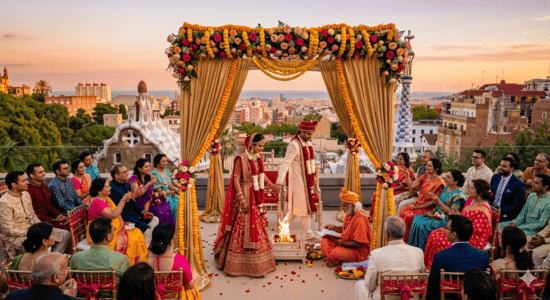
One region, four quite different days. The choice is made before the venue is.
Families looking for Hindu wedding venues in Barcelona usually begin by collecting addresses, and that is the wrong order. Catalonia holds four distinct kinds of country inside a two-hour drive: a Mediterranean capital, a wine valley, a coastline, and a mountain hinterland running up to the French border. Each produces a genuinely different wedding, and the four differ far more in cost, workable guest numbers and exposure to weather than any two properties within one of them do. Settle which of the four you are in, and the venue search takes a weekend instead of six months.
A few things hold across all four and can be taken as given. Barcelona’s airport carries direct flights from most major hubs and the high-speed rail brings guests from Paris or Madrid in a few hours. Lodging across the wider region is plentiful and, outside the peak coastal weeks, reasonable. The climate runs warm and dry from May through October, with the shoulder months the most comfortable for an open-air rite. And the Catalan wedding trade has grown genuinely fluent in Indian celebrations over two decades, so you are rarely explaining the basics. What follows is what separates the four, and it is written from the priest’s side rather than the brochure’s.
Barcelona: the city
The city offers nineteenth-century palaces in the Eixample and the Born, modernist hotels with genuine ballrooms, and a handful of architectural pavilions that have hosted some of the most photographed Indian weddings in Europe. Its real advantage is concentration. Everything sits close together, guests sleep within walking distance of the celebration, and the city itself entertains anyone staying a few days on either side. A wedding kept in the center has a cosmopolitan surround, old stone and contemporary design and a serious cultural city, that no rural property can offer.
The costs are equally real. Central addresses carry the strictest rules on amplified sound after eleven, indoor open flame is more restricted here than anywhere else in the region, and an urban wedding is more visible and less private by its nature. Lodging is in hotels rather than under one shared roof, so the party is near the venue rather than living together across the days. Against that, the city is the only one of the four where numbers are genuinely elastic, because a ballroom scales where a courtyard cannot. If ease of arrival and a large or uncertain guest list are your binding constraints, the city wins on both. The fire, the appointed hour and the order in which to settle them are treated in the companion account of the Hindu wedding ceremony in Barcelona.
Penedès: the vineyards
Southwest of Barcelona, the Penedès is the principal wine country of Catalonia and the source of most of its cava. Its old family estates, the masies, sit among vines and olive terraces, and a good many of them open for private gatherings across several consecutive days. This is the one setting of the four that delivers the shape an Indian wedding naturally wants: one property, exclusive use, the whole sequence from the music evening through the turmeric morning to the leave-taking unfolding on the same ground, with nobody shuttling between a hotel and a ceremony site.
It is also the most forgiving on the practical side. Enclosed courtyards and walled gardens are sheltered from the wind that troubles the coast, which makes the fire straightforward, and the region sits forty-five minutes from the airport. The natural size is roughly seventy to a hundred and fifty guests. Many estates house the two families on the grounds with a village hotel absorbing the rest, and that nearest hotel varies a great deal from one property to the next, so it is worth pinning down before you fall for a place. This is the Catalan equivalent of the Tuscan villa or the Portuguese quinta, and it is what most families choose once they understand the four options. How the region compares with the continent’s other wine-country choices is set out in the survey of Hindu wedding destinations in Europe.
Sitges and the Costa Brava: the coast
Two quite different coasts get spoken of as one. Sitges lies half an hour south of the city, a compact seaside town with villa estates and easy access, and it is the practical choice for a family that wants the sea without adding a long transfer to everyone’s journey. The Costa Brava begins an hour or more north and is a different proposition: pine headlands, coves cut into rock, and villas standing directly above the water. It is the more dramatic of the two by a wide margin, more secluded, and considerably harder to house a large party near.
Both share the coastal trade-offs. Peak summer pricing on the sought-after stretches is the highest in the region, lodging around a remote Costa Brava villa scatters across several towns, and the season is narrower at both ends than it is inland. What families almost never ask about, and should, is the wind. That is the next section, because on this coast it is not a footnote.
Ask a coastal property which wind it sits exposed to. Anyone who has run that terrace for a decade will answer in a sentence, and the answer decides where the canopy stands.
The wind, which nobody asks about
A Vedic marriage is conducted before an open flame, and flame is the one element in the rite that weather can actually interrupt. Catalonia has three winds worth knowing by name. The tramuntana is the hard, dry northerly that pours down over the Empordà and the northern Costa Brava, funnelled between the Pyrenees and the sea. It arrives with little warning, can blow for two or three days without easing, and it is the single most consequential wind for anyone planning an open-air ceremony north of Palamós. The garbí, the afternoon sea breeze, is gentler and far more predictable: it rises through the late morning along the whole coast and blows steadily into the evening. It will not scatter a fire, but it will lean the flame and pull at loose canopy fabric on any unscreened seafront terrace. The llevant, the easterly, is the one that brings rain and heavy sea.
None of this argues against the coast. It argues for asking one question and siting the canopy accordingly. A walled courtyard, a terrace with a solid parapet, or a garden set back behind a treeline handles all three. An exposed cliff terrace facing north on the Empordà is the one configuration to think hard about, however good the photographs are. Inland, the Penedès and the Montserrat foothills are sheltered enough that the question barely arises, which is a quiet argument for those two settings that no brochure will make on their behalf.
Montserrat and the Pyrenees: the mountains
Inland and north the land rises through the serrated massif of Montserrat and on into the Pyrenean valleys at the French border. This is the quietest of the four and the least considered, and for a family drawn to mountains rather than sea it offers something the rest of Catalonia cannot. Romanesque hamlets, stone manor houses, the extraordinary sawtooth profile of Montserrat itself, long valleys holding old monasteries: a wedding kept here has a gravity and a stillness that a coastal villa does not reproduce.
The cost of that is logistics. These properties sit ninety minutes or more from the airport, lodging around any one of them is the thinnest of the four, and the workable scale is fifty to a hundred guests rather than more. The fire is rarely an obstacle, since these are rural properties with open ground and no wildfire pressure comparable to the dry coast, but mountain weather turns fast and a named indoor fallback matters more here than anywhere else. The compensations are real: this is generally the gentlest of the four on budget, and the sense of place is the strongest.
Scale and cost, set against each other
The four do not cost the same and do not hold the same number of people, and knowing the rough shape before visiting anywhere saves a great deal of wasted affection for properties that were never going to work. The city is the most expensive and the most restricted on flame and sound, and simultaneously the easiest for guests and the only one that scales without limit. The Penedès estates sit in the middle on cost and are the most accommodating for a multi-day gathering at moderate size. The coast varies most by season, with July and August on the best stretches commanding the highest prices in the region. The mountains are usually the gentlest on cost, the narrowest on numbers, and the longest on travel.
None of that is a ranking. It is a map of trade-offs, and the useful question is which constraint binds hardest for your own gathering. A large or still-uncertain guest list points to the city or a bigger Penedès estate. A firm budget and a small party point inland and upward. A wish to live together on one property for four days points to the Penedès almost without competition. A determination to have the sea in view accepts the coastal season and the coastal pricing in exchange. Knowing which of those four sentences describes you settles the choice faster than a dozen site visits made without that clarity. The questions to put to whichever property you shortlist are set out in the guide to choosing a European venue.
The residency rule, and why it settles the legal plan
Spain is often described as recognizing only civil marriage. That is not accurate, and the accurate version matters. Spanish law gives civil effect to a religious marriage where the confession concerned holds either a cooperation agreement with the state or the status known as notorio arraigo: the Catholic Church under the Concordat, the Evangelical, Jewish and Islamic federations under the 1992 laws, and subsequently bodies including the Buddhist, Orthodox, Latter-day Saint and Jehovah’s Witness communities. Hindu communities are not among them. The practical conclusion is the familiar one, that a Vedic marriage in Catalonia carries no civil status, but it follows from that specific list rather than from a blanket rule.
The provision that actually governs a destination wedding is different and much less known. For a civil marriage in Spain, at least one party must generally be a Spanish national or have been legally resident in Spain for two continuous years immediately before the wedding. Two people flying in from London, Vienna or Mumbai will ordinarily not be approved for a civil ceremony at all. The file itself, the expediente matrimonial, is opened at the Registro Civil or before a notary and requires municipal registration, a certificate of no impediment, apostilled and translated documents, and a public posting period, none of which a visiting couple can satisfy.
So the plan is not that registering at home is simpler. For most families it is the only route open. Complete the civil marriage in your country of residence before you travel, keep the certificate, and let the Catalan day be the wedding the family came for. These requirements change from time to time and should be confirmed with the relevant authority or a qualified professional rather than taken from any page, this one included; what is written here is general information and not legal advice. How the position differs country by country across the continent is set out in the account of Hindu wedding legal recognition in Europe.
Choosing among the four
There is no best option, only a best fit. If arrival and an easy welcome for guests coming from several countries matter most, the city. If you want one estate where everyone lives together across the whole sequence, the Penedès. If the sea is the thing you actually want, Sitges for convenience or the Costa Brava for drama, with the wind question asked before the deposit. If you want quiet, altitude and a contemplative day, the mountains repay the longer drive.
Most families settle it by visiting two or three contrasting properties in different parts of the region rather than five in the same one. Standing in a place tells you in ten minutes what photographs never will, and two days of looking saves months of second-guessing. It is also worth bringing the priest into the shortlisting rather than only the booking, since the questions that decide whether a property can actually hold the rite, where the fire can stand, which way the canopy faces, whether the wind crosses the terrace at four in the afternoon, are ones he has already answered at a hundred other properties.
City, vineyard, coast, mountain. Choose by the gathering you actually have, not by the photograph you liked.
gṛbhṇāmi te saubhagatvāya hastam
mayā patyā jaradaṣṭir yathāsaḥ
I take your hand for good fortune, that with me as your husband you may reach old age together.
ṚGVEDA 10.85.36 · THE TAKING OF THE HAND
The hand is taken before the fire is circled and long before the seven steps are walked, and the words spoken over it ask for one thing only: that these two reach old age together. Nothing in that sentence depends on where it is said. A palace courtyard in the Eixample, a masia among the vines, a terrace above a cove, a stone manor under the sawtooth ridge, each of them becomes, for the length of the rite, the ground on which a household is founded. Catalonia’s gift is the unusual range of such ground inside one small region. The choosing is worth doing carefully, and then it is worth forgetting, because what the day is finally made of is the fire, the words, and the two people saying them.
The verse cited above is the hand-taking mantra of the marriage hymn of Sūryā in the Ṛgveda; on the domestic marriage rite in its textual form, the Pāraskara Gṛhya Sūtra; with scholarship on the rites through the Oxford Centre for Hindu Studies.
© 2026 AUSTRIAVIENNAPUJA.COM · SANĀTANA DHARMA IN EUROPE
Preserving authentic Vedic transmission across the European continent