
Vivāha | Judging the Place
What a Vedic Marriage Asks of Its Setting
A working method for judging a property in Europe: the written answers that decide whether a place can hold a sacred fire, a maṇḍapa, and several days of gathering, and why beauty and reputation decide nothing at all.
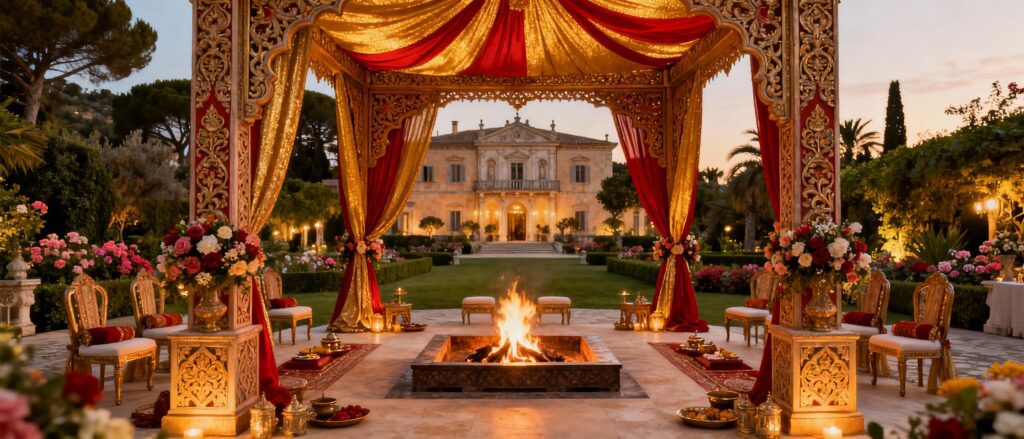
A property is judged by what it will allow, not by how it photographs.
Written by Pandit Sahadev, Vedic priest and pandit in charge of ceremonies at Radha Govinda Math, Traiskirchen
Choosing a European venue for a Hindu wedding is less a matter of taste than of verification. Properties that market themselves to international couples speak a vocabulary shaped by the Western ceremony, an aisle, a registrar’s table, forty minutes, a dinner, and the phrase multicultural ready sits easily in brochures written by people who have never watched a Homa kindled. The setting a Vedic marriage needs is not the one that photographs best. It is the one whose management can answer a short and specific list of questions in writing, without hedging, before any deposit leaves the family’s hands.
That list is the whole of this page. Once a family holds it, the search narrows quickly and stops being anxious. A celebrated estate that cannot hold a live fire in any weather is the wrong property. An unknown country house that can, that gives you the building for four days, and that lets a caterer arrive with their own staff, is the right one, whether or not it has ever seen a maṇḍapa raised in its garden. What follows sorts one from the other, and it is written from the priest’s side of the table, where the failures become visible only after the money has been paid.
Why the Brochure Language Misleads
A Western wedding asks very little of its setting. A room, a short ceremony, a meal, and the day is served. A Vedic marriage asks a great deal more, and asks it of the physical property rather than of the imagination: a canopy with real room beneath it, a contained live flame that will burn for the length of the rite, several days rather than a single afternoon, and food prepared to standards the house kitchen may never have met. None of this maps onto the template the European venue trade was built around, and so a property can be entirely sincere in describing itself as wedding ready while being quite unsuited to this particular kind of day. The fault is rarely deception. It is a mismatch of assumptions that nobody in the conversation notices until the week of the ceremony.
The remedy is to abandon the general question. Ask a venue whether it can host an Indian wedding and it will say yes, because it has hosted one, or seen photographs of one, or believes it could. Ask instead what may be lit, on what surface, under whose written permission, for how many consecutive days, and by whose kitchen, and the answers separate the suitable from the unsuitable within a single exchange of correspondence. Keep those answers in writing rather than trusting a warm conversation in a beautiful room, since the warm conversation will be forgotten by the staff member who has since left, and the written answer will not.
Every property answers yes to whether it can host an Indian wedding. Ask instead what may be lit, for how many days, and by whose kitchen, and let the written answer decide.
The Fire Comes First
Everything begins with Agni, because the marriage of the Gṛhya Sūtras is transacted before the kindled fire and not merely near it. The Pāṇigrahaṇa, the taking of the hand, the Lāja Homa in which the bride’s brother pours the parched grain, the Agni Pradakṣiṇā, the circling of the flame, and the Saptapadī, the seven steps that complete the bond, are all performed with the fire established and fed. Agni is the witness before whom the words are spoken, and the tradition treats that witness as present in the flame itself. This is why an electric lamp or a concealed gas effect cannot stand in its place, and why the first question to any property is the plainest one a family will ask all year: may a small contained live fire be lit here, and in what configuration?
Outdoors, in a garden, a courtyard, or an open terrace, nearly every European property can accommodate the fire with sensible provision, and the open setting also allows the largest gathering to stand around it. Indoors the rules tighten and the answer must be explicit rather than encouraging: written permission naming the room, adequate ventilation for the smoke of ghee and wood, a safe vessel raised off the floor surface, an extinguisher and a named person watching, and confirmation that the property’s own insurer permits it. Settle both arrangements at once, the open place where the fire will be kept in fair weather and the covered fallback for the day the sky turns, and require the fallback to be named as a specific room or structure rather than described vaguely as an indoor alternative. A property that can offer only the open option leaves the entire rite hostage to the forecast. The meaning of the offering itself, and what the flame is understood to carry, is set out in the account of Homa and the sacred fire.
Room for the Maṇḍapa, and the Direction It Faces
The maṇḍapa under which the marriage is kept needs genuine floor: an open square of roughly three to four meters in each direction, clear of pillars and fixed furniture, with height enough for the raised covering and for the four posts to stand without leaning into a beam. Inside that square sit the vedi where the fire is established, the seats of the couple, the place of the officiating priest, and room for the parents who perform the Kanyādāna, so the footprint is not a stage but a small working precinct that several people move within. Rooms that read as generous in photographs frequently prove too shallow once the canopy is measured against them, and the honest test is a floor plan with dimensions rather than an assurance that the space is large.
Orientation follows the tradition’s preference rather than an unbendable rule. The couple face east where the room allows, toward the quarter of the rising sun and of beginnings, with north or northeast taken as the next best arrangement, and the priest positions himself so that the fire lies between him and them. A room whose only workable layout throws the couple toward an awkward quarter is not thereby disqualified, but it is worth knowing before the contract rather than on the morning. Ask also where the guests will be, since a Vedic ceremony gathers people around the canopy rather than seating them in rows facing a platform, and a hall built solely for theater style seating may resist the circular arrangement the rite naturally wants. Two further details repay attention: what the floor is made of, because parquet, carpet, and historic stone each impose their own conditions on a fire vessel, and whether a protective plate or a bed of sand may be laid beneath it.
Three or Four Days, Not a Single Afternoon
A Hindu marriage unfolds as a sequence rather than an event. The maṇḍapa is raised and consecrated, Gaṇeśa is invoked so that the whole undertaking proceeds without obstruction, the turmeric is applied on its own morning, the henna and the music evening each claim their own hours, the marriage itself occupies the appointed window, and the Vidāi closes the gathering with the bride’s leave-taking. Each of these wants its own space and its own mood, and none of them can be compressed into the slot a single day hire allows. The property must therefore offer exclusive use across the full span, several distinct or reconfigurable spaces, lodging on site or very near for both families and for the priest, and permission to raise the canopy once and leave it standing rather than build and strike it inside a day.
This requirement quietly eliminates a great many otherwise lovely places. Urban hotels and single day halls, however willing their staff, are built around the one afternoon event and cannot furnish the continuity a layered celebration needs. Worse still is the property that takes another booking on the day before or the day after yours, since your setup and your clearing away are then pressed into windows that cannot hold them, and the pressure lands on the morning of the rite. Ask plainly whether the estate is yours alone for the whole span or shared with events on either side, and get the answer in the contract rather than in conversation. The country estates and converted historic houses of the continent are the settings that most reliably give the unhurried, exclusive use this kind of gathering requires, and which regions hold the best of them is surveyed in the account of Hindu wedding destinations in Europe.
The Kitchen and the Family’s Discipline
The wedding meal is traditionally vegetarian, and in many families it is prepared without onion or garlic, following the reckoning that food carries a quality which passes into those who eat it and into the occasion it serves. A great many European properties hold exclusive contracts with an in-house kitchen whose menus, suppliers, and methods were never built for this. Three questions settle the matter: whether an outside caterer may bring their own staff and ingredients; whether the house kitchen, if it must be used, can genuinely prepare a fully vegetarian menu to the family’s standard rather than a plausible approximation of it; and whether kitchen access runs across all the days of the gathering rather than the main day alone.
A property that insists on its own kitchen without flexibility is, whatever else it offers, the wrong choice for a family that keeps strict dietary discipline. Where an outside caterer is permitted, confirm two further things early. Ask whether the kitchen has the space, the burners, and the cold storage a large Indian menu actually demands, since no caterer can produce a feast for two hundred from a single domestic oven, and ask whether the venue charges a fee for food brought in from outside, a charge that can quietly add a substantial sum to the budget. Ask too, if the family intends any food to be offered before it is served, whether a small quantity may be prepared or held aside for that purpose. These are among the hardest points to resolve late and among the easiest to settle in the first exchange of letters.
What to Look At on the Site Visit
Walk the property with a different eye than the one that admires it. Stand where the fire will be and look up: is there a canopy, a branch, a low eave, or an awning above that point, and where will the smoke go when the wind sits in its usual quarter? Find the nearest water, since the rite requires it and a long walk to a tap becomes a nuisance repeated many times. Ask where the priest may wash and change, where the Sāmagrī and the ritual vessels can be stored securely overnight, and where the fire vessel will rest between the days of the sequence. Look at the power supply near the canopy for sound and light, and at the distance from the parking to the ceremony ground, which the elderly will walk in formal dress and possibly in heat.
Two habits improve every visit. Go at the hour the ceremony is actually appointed for, because a courtyard that is charming at six in the evening may sit in unbroken sun at eleven in the morning, and a hall that is bright at midday may need lighting by four. And walk the route the procession will take, since the arrival of the groom’s party moves with music and does not always fit within the property’s grounds. If it must use a public road or a shared driveway, someone must obtain permission for that, and it is better learned on a quiet visit than discovered on the day with two hundred guests assembled and a drummer already playing.
Access, Lodging, and the Older Guests
Families rarely think to ask how the gathering will reach and move about the place, and rarely regret anything more. An Indian wedding draws guests from several countries and across three generations, and a setting that is beautiful but reached only by a long drive on poor roads, or whose ceremony space sits up two flights with no elevator, presses hardest on exactly those elders whose presence carries the most weight. The honest questions are how far the property lies from an airport and a station, whether the last stretch of the journey is manageable for someone frail, where guests will sleep if the house cannot hold them all, and how they will travel between their lodging and the venue across several days rather than once.
None of this argues against a remote or storied place. Many families gladly accept a harder journey for a setting they love, and the difficulty is part of what makes the gathering memorable. The point is to weigh it deliberately rather than discover it. A nearer and plainer venue that lets every guest arrive unwearied sometimes serves a marriage better than a famous one that exhausts half the company on the way to it, and the grandmother who arrives rested and sits comfortably through the Saptapadī has been served better than the photograph was.
Sound Curfews and the Appointed Hour
The celebration around the rite is loud and joyful, and a good deal of European wedding sorrow comes from a late collision with local noise regulation. Many properties, particularly in residential districts and along certain coasts, must cut amplified sound at a fixed hour, commonly ten or eleven at night, and a family that has planned a long musical evening only to hear it silenced has been failed by a question nobody asked. Confirm the curfew on amplified music in writing, confirm whether an exception can be arranged or purchased for the wedding night, and ask whether the restriction applies to live drums as well as to speakers, since the two are often treated differently.
Timing presses from the other direction as well. The Muhūrta, the auspicious window within which the marriage is solemnized, is calculated from the local horizon of the place itself and cannot be moved for convenience, and it occasionally falls early in the morning or at an hour that sits awkwardly against the property’s own routine. Tell the venue this at the outset rather than late, so that the day is built around the appointed moment instead of the moment being bent to suit the day. A property accustomed to international celebrations will take it in stride. One that is not may need the conversation held gently and in very good time, particularly where an early ceremony means staff on site before their usual hours.
What the Contract Must Actually Say
Everything gathered above is worth nothing if it lives only in an email thread. The agreement should name, in its own clauses, the written permission for a contained live fire together with the exact location agreed for it; the covered fallback space named specifically; the dates and hours of exclusive use, including the time allowed for setup and for clearing away; whether the canopy may stand across the whole sequence; the permission for an outside caterer and any fee attaching to it; the cutoff for amplified sound and any agreed extension; the guest numbers and the lodging included; and the terms governing postponement, since a wedding assembled across borders occasionally has to move.
One distinction deserves stating plainly, because families are sometimes told otherwise by well-meaning venue staff. The rite performed under the canopy and the civil registration recognized by the state are two separate matters, and no property, however experienced, converts one into the other. The venue’s business is the ground, the fire, the days, and the food. The legal formality follows its own procedure in its own jurisdiction, and the requirements across the continent are set out in the account of Hindu wedding legal recognition in Europe. Keeping the two apart in the family’s own planning prevents the commonest and most avoidable disappointment of a destination marriage.
Priest and Planner: Two Judgments on One Place
A well-run European celebration rests on two people whose roles should never be blurred. The priest holds the ceremony: the Mantras, the fire, the canopy, the appointed hour, the meaning of each gesture and the order in which they come. The planner holds the event around it: the property, the suppliers, the logistics, the hospitality, the festivities that surround the rite. They meet at exactly one point, the choice of place, where the priest judges whether the property can carry the sacred elements and the planner judges whether it can carry two hundred people through four days.
A place that satisfies the planner’s checklist but fails the priest’s questions about fire and canopy is not the right place, whatever it looks like in the photographs. The reverse holds equally: a property the priest finds ritually faultless but which the planner knows cannot move a large company through a seated meal will strain the day in its own way. Bring both judgments to bear before anything is signed, and let the written answers rather than the marketing settle the question. The wider work of the officiating priest across the continent, and what he needs from a property in order to serve it well, is described in the account of the Vedic pandit in Europe.
The right property is not the grandest one. It is the one that will hold a fire, give you four days, and feed your people as the tradition asks.
iheva dhruvāṃ ni minomi śālām
kṣeme tiṣṭhāti ghṛtam ukṣamāṇā
Here I set up the firm dwelling; may it stand in peace, flowing with abundance.
ATHARVAVEDA 3.12.1 · THE HOUSE-BLESSING HYMN
The old house-blessing hymn is the fitting note on which to close, because it names what all the practical questions are for. A place does not become fit for a sacred occasion through its grandeur or its fame. It becomes fit when the rite is properly held within it, when the firm dwelling is set up, as the verse says, and made to stand in peace. Every question in this guide is a means to that single end: to find the setting where the fire can truly burn, the canopy truly rise, the gathering truly be fed and housed and carried without strain across its days. Choose by those, and the loveliest part looks after itself, for any ground on which a marriage is rightly kept becomes, for that little while, a consecrated one.
The verse cited above is from the house-blessing hymn of the Atharvaveda. For the domestic rites of marriage in their textual form, the Pāraskara Gṛhya Sūtra; with primary texts gathered at Sanskrit Documents and scholarship through the Oxford Centre for Hindu Studies.
© 2026 AUSTRIAVIENNAPUJA.COM · SANĀTANA DHARMA IN EUROPE
Preserving authentic Vedic transmission across the European continent