
Tāntric Āgama and the Subtle Body
The Six Centers as the Texts Describe Them
Where the familiar seven-color model came from, what the Sanskrit sources actually set out, and what the inner rite consists of for one who holds the transmission.
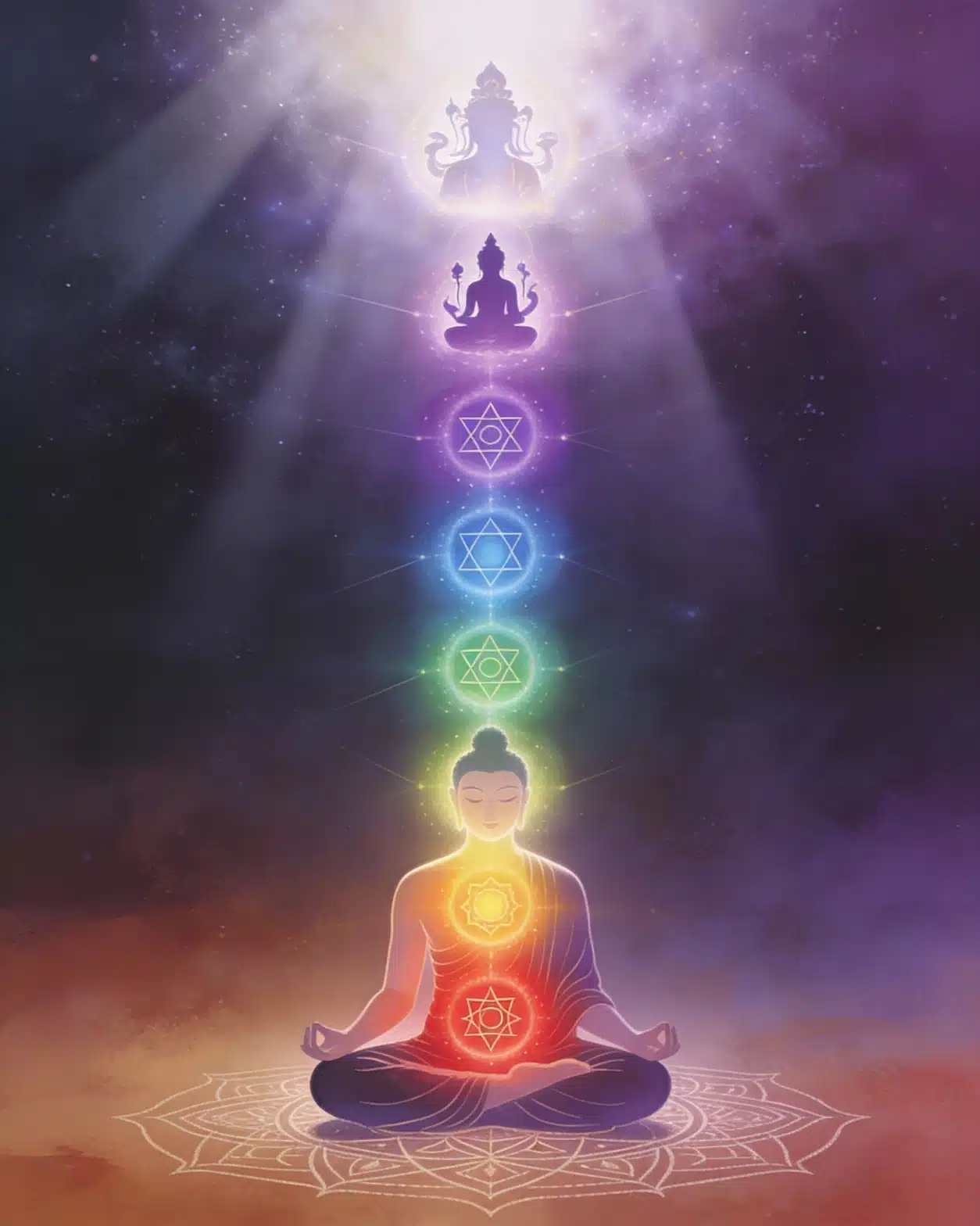
Each center a lotus, its petals carrying syllables, its interior holding the figure of its element.
Written by Pandit Sahadev, Vedic priest and pandit in charge of ceremonies at Radha Govinda Math, Traiskirchen
Chakra Pūjā, used with any precision, does not name a practice of picturing colored spheres along the spine. It names the formal inner rite in which the presiding powers of the six centers of the subtle body, the Ṣaṭ-cakras, are invoked at their stations by their own seed syllables and worshipped through the inner offering by a practitioner who holds initiation.
The model most readers arrive with is about a hundred years old and its origin is traceable, which is worth establishing before anything else, since the rest of this account makes little sense while the substitute is still in place.
Which rite does the term name?
The phrase carries more than one sense in the Tāntric literature and a reader should know which he is looking for.
In the sense treated here, it is the inner worship of the six centers of the subtle body, performed within the practitioner. In the Śrīvidyā tradition, cakra pūjā ordinarily means the worship of the Śrī Cakra, the nine interlocking triangles of the great Yantra, worshipped through its enclosures with its own quite separate apparatus of Devatās and Mantras. That is a different rite and a reader wanting it should look for it under that name. And in certain Kaula texts the phrase denotes the circle assembly, the gathering of initiates in a ritual circle, which belongs to a restricted transmission and is not a subject for a public page.
What follows concerns the first sense: the six centers, their presiding powers, and the inner rite directed at them.
Where the seven-color model came from
The familiar arrangement, seven centers in the colors of the spectrum, each governing an emotional theme, is presented everywhere as ancient and Indian. Its actual provenance is narrower and can be stated.
The spectral color sequence appears in the Theosophical literature of the early twentieth century, above all in Charles Leadbeater’s work on the subject published in 1927, which drew on clairvoyant description rather than on the Sanskrit sources and assigned colors that had no precedent in them. Woodroffe’s translation of the Ṣaṭ-cakra-nirūpaṇa had appeared eight years earlier and gives quite different colors, tied to the elements: yellow for earth at the base, white for water, red for fire, smoke-gray for air, white for ether. Nothing resembling a rainbow is anywhere in the Sanskrit material.
Nor is the count seven. The classical enumeration is six, with the crown treated as a separate matter, for reasons set out below. And the associations are not psychological themes but elements, syllables, presiding Devatās and geometric figures. This is not a quibble about detail. The two systems are doing different things: one is a chromatic and emotional scheme for self-work, the other a phonetic and ritual scheme requiring transmission.
The classical centers are built from syllables, not from colors. Once that is seen, the system stops looking like a chart of moods and starts looking like what it is.
The texts that actually describe the centers
The Ṣaṭ-cakra-nirūpaṇa of Pūrṇānanda, composed in the sixteenth century as part of a larger work, is the most systematic account in Sanskrit. Its verses give each center from the base to the brow with a full set of attributes: the number of petals and the syllable on each, the seed Mantra of the governing element, the figure enclosed within the lotus, the presiding Devatā and Śakti, and the region of the body. It reached Western readers through Woodroffe’s translation of 1919, published as The Serpent Power, which remains the standard rendering.
The Śiva Saṃhitā treats the channels and the ascent and is one of the principal Haṭha texts. The Kulārṇava Tantra is the main authority on initiation and on the qualifications of a teacher. Behind these stand the Yoga texts that describe the centers in less systematic form, and a considerable body of Āgamic material.
One honest observation about the corpus: the six-center system as it is now known is a relatively late synthesis. Earlier texts describe different numbers of centers, sometimes four, sometimes five, and the standardization at six with the crown above them is not present from the beginning. The tradition has a history rather than a single unvarying form, and saying so does not weaken it.
The three channels and the three knots
The centers are nodes where the subtle channels converge. The Suṣumṇā runs through the spinal axis from base to crown and is the path of the ascent. The Iḍā ascends to its left carrying the lunar and cooling current, and the Piṅgalā to its right carrying the solar and activating one, the two crossing at the centers as they rise.
Across the central channel stand three Granthis, knots, and these are named specifically rather than left vague. Brahma Granthi at the base, bound to attachment to the body and to what sustains it. Viṣṇu Granthi at the heart, bound to attachment to states, relations and the emotional life. Rudra Granthi at the brow, bound to attachment to attainment itself, which the tradition treats as the subtlest and the last to yield.
The progression they describe is worth noticing, because it is the same one the Śākta literature gives in another idiom: gross attachment, then affective attachment, then spiritual pride. The three knots are not obstacles placed at random along a route. They are an account of what actually holds a person, arranged in the order in which it lets go.
The fifty petals and what they carry
Here is the detail that settles the question of what kind of system this is, and it is almost never mentioned in popular treatments.
The petals of the six centers number four, six, ten, twelve, sixteen and two. They total fifty. Each petal carries a syllable, and the fifty syllables are the letters of the Sanskrit alphabet, distributed in order from the base upward. The sixteen at the throat are the vowels. The remainder are apportioned among the other centers by their classes.
The implication is direct. The centers are conceived as the seat of the whole of articulate sound, laid out through the body, which is why the rite that engages them is conducted through Mantra and why pronunciation is treated as load-bearing rather than incidental. A system built on the alphabet cannot be worked by visualizing colors, because color is not what it is made of. This one fact does more to distinguish the classical doctrine from the modern one than any amount of assertion.
The six centers, one by one
Mūlādhāra, the root support at the base. Four petals, enclosing the yellow square of earth. Seed Laṃ. Brahmā presides with the Śakti Ḍākinī, and the coiled Śakti rests here.
Svādhiṣṭhāna, at the sacral region. Six petals, enclosing the crescent of water. Seed Vaṃ. Viṣṇu presides with Rākiṇī.
Maṇipūra, the city of jewels, at the navel. Ten petals, enclosing the red triangle of fire. Seed Raṃ. Rudra presides with Lākinī. It is the seat of the digestive fire and of transformation in the subtle body.
Anāhata, the unstruck, at the heart. Twelve petals, enclosing the hexagram of air. Seed Yaṃ. Īśa presides with Kākinī. The tradition places the individual self here as a small flame within the lotus, and the name refers to sound not produced by percussion.
Viśuddha, the purified, at the throat. Sixteen petals bearing the vowels, enclosing the circle of ether. Seed Haṃ. Sadāśiva in his five-faced form presides with Śākinī. Its concern is sound and speech.
Ājñā, at the brow. Two petals, containing the praṇava. Śambhu presides with Hākinī, beyond the elements, since the five elements are exhausted at the throat. The name means command, and the sources connect it to the receiving of direction, whether understood as the inner directive perceived here or as the teacher’s instruction taking hold. The texts are less specific on this than popular accounts suggest, and the point is not worth overstating.
Sahasrāra is not a seventh
The thousand-petaled Sahasrāra at the crown is regularly counted as the seventh center, and the classical texts are careful to treat it otherwise. It stands above and beyond the six. It has no element, no Bīja in the sense the others have, and it is not a station of the operative field.
It is the seat of the union toward which the whole ascent moves. The distinction is not a technicality: the six are where work is done, and the crown is where the work arrives. Counting it as a seventh among equals flattens exactly the structure the doctrine is built to express. The union it names is approached in outer worship as well, treated in the account of the Śiva Pūjā.
Kuṇḍalinī, stated carefully
Kuṇḍalinī, from a root meaning coiled, is described in the Ṣaṭ-cakra-nirūpaṇa as the supreme Śakti held dormant at the base, who on awakening rises through the centers to union with Śiva above the crown.
The texts are cautious here and that caution should be reported rather than smoothed away. They frame the awakening as proceeding through initiation from a qualified teacher, sustained recitation of the transmitted Mantra, prescribed breath discipline and the inner worship at each station, and they consistently counsel against forcing it through self-directed technique. The teacher’s presence is treated as the stabilizing ground of the whole undertaking, and the literature is candid that a practice pursued without it can go badly.
This page reports what the tradition holds about how the path is properly walked. It makes no claim about physiological or psychological outcomes, and anyone offering guaranteed results from a paid session is making claims the texts themselves decline to make.
What the inner rite consists of
The rite opens with the sipping of water and the regulation of breath, then the Saṅkalpa, in which the practitioner names himself by his lineage and initiation name rather than his birth name, because the rite is conducted from within the identity initiation establishes.
Then Bhūta Śuddhi, the purification of the elements, which is the foundational act of Tāntric worship: the gross body is dissolved through its elemental constituents, each into the next, into consciousness, and reconstituted as a body fit to receive the Devatās. Nothing that follows is operative without it.
The core is Nyāsa, placement, in which the presiding power of each center is installed at its station by its seed Mantra with the accompanying gesture. The seeds are recited at their stations with the intonation and inner form the teacher transmits, attention held at each in turn. The order of dissolution and the order of installation are not the same and are not interchangeable, and the sequence is preserved identically across authentic lineages. The disciplined daily life within which such practice sits is described in the account of Sandhyā Vandanam.
Dīkṣā and its three kinds
The Kulārṇava holds that no Tāntric practice is operative without Dīkṣā from a qualified teacher in an unbroken line, and it distinguishes kinds of transmission rather than treating initiation as one undifferentiated act.
Śāmbhavī Dīkṣā is transmitted by the teacher’s regard, word or intention, without external procedure, and is held to be the highest. Śāktī Dīkṣā is transmitted by direct conveyance of Śakti, with the disciple largely passive. Māntrī Dīkṣā is the ordinary form, transmitted through the formal imparting of the Mantra with its prescribed rite, and is the one most practitioners receive.
The text sets real requirements on a teacher: learning received through his own teacher, realization through his own practice, the discernment to judge readiness, and freedom from desire for gain. That last is the one that disqualifies most of what is advertised. The reasoning behind requiring transmission at all is not institutional; the tradition holds that the transmission conveys the capacity for the practice, and that the outward actions performed without it lack the ground from which the Mantra works. Where initiation has not been received, the Vedic and Āgamic worship conducted by a qualified officiant is the sound preparatory ground, and the formation of such an officiant is described in the account of the lineage a priest stands within.
Keeping the practice in Europe
The doctrinal question is straightforward. What the rite depends on is the initiation being present in the practitioner, the lineage being intact, and the Mantras being correctly pronounced and directed. None of these is geographic. A practitioner in Vienna holding genuine transmission stands where one in Vārāṇasī stands.
The practical difficulties are real and worth naming. Finding a teacher with genuine transmission in Europe is hard, and the field is populated by people offering paid activation sessions who hold nothing at all. Three tests are worth applying. Ask which lineage the teacher stands in and whether it can be named specifically. Ask what he received and from whom. And notice whether initiation is being sold on a schedule to whoever pays, since the Kulārṇava’s requirement of freedom from desire for gain is exactly what that arrangement fails.
Where no such teacher has been found, the honest counsel is patience rather than substitution. The daily observances, the household rites and the fire offerings conducted by a qualified officiant constitute a genuine discipline in their own right, not a consolation prize, and the fire dimension of that practice is set out in the account of Homa in the Vedic tradition. The tradition has never held that a person without Tāntric initiation is without a path.
Fifty syllables laid through the body, three knots across the channel, six stations and one arrival. The rite is made of sound, and sound must be received from someone.
gurur brahmā gurur viṣṇur gurur devo maheśvaraḥ ।
gurur eva paraṃ brahma tasmai śrī gurave namaḥ ॥
The teacher is Brahmā, the teacher is Viṣṇu, the teacher is the god Maheśvara. The teacher is indeed the supreme Brahman. To that teacher, salutation.
Guru Stotra · Traditional
The verse is recited before Tāntric practice everywhere, and it explains why this doctrine cannot be taken from a page, including this one. What it claims is not that the teacher is admirable but that the transmission is the thing itself. An account of the six centers can set out what the sources say and correct what has been substituted for them. It cannot hand over what only a teacher hands over, and a reader who understands that has understood the most important thing on this page.
For further study: on the six centers, their petals, syllables and presiding powers, the Ṣaṭ-cakra-nirūpaṇa of Pūrṇānanda in Woodroffe’s translation; on the channels and the ascent, the Śiva Saṃhitā; on initiation and the qualifications of a teacher, the Kulārṇava Tantra; with primary texts at Sanskrit Documents and scholarship on the Tāntric Āgamas through the Oxford Centre for Hindu Studies.
© 2026 AUSTRIAVIENNAPUJA.COM · SANĀTANA DHARMA IN EUROPE
Preserving authentic Vedic and Tāntric transmission across the European continent