
Śiva, the Ascetic and the Householder
The Figure, the Emblem, and How the Rite Is Kept
Who he is in the iconography, what the Liṅga stands for, the substances of the pouring and the rules that govern them, the great hymn, and the days on which his worship falls.
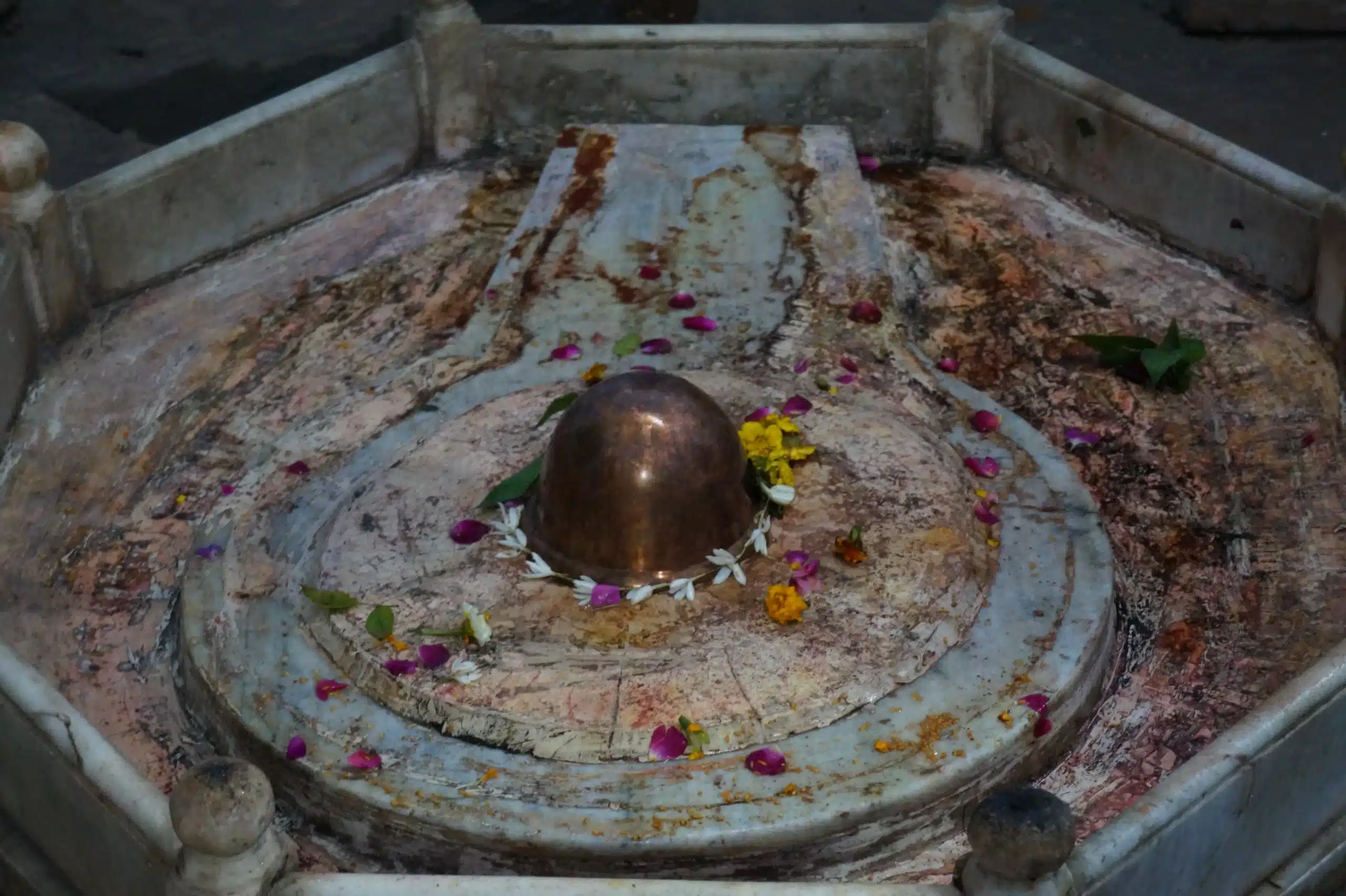
The Liṅga upon its pīṭha, bathed and offered to, at the center of the household rite.
Written by Pandit Sahadev, Vedic priest and pandit in charge of ceremonies at Radha Govinda Math, Traiskirchen
No figure in the tradition holds together so improbable a pair of qualities as the one met in Śiva Pūjā. He is the ascetic on the mountain, hair matted, body smeared with ash, withdrawn entirely into meditation. He is also the husband of Pārvatī and the father of Gaṇeśa and Skanda, head of the most beloved household in the whole literature. Understanding how those two go together is the beginning of understanding his worship.
This account gives both: who he is, and then how the rite is actually kept, with the substances of the pouring, the rules that govern what may and may not be offered, the structure of the great hymn, and the days on which his worship falls in the year.
A figure of two worlds
Look at almost any image and both worlds are present at once. The matted hair piled high and the ash across the body belong to the renouncers, the wandering yogīs and forest sages who set everything aside. The crescent in the hair, the serpent at the throat, the trident in the hand are marks of one who has gone past ordinary fear and ordinary attachment. And beside him in the same image sits Pārvatī, often with a child in her lap.
Most traditions separate these ideals. The hermit goes one way and the householder another. This one placed both in a single figure and asked the devotee to take him whole. His worship is therefore not a choice between renunciation and life in the world but an approach to a presence in whom both are held without strain.
The matted hair, the ash, the serpent
The jaṭā is the hair of one who has stopped grooming for the world’s eye, wild because he is no longer arranging himself for anyone. The vibhūti, the ash, is gathered from the cremation ground and carries a message the tradition does not soften: the body so anxiously preserved is finally ash, and one who has faced that need not flatter it.
The serpent at the throat is what is most feared, worn as an ornament. The trident, the triśūla, is read for its three prongs as the three Guṇas, the restless, the inert and the luminous, with the one who bears it mastered by none of them. The crescent marks time itself held in his hair, waxing and waning without touching him. Every detail insists on the same thing.
The river caught in his hair
Gaṅgā descending from the heavens would have shattered the earth with the force of her fall, and Śiva offered his head to receive her. The river was caught and gentled in the labyrinth of his matted hair and released slowly onto the earth as the current we know. He is called Gaṅgādhara for it.
The image corrects the usual picture of his withdrawal. Worship is often imagined as petitioning a remote figure to become involved. This account reverses that: the depth and stillness are precisely what allow him to receive what would otherwise destroy, and to let it land gently. The ascetic is not less engaged with the world than the busy householder but engaged at a level the busy life cannot reach.
The hermit on the mountain and the husband at the hearth are one figure. The renunciation is not the refusal of love. It is what makes love unanxious.
Pārvatī and the household on Kailāsa
Beside the ascetic stands Pārvatī, daughter of the mountain, held by the tradition to be his equal rather than his adjunct. The accounts of her courtship are unusually human: she undertook long austerities to reach him, not because he was unreachable but because she had recognized in him what her own nature was made for, and he recognized her in turn.
From that union came Gaṇeśa, who removes obstacles and is invoked before every undertaking, and Skanda, the young commander. The family scenes recur throughout the art and the stories, the four of them on Kailāsa, the parents tender and amused, the boys at play. That a renouncer should be shown so unselfconsciously as husband and father is the surprising thing, and it is a large part of why households keep this worship so warmly. The wider devotional life of a home is treated in the account of Pūjās and Homas.
Why the two sides explain each other
The two are not in tension. Only because he is rooted in inner freedom can he love without grasping. The householder is possible because of the ascetic and not despite him, and the ascetic is shown not as one who fled from love but as the one whose love is least anxious.
For an ordinary person, neither hermit nor perfect spouse, this is a kindness. It says the inner work of becoming free and the outer work of loving a family are one path rather than two. The steadiness cultivated in quiet is what supplies patience at home, and the freedom from grasping is what makes affection generous. To worship him is in part to ask to grow in that direction.
What the Liṅga is
The emblem on the altar is the Liṅga, and the word means a mark or a sign. It is aniconic deliberately: a form given to what has no form, chosen for its plainness because he is finally beyond any particular shape. The tradition’s own reading is that the Liṅga marks the unmanifest, and the pīṭha on which it rests is Śakti, so that the emblem as a whole holds the pair rather than the one.
Types are distinguished. A cala liṅga is movable, kept on a household altar, of stone or metal. An acala liṅga is fixed and installed in a temple by consecration. A bāṇa liṅga is a naturally formed stone from the Narmadā, requiring no installation rite, which is why it is often recommended for a household and is worth asking about when acquiring one. A liṅga of clay or of ash may be made for a single occasion and dispersed afterward.
The channel running from the pīṭha is not decorative. Everything poured over the Liṅga runs off through it, and the tradition is specific that this outflow is not stepped over or across. It is a small rule and households outside Bhārata routinely do not know it.
Abhiṣeka: the pouring
The central act of his worship is Abhiṣeka, the pouring of substances over the Liṅga in a continuous stream while Mantras are recited. Śiva is worshipped by pouring in a way no other deity is, and the vessel used, the dhārā pātra suspended above the emblem to drip continuously, exists for no other purpose.
The simplest form is water alone, and it is complete. Where the fuller offering is made, the substances are the Pañcāmṛta, the five nectars: milk, curd, ghee, honey and sugar, each poured in turn with water between them and a final water rinse at the end. Larger observances extend the list with coconut water, sugarcane juice, sandal paste and the rest, and each addition has its own Mantra.
The order matters, water between each, and the closing rinse is not optional, since what remains on the emblem after the pouring should be water and nothing else. A household keeping the simple daily form need do no more than pour clean water slowly and speak the five syllables.
What is offered, and what is not
This is the practical knowledge households most often lack, and it is easily stated.
Offered: Bilva leaves above all, along with white flowers, the blue-flowered aparājitā, dhattūra, arka, and unbroken rice grains. Bhasma is applied in three horizontal lines and rudrākṣa is worn.
Not offered: the ketakī flower, excluded because of its false witness in the Liṅgodbhava account, where it corroborated Brahmā’s lie and was cursed to have no place in Śiva’s worship. Turmeric is generally avoided in his worship though it belongs to Pārvatī’s, and the same applies to kumkuma on the Liṅga itself. The tulasī leaf belongs to Viṣṇu and is not customarily offered here, though transmissions differ on this and a household should follow its own. Coconut is offered but the water of a coconut is not used for the pouring in some transmissions.
Where a household’s own tradition differs from any of this, its own tradition governs. What matters is knowing that these rules exist rather than offering by guesswork.
The Bilva leaf and its rule
The Bilva is his leaf and the offering has a form. The leaf comes as three leaflets on a single stem, read as the three eyes, the three Guṇas or the three prongs of the trident, and the three-fold leaf is offered whole, not separated into its parts.
It is laid on the bathed Liṅga with the stem pointing toward the worshipper and the smooth upper surface downward against the emblem. A leaf already offered may be washed and offered again, which the tradition permits for Bilva and for very little else. Torn or insect-eaten leaves are set aside.
In Europe fresh Bilva is difficult to obtain and this is a genuine constraint rather than an excuse. Dried leaves are used, and where none are available the worship proceeds with water and the Mantra, which is complete. A rite is not invalidated by the unavailability of a plant that does not grow in the country.
The Pañcākṣara
The five-syllable Mantra, namaḥ śivāya, is the most beloved of his addresses, and its relation to the Veda is worth stating precisely because it is usually stated loosely.
The phrase occurs within the Śrī Rudram, in the Namakam, in the eighth anuvāka, in the longer sequence namaḥ śivāya ca śivatarāya ca. The Pañcākṣara as recited is drawn from that passage rather than being a direct quotation of it, and the tradition treats its position at the center of the Namakam as significant, since the Rudram has that phrase at its heart with equal weight of hymn on either side.
Prefixed with the praṇava it becomes the six-syllable form. Many keep no other practice than the soft repetition of the five syllables through the day, and the tradition holds that sufficient.
The Śrī Rudram and the Rudrābhiṣeka
The Śrī Rudram is his great Vedic hymn, from the Taittirīya Saṃhitā of the Kṛṣṇa Yajurveda, and it has two parts that households hear named without knowing what they are.
The Namakam is eleven anuvākas of salutation, so called because of the repeated namaḥ, and it addresses Rudra in every aspect including the ones a devotional hymn might be expected to omit. The Camakam is eleven anuvākas of petition, from the repeated ca me, asking for a long enumerated list of goods. Salutation first, then asking. The order is the teaching.
When a household engages a priest for a Rudrābhiṣeka, this is what is being performed: the Rudram recited while the Abhiṣeka proceeds. The scales have names. Ekādaśa Rudram is eleven recitations of the Namakam with the Camakam interposed by a set pattern. Laghurudram is eleven of those, Mahārudram eleven of those again, and Atirudram a further eleven, which requires many priests and several days. A household commissioning one should know which scale it is asking for, since the difference is considerable in both duration and cost.
Pradoṣa, Monday, and the fortnight
Pradoṣa is the most important recurring observance and it is regularly described vaguely. It is the Trayodaśī, the thirteenth tithi, in the window around sunset, roughly the hour and a half spanning dusk. It falls twice each lunar month, once in each fortnight.
The timing is computed from local sunset, not from a clock hour, which is the point that matters for a household in Europe. Pradoṣa falling on a Saturday is called Śani Pradoṣa and is kept with particular attention; on a Monday, Soma Pradoṣa.
Monday is his day of the week, and the practice of the sixteen consecutive Mondays is a common household observance. A family keeping Monday, both Pradoṣas, and the great night once a year finds the year quietly shaped around him.
Śiva’s fierce form as Kāla Bhairava keeps a calendar of its own: the Aṣṭamī of each dark fortnight, and above all the Aṣṭamī of the dark fortnight of Mārgaśīrṣa, held to be the day of his manifestation. The account and the observance are set out under Kāla Bhairava Pūjā.
Mahāśivarātri and its four watches
Mahāśivarātri falls on the fourteenth of the dark fortnight in the month preceding the spring, in Phālguna or Māgha depending on which reckoning a region follows, which places it in February or March. It is kept by fast through the day and vigil through the night.
The vigil has a structure that is its defining feature and is almost always omitted from descriptions. The night is divided into four praharas, watches of roughly three hours, and an Abhiṣeka is performed in each. In the common observance the first uses milk, the second curd, the third ghee and the fourth honey, with recitation and offering between them, carrying the household through to dawn.
Keeping vigil is fitting for this figure specifically. He is the meditator whose hours are the quiet ones, and to stay awake through a night once a year is to share, briefly, in that watchfulness. In Europe the four watches are computed from local sunset and sunrise, and in February that is a long night, which makes the observance harder here than in Bhārata rather than easier.
Keeping the worship in a European home
The daily rite transfers without difficulty. A small Liṅga on a household altar, clean water poured slowly, the five syllables, and where possible a Bilva leaf. That is the whole of it and it is complete.
Four practical points. Bilva is scarce and dried leaves serve. The outflow from the pīṭha needs somewhere to go, which in an apartment usually means a tray beneath, and it should be poured out rather than left. Pradoṣa and the praharas of Mahāśivarātri are computed from local sunset, so Vienna’s own times govern and an Indian calendar will mislead. And where a Rudrābhiṣeka is wanted, the scale should be settled with the officiant in advance, along with how many reciters it requires. The formation of such an officiant is described in the account of the lineage a priest stands within, and the recitational discipline that underlies it in the account of Sandhyā Vandanam.
Nothing essential is wanting at this distance. The figure honored here was never tied to one country, and water poured over a smooth stone is the same act under any sky.
Water poured slowly over a plain stone, a three-fold leaf, five syllables. The most elaborate worship in the tradition reduces without loss to this.
namaḥ śivāya ca śivatarāya ca ।
namaḥ tīrthyāya ca kūlyāya ca ॥
Salutation to the auspicious one and to the more auspicious; salutation to him of the fords and to him of the riverbanks.
Śrī Rudram, Namakam · Taittirīya Saṃhitā
The five syllables of the household Mantra sit inside this line, and the hymn continues past them to salute him at the fords and the riverbanks, at the crossings and the ordinary edges of water where people actually go. That is the character of the whole Namakam. It salutes him in the high aspects and then in the plain ones without changing register, which is the same thing the figure himself holds together, and it is why a worship that can extend to eleven reciters over several days loses nothing when it contracts to one person pouring water in a flat.
For further study: on the Śrī Rudram, the Taittirīya Saṃhitā of the Kṛṣṇa Yajurveda; on the Liṅgodbhava, the ketakī and the accounts of his household, the Śiva Purāṇa; with the hymns and the Abhiṣeka Mantras gathered at Sanskrit Documents and scholarship on the Śaiva traditions through the Oxford Centre for Hindu Studies.
© 2026 AUSTRIAVIENNAPUJA.COM · SANĀTANA DHARMA IN EUROPE
Preserving authentic Vedic transmission across the European continent