Jyotiṣa | The Eye of the Veda
Vedic Astrology Consultation in Austria: The Eye of the Veda
On Jyotiṣa, the discipline the old tradition called the eye of the Veda: what it actually is, why it was always more an art of orientation than of prophecy, and how a consultation is conducted faithfully in Austria.
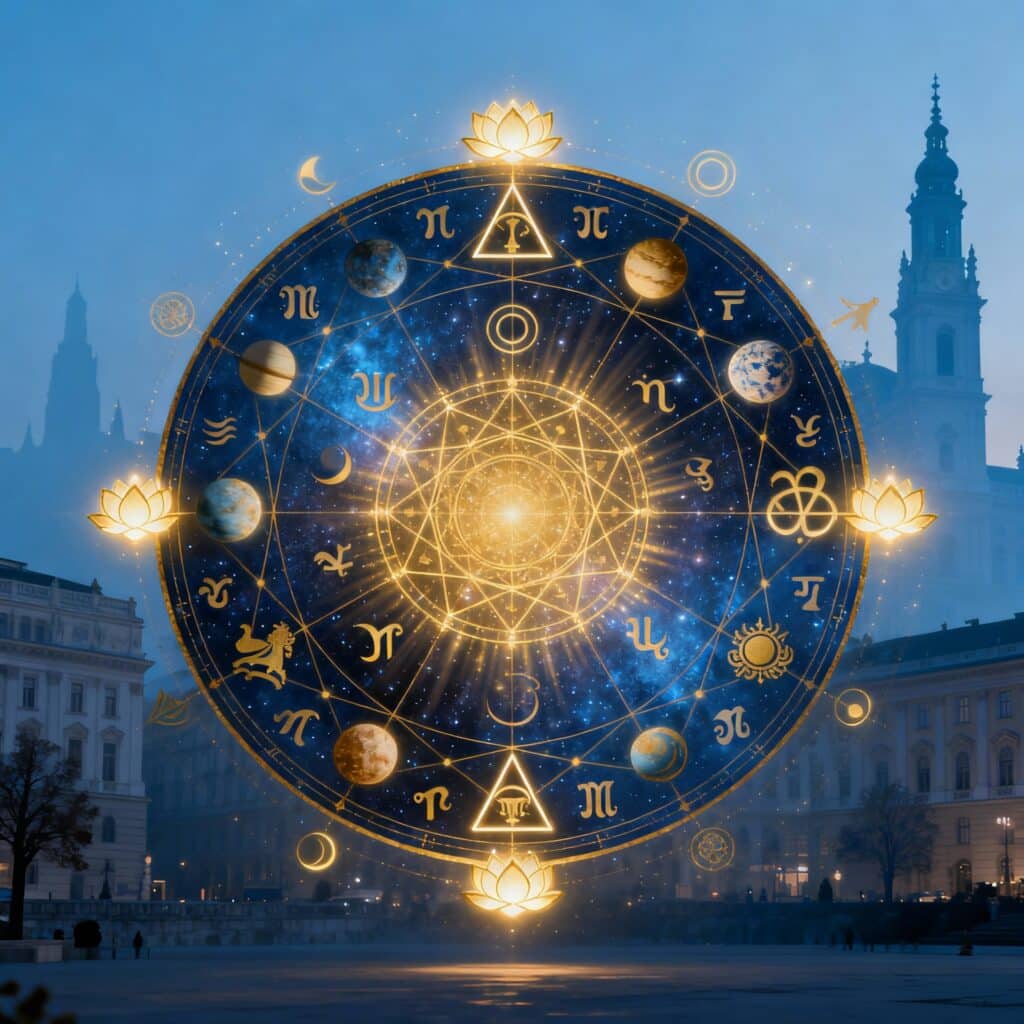
The discipline behind a Vedic astrology consultation in Austria has an old and lovely name within its own tradition: Jyotiṣa, the science of light, called by the ancients the eye of the Veda. The name repays attention. An eye does not create what it sees; it lets one find one’s way. Jyotiṣa was understood in just this spirit, not as a power that bends a life to the will of the planets, but as an instrument for seeing one’s situation clearly, finding the right moment for an undertaking, and orienting oneself within the larger order of things. To consult it well is to gain not a prophecy but a kind of sight.
This matters because the popular picture of astrology, fortunes foretold, fates pronounced, is almost the opposite of what the serious tradition intends. Jyotiṣa is a discipline of orientation: it helps a person understand the qualities of a time, the shape of their own nature, and the wise moment to act, so that they may move through life with awareness rather than blindness. This page sets out what the discipline is, what a genuine consultation involves, and how it is kept with integrity for those living in Austria, where its light falls no less truly than anywhere else.
Why It Is Called the Eye of the Veda
The tradition counts Jyotiṣa among the six Vedāṅgas, the auxiliary disciplines that support the Veda and through which the sacred knowledge is correctly applied, and it assigns this one the role of the eye. The reasoning is practical: the sacred rites of the tradition were meant to be performed at their proper moment, and Jyotiṣa is the discipline that determines when that moment is. Without the eye, one cannot see the right time; without the right time, the rite loses something of its fitness. So the discipline began, at root, as an art of timing in the service of the sacred.
This origin tells us a great deal about its true character. Jyotiṣa was never, in its serious form, a parlour art of telling strangers their futures; it was a precise discipline for aligning human action with the rhythms of a larger order. That is why a genuine consultation has at its heart not the question “what will happen to me” but the better questions “what is the nature of this time, what is the shape of my own tendencies, and when is the wise moment to act.” The discipline answers these, and in answering them serves the same purpose it always did: helping a life move in accord with something larger than itself.
An eye does not create what it sees; it lets one find the way. Jyotiṣa is an instrument for seeing clearly, not a power that bends a life.
The Two Layers of the Discipline, and Its Texts
It helps to understand that Jyotiṣa is not one thing but two layers grown one upon the other. The older, the Vedāṅga Jyotiṣa, was essentially calendrical: its concern was the reckoning of the lunar and solar cycles and the lunar mansions, so that the sacred rites could be fixed at their correct times. This is the layer that earned the discipline its name as the eye of the Veda. Upon this astronomical foundation grew the later and more elaborate layer, the Horā or natal astrology, the reading of an individual’s birth chart, which took its mature form in the early centuries of the common era and shows, in its mathematics, some contact with the wider astronomy of the ancient world.
Both layers rest on a body of authoritative texts. The astronomical foundation is preserved in works such as the Sūrya Siddhānta, one of the classical treatises of mathematical astronomy, while the natal tradition is anchored in the Bṛhat Parāśara Horā Śāstra, regarded as the foundational authority of horoscopic Jyotiṣa, with the source texts of the discipline gathered also at Sanskrit Documents. A practitioner formed in the tradition works from these, not from invention, and a consultation conducted with integrity is the application of this inherited body of knowledge to one particular life.
Jyotiṣa and the Doctrine of Karma
Beneath the whole practice lies the doctrine that gives it its true meaning and its true limits: the teaching of Karma. The tradition holds that a chart does not impose a destiny from outside but reflects the portion of a person’s own accumulated tendencies, their prārabdha, the ripened fruit of past action, that has come due for this life. The configuration of the heavens at birth is read not as a cause that compels but as a mirror that shows what the person already carries, the inclinations and the timing that their own past has set in motion. The planets, in this understanding, do not push a life; they indicate its shape.
This is precisely why a serious reading is counsel and never sentence. The doctrine of Karma holds in the same breath that the past has shaped the present and that present action remains genuinely free: the ripened tendency is given, but how a person meets it, the conduct they choose, the effort they sustain, the character they build, is their own and genuinely shapes what follows. A chart shows the hand that has been dealt; the playing of it is never foreclosed. To read Jyotiṣa rightly is to hold both truths at once, that a life carries real tendencies worth understanding, and that the freedom to meet them well is never taken away. Any reading that forgets the second half has abandoned the doctrine on which the first half rests.
What a Consultation Genuinely Offers
A serious session is a conversation grounded in the careful study of a person’s chart and the qualities of the present time. A skilled practitioner will describe the seeker’s nature with its strengths and difficulties, speak to the chapter of life they are currently passing through, and help them understand the season they are in, whether one that favours expansion and new beginnings or one that asks patience and consolidation. The value of this is orientation: a person who understands the season they are in can work with it rather than against it, which is among the most practical kinds of wisdom there is.
The session may also address specific questions, the timing of a marriage, a move, a major decision, and here the discipline’s old strength as an art of timing comes to the fore. None of this is offered as a fixed forecast of events. It is offered as informed counsel about the qualities of a time and the tendencies of a life, leaving the choices themselves squarely with the seeker. The most useful sessions send a person away not with a prediction to dread or await, but with a clearer sense of themselves and their moment, and a steadier footing for the decisions ahead.
The Art of the Right Moment
One of the discipline’s most distinctive and valued applications is the choosing of an auspicious time for an important undertaking, a marriage, the entry into a new home, the start of a significant venture, what the tradition calls the Muhūrta. The practitioner studies the qualities of the available times, weighing the lunar day, the weekday and its ruling power, the lunar mansion the moon occupies, and their combinations, and identifies the window whose character best suits the purpose. This is the original heart of Jyotiṣa, the art of timing in service of right action, and it remains the application that many seekers find most concretely useful in their lives.
It is worth understanding the spirit of this rightly. Choosing a good time is not a superstition that a wrong moment dooms an undertaking; it is the sensible wish to begin something important under favourable conditions rather than unfavourable ones, in the same spirit that one would not choose to set sail into a storm. The tradition simply offers a refined and ancient method for reading the weather of time. The fuller framework of how such timing is calculated, and how it joins with the other services of the discipline, is set out in the account of a Vedic horoscope reading.
Diagnosis and the Tradition’s Own Response
Where a session identifies a genuine area of difficulty in a chart or a hard season ahead, the tradition does not leave the seeker merely with the bad news. It offers its own responses, the Upāya, prayer, the chanting of sacred verses, acts of giving and discipline, and ceremonies meant to be undertaken with sincerity. These are best understood within the tradition’s own framework of meaning: as ways of meeting a difficulty with devotion and steadiness, of turning toward the sacred in a hard time, rather than as mechanical fixes that guarantee a changed outcome. Read against the doctrine of Karma, they are not bribes that cancel a debt but disciplines that change the one who bears it.
Held honestly, these responses are valuable precisely because they change the person’s relationship to their situation rather than promising to change the situation on demand. A hard season met with devotion, patience, and a turning toward the sacred is a different thing from one merely endured, and that difference is real. It is also worth knowing that isolated remedies pressed as quick fixes rarely carry the meaning the tradition intends; the wider and honest account of why is set out in the discussion of why Śani remedies do not work when treated as mere transactions.
Kept Faithfully in Austria
The discipline travels intact, because the sky is the same everywhere. A consultation for someone living in Austria is conducted exactly as it would be anywhere, with the one technical care that the chart be cast from the true coordinates of the person’s birthplace, since the calculation depends on the exact spot on the earth. With that attended to, nothing of the discipline is lost in the European setting; its light falls on Vienna as fully as on any city, and the qualities of a time are the same qualities whoever reads them.
A session is also easily conducted at a distance, since it asks only the birth details and the practitioner’s careful attention to them, which means a person anywhere in Austria or beyond can receive a genuine reading without travel. What matters is not nearness but the hand that reads, its training in the texts, its knowledge of the tradition, its judgement to weigh a whole chart rather than seize on a single alarming point. The broader place of this discipline within a life lived faithfully far from the tradition’s homeland is set out in the account of Sanātana Dharma as a way of life, of which Jyotiṣa is one thread among many.
The discipline does not foretell what must come. It helps a person read the weather of their time, and choose their moment well.
īśāvāsyam idaṃ sarvaṃ
yat kiñca jagatyāṃ jagat
“All this, whatever moves in this moving world, is held within by the divine.” Live, then, with that awareness.
ĪŚA UPANIṢAD 1
The opening line of the Īśa Upaniṣad holds the deepest spirit in which the eye of the Veda was meant to be used. All that moves is held within a larger order, the verse says; live, then, in awareness of it. Jyotiṣa is one ancient way of cultivating exactly that awareness, a way of seeing one’s own small life within the great moving order of time and finding one’s wise place within it. It does not lift a person out of that order, nor promise to bend it to their wishes. It simply lends them an eye, so that they may walk through their days seeing more, fearing less, and choosing their moments in quiet accord with the larger life of which their own is a part.
The verse cited here is from the Īśa Upaniṣad, with the Jyotiṣa texts, including the Bṛhat Parāśara Horā Śāstra and the Sūrya Siddhānta, gathered at Sanskrit Documents and scholarship on the tradition through the Oxford Centre for Hindu Studies.
© 2026 AUSTRIAVIENNAPUJA.COM — SANĀTANA DHARMA IN EUROPE
Preserving authentic Vedic transmission across the European continent