Navarātri | The Nine Nights of the Devī
Navratri in Europe: Keeping the Nine Nights
What the nine nights are actually structured to accomplish, why they divide into three, the Kalaśa and the sown grain, the forty-eight minutes at the junction of Aṣṭamī and Navamī, and how a household keeps the whole of it in a European flat.
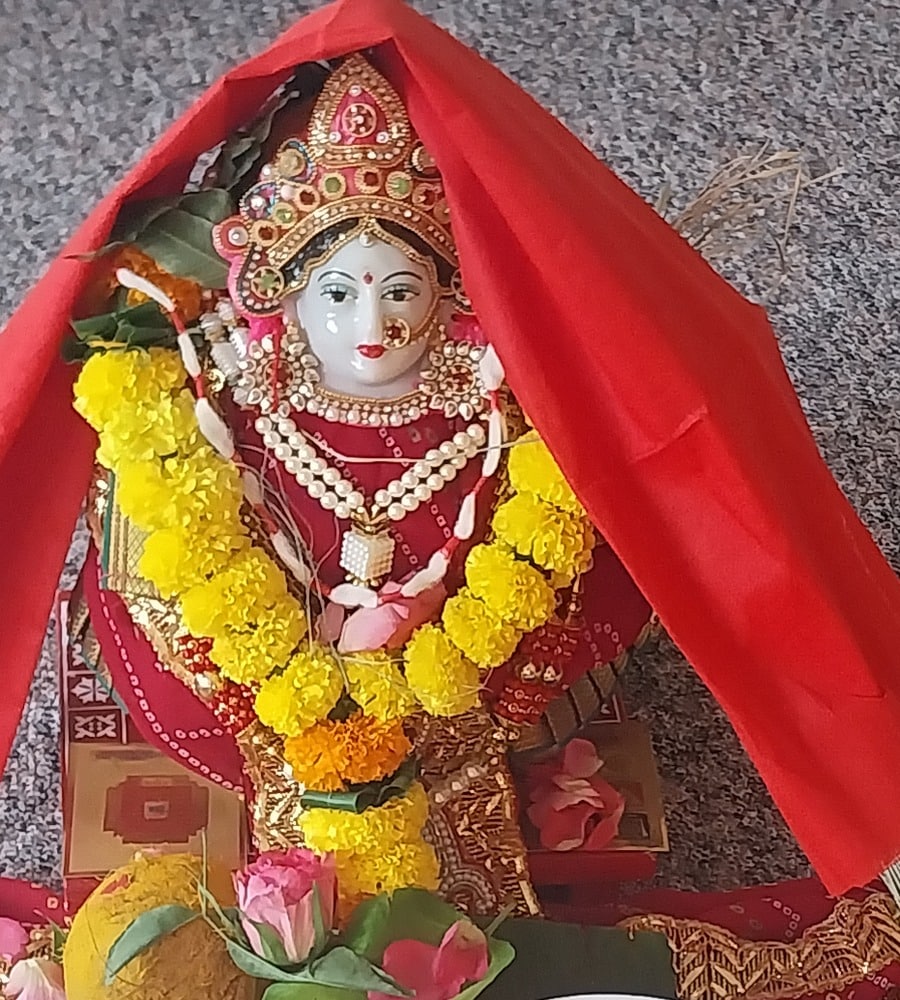
The altar established, the lamp lit, the offerings set out for the first of the nine nights.
Keeping Navratri in Europe is not a matter of transplanting a festival. Navarātri is not a festival in the sense the word carries in English. It is a nine-night observance with an internal architecture, a sequence in which each stage depends on the one before it, and a household that keeps it without knowing that architecture keeps the outward form while missing what the form was built to carry. The autumn observance, Śāradīya Navarātri, falls in 2026 from Sunday 11 October to Vijayadaśamī on Tuesday 20 October, though the exact civil days on which certain tithis fall must be read from a Pañcāṅga computed for one’s own location rather than taken from an Indian one, for reasons set out below.
What follows sets out the structure: what the nine nights are for, why they divide into three groups of three, what is established on the first morning and why it must be established at a calculated hour, what happens in the forty-eight minutes that join the eighth night to the ninth, and what a household in Vienna or anywhere else in Europe can realistically keep across nine consecutive evenings of an ordinary working week.
Why the Nine Nights Divide Into Three
The nine nights are not nine repetitions of one worship. They fall into three triads, and the triads proceed in a fixed order that is the whole logic of the observance. The first three nights are given to Durgā in her fierce aspect, and their work is removal: the clearing away of what obstructs, the accumulated inertia and the habits of mind that make any further progress impossible. The second three are given to Laxmi, and their work is acquisition: once the ground is cleared, what is needed is established in it, the qualities and the substance by which a life is actually sustained. The third three are given to Sarasvatī, and their work is knowledge, which is what the first six were for.
The order cannot be rearranged, and the reason is not arbitrary. Nothing can be established in ground that has not been cleared, and knowledge received into a mind still governed by what the first triad removes does not hold. This is the same sequence the tradition applies elsewhere: purification, then establishment, then realization. Navarātri simply gives it nine nights and a Devatā for each stage. A household that understands this stops asking which night is the important one. They are consecutive stages of a single operation.
Three nights to remove, three to establish, three to know. The observance is not nine days of worship but one process in nine stages.
The Devī Māhātmya and Its Three Narratives
This threefold structure is not a later systematization imposed on the observance. It is drawn from the text that stands at the center of it. The Devī Māhātmya, seven hundred verses embedded in the Mārkaṇḍeya Purāṇa and recited through the nine nights, is itself composed in three Caritas, three distinct narratives, each presided over by one form of the Devī.
The Prathama Carita, the first and shortest, tells of Madhu and Kaiṭabha and belongs to Mahākālī. The Madhyama Carita tells of Mahiṣāsura, the buffalo demon, and belongs to Mahālakṣmī. The Uttama Carita, the longest, tells of Śumbha and Niśumbha and belongs to Mahāsarasvatī. The three Caritas and the three triads of nights are the same division, and a household reciting the text across the nine nights is moving through the narrative and the observance simultaneously. Where the full Saptaśatī cannot be recited, the tradition provides for recitation in portions distributed across the nine days, which is the ordinary practice in households that keep it.
Ghaṭasthāpana: The Kalaśa and the Sown Grain
The observance opens on the morning of Pratipadā with Ghaṭasthāpana, the establishment of the Kalaśa, the vessel in which the Devī is invited to be present for the duration. This is the act that makes the nine nights a single continuous observance rather than nine separate worships, and it is the reason the rest of it holds together.
A bed of earth is laid in a broad vessel and the Sapta Dhānya, seven grains, sown into it. The Kalaśa is set upon or beside this, filled with water, marked, wound with thread, and topped with leaves and a coconut. The Akhaṇḍa Dīpa, the unbroken lamp, is kindled and maintained without extinction for the whole nine nights. Over the following days the sown grain germinates, and the condition of the sprouts at Vijayadaśamī is read as an indication of what the observance has produced. This agrarian element is not decorative. It is the same instinct that runs through the domestic rites generally: the household does not merely petition for growth, it sows something and watches it grow while the petition is being made. In a European October the germination is entirely reliable, since the vessel stands indoors in a heated room.
Ghaṭasthāpana is performed within a calculated window, ordinarily in the first third of the day while Pratipadā is current, avoiding Citrā Nakṣatra and Vaidhṛti Yoga where these fall, with Abhijit Muhūrta serving where the primary window cannot be used. That window is a function of local sunrise, which is the point at which most European households go wrong, and the subject of the next section.
Why an Indian Calendar Gives a European Household the Wrong Hour
A Tithi is not a day. It is the interval in which the Moon gains twelve degrees of elongation from the Sun, and it begins and ends at a moment, not at midnight. Which civil day a Tithi governs is determined by which Tithi is current at sunrise at the place of observance. Vienna’s sunrise in October falls some three and a half hours after Delhi’s. A Tithi that ends shortly after sunrise in India has already ended before sunrise in Austria, and the civil day to which it attaches shifts accordingly.
The practical consequences are concrete. The hour for Ghaṭasthāpana is not the Indian hour converted to Central European Time; it is computed afresh from Viennese sunrise. And a Tithi merger, of the kind reported for 2026 in which Aṣṭamī and Navamī fall on a single civil day in the Indian reckoning, may or may not occur on the same civil day in Europe, since the merger depends on where the Tithi boundaries fall relative to local sunrise. A household following an Indian almanac app on a European phone may keep Sandhi Pūjā on the wrong day and never know. This is one of several reasons the observance benefits from a Pañcāṅga computed for the actual location, which is the ordinary work of Jyotiṣa as it is practiced in Europe.
Sandhi Pūjā: The Forty-Eight Minutes
At the junction of Aṣṭamī and Navamī there falls a window of forty-eight minutes, the last twenty-four of the eighth Tithi and the first twenty-four of the ninth, and this interval is held to be the most concentrated of the entire observance. It is called Sandhi, the joining. The tradition places the decisive moment of the Devī’s victory here, at the seam between two Tithis rather than within either, and the worship offered in this window is regarded as carrying a weight the other nights do not.
Two things follow for a household abroad. The first is that this window is computed, not chosen: it falls where the Tithi boundary falls, which may be at three in the morning as easily as at seven in the evening, and the tradition does not adjust it for convenience. The second is that it is the one point in the nine nights where precision genuinely matters to the minute. A household that can keep only one thing properly should keep this.
Kumārī Pūjā and the Worship of the Living Form
On Aṣṭamī or Navamī, according to regional usage, the household performs Kumārī Pūjā, in which a young girl is worshipped as the Devī present in a living form. She is received, her feet are washed, she is offered cloth, ornament and food, and she is honored as the Devatā rather than as a symbol of the Devatā. The distinction is the whole content of the act. The tradition holds that the divine is not exclusively resident in the consecrated image but is present and worshippable in the living, and Kumārī Pūjā is where a household is required to act on that rather than merely assent to it.
In a European setting this is one of the more straightforward observances to keep, since it requires no ritual apparatus, only a child of the appropriate age from the household or the community and a family willing to treat the act with the seriousness it asks for. It is also, in the experience of most families who keep it, the observance the children themselves remember.
Nine Consecutive Evenings in a European Household
The difficulty in Europe is not doctrinal. It is that nine consecutive evenings fall across an ordinary working week, and in 2026 the observance opens on a Sunday and runs through two full working weeks before closing. A household that plans for a grand nightly worship will keep three nights well and abandon the rest, which is worse than keeping all nine modestly.
The structure that works is a short fixed evening observance on every one of the nine nights, twenty minutes or so, with the fuller worship reserved for the opening, for Aṣṭamī and Navamī, and for Vijayadaśamī. The Akhaṇḍa Dīpa is the one element that must not lapse, and a household in a flat with smoke detection should use an oil lamp in a stable holder in a place where it can burn unattended, which is a matter of siting rather than of compromise. Fasting through the nine days follows regional and family usage and admits of considerable variation; what the tradition asks is restraint maintained without interruption, not severity that collapses on the fourth day.
Where a household wishes the fuller form, the worship of the Devī in her nine forms and the fire offering that some families keep alongside it are conducted as the Durgā Pūjā proper, and the worship of the second triad in its dedicated form as the Laxmi Pūjā.
Vijayadaśamī and the Close of the Observance
The tenth day is not an appendix. Vijayadaśamī is where the nine nights discharge into action, and its observances are all concerned with beginning something. The sprouted grain is taken from the vessel and distributed, worn or given, its condition read. The Devī is formally released from the Kalaśa, the observance closed rather than merely stopped. Śamī Pūjā is kept, and Aparājitā, the unconquered, is invoked.
And two acts are performed that give the day its character. In Āyudha Pūjā the tools of one’s work are cleaned, set before the Devī and honored, on the understanding that the instruments through which a person acts in the world participate in the Devatā’s power and are not merely objects. For a household in Europe these are laptops, instruments, vehicles and the equipment of a trade, and the act is neither quaint nor figurative when performed with that understanding. In Vidyārambha a child is begun in letters on this day, the first characters formed under the presiding of Sarasvatī, whose triad has just closed. A nine-night observance concerned with removal, establishment and knowledge ends by putting a child’s hand to the first letter. The structure closes on itself.
Settle Before the First Morning
Have the Ghaṭasthāpana window computed for your own city rather than taken from an Indian almanac. Confirm on which civil day Aṣṭamī and Navamī fall locally, and at what hour the Sandhi window opens, since these can differ from the Indian reckoning. Decide where the unbroken lamp will stand for nine days before the first one is lit. Obtain the seven grains and the earth in advance; they are needed on the opening morning and not after. Fix a modest nightly form the household can actually sustain for nine consecutive evenings, and reserve the fuller worship for the opening, the eighth, the ninth and the tenth.
A household keeping the nine nights in Europe is not keeping a reduced version of something happening properly elsewhere. The Kalaśa established in a Viennese room is established; the Tithi is the Tithi; the grain sown in that vessel germinates on the same schedule it germinates on anywhere. What the observance asks for is continuity across nine nights and precision at the points where precision is asked, and both of these are entirely available to a family in a flat in central Europe who understand what they are undertaking.
yā devī sarvabhūteṣu śaktirūpeṇa saṃsthitā
namas tasyai namas tasyai namas tasyai namo namaḥ
“The Devī who abides in all beings in the form of power: to her salutation, to her salutation, to her salutation again and again.”
DEVĪ MĀHĀTMYA, CHAPTER 5 · THE HYMN OF THE DEVAS
The refrain repeats through the hymn with a single word changed each time, naming the Devī as she abides in all beings as consciousness, as intelligence, as sleep, as hunger, as forbearance, as error. The construction is deliberate. What is worshipped through the nine nights is not a being located elsewhere and petitioned from a distance, but that which is already constituting the one who petitions.
Primary sources: the Devī Māhātmya, chapters 81 to 93 of the Mārkaṇḍeya Purāṇa, in its three Caritas; with the text and the Navarātri liturgy gathered at Sanskrit Documents. Tithi, Nakṣatra and Muhūrta timings must be computed for the place of observance and not taken from a calendar prepared for another longitude.
© 2026 AUSTRIAVIENNAPUJA.COM · SANĀTANA DHARMA IN EUROPE
Preserving authentic Vedic transmission across the European continent