
Vivāha | Rite and Custom
Haldi, Mehndi and Sangeet: Rite or Custom?
On the events that gather around a Hindu wedding: which of them belong to the Vedic rite, which are the custom of a family or a region, why the tradition itself makes room for custom, and how to plan the days in Europe.
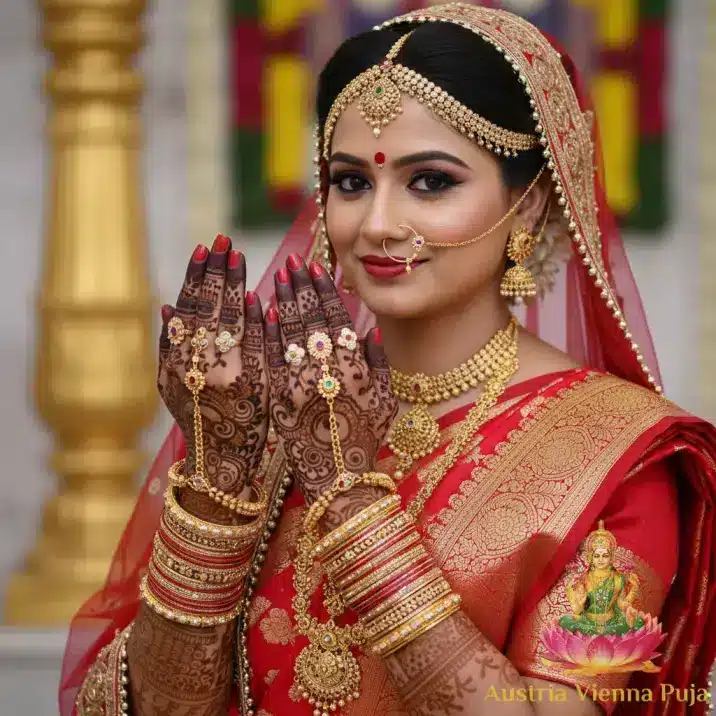
Mehndi belongs to the bride’s adornment, a custom of great beauty, though not part of the rite.
Written by Pandit Sahadev, Vedic priest and pandit in charge of ceremonies at Radha Govinda Math, Traiskirchen
Couples planning a wedding in Europe often send a schedule before they send anything else. Haldi on the first morning, Mehndi that evening, a Sangeet the next night, and the Vivāha on the final day. The question that follows is a good one: which of these events need a priest, and which of them belong to the Vedic rite at all?
The short answer is that only the Vivāha is the rite. The longer answer is more interesting, because the tradition does not treat custom as an intruder. It names custom, makes room for it, and draws a clear line between what may vary and what may not.
What the Tradition Says About Custom
The Āśvalāyana Gṛhya Sūtra, one of the manuals of the domestic rites belonging to the Ṛgveda, opens its account of the wedding with a remarkable admission. The customs of the different lands and of the different villages vary widely, it says, and these one should follow at the wedding. Then it adds: what is common to all, that we shall state.
In two short sentences the text does two things. It grants custom a real authority, so that a family’s way of celebrating is not a deviation to be corrected. And it marks out a core that does not belong to any one region: the acts the sūtra goes on to describe, which every Vivāha must contain.
Custom is honored, not merely tolerated. But it surrounds the rite; it does not replace it.
The Core That Does Not Vary
What the sūtra calls common is a short and exact sequence. The groom takes the bride’s hand. Offerings are made into Agni, among them the parched grain of the Lāja Homa. The couple circle the fire, the bride steps on a stone, and the seven steps of the Saptapadī are taken together. Afterward the bride is shown the pole star and the star Arundhatī as images of constancy. The later Dharmaśāstra places the Kanyādāna, the giving of the bride by her family, at the opening of this sequence.
The Manusmṛti states plainly when the sequence completes the marriage: at the seventh step. Everything else at a wedding, however joyful, happens around these acts. What they are and why each matters is set out in what makes a Hindu wedding authentic and, for the ceremony itself, in how two people are made a household.
Haldi: Turmeric Before the Bath
Haldi is the anointing of the bride and groom with a paste of turmeric before a ceremonial bath. Turmeric, haridrā, has long been counted among auspicious substances, and the anointing prepares the body for the rite in the way a bath prepares it for any pūjā.
Its forms are regional. North Indian families call it Haldi; Gujarati and Rajasthani families often call it Pithi; in Telugu homes the turmeric ceremony is called Nalugu. These differences are exactly the customs of lands and villages the sūtra had in mind. Haldi is not among the acts the Gṛhya Sūtras set out, and it needs no priest, though some families like to open the morning with a short Gaṇeśa pūjā.
One practical note for Europe: turmeric stains. Hotels and villas often have rules about it, and the Haldi is best held outdoors or in a room where yellow marks will not become an argument with the venue.
Mehndi: Adornment, Not Rite
Mehndi is the painting of the hands and feet with henna, chiefly for the bride, in designs that can take hours to complete. It belongs to the bride’s adornment, the śṛṅgāra that dresses her for the day, alongside her jewelry, her bangles and her clothes. Henna is used for celebrations far beyond the Hindu world, across South Asia, the Middle East and North Africa, and the Mehndi evening is shared by families of many faiths.
No mantra is spoken over the henna, and no Gṛhya rule governs it. That does not make it trivial. Custom carries meaning of its own, and the old practice of hiding the groom’s initials in the design, for him to search for later, is a small piece of play that the rite itself would never contain. Mehndi needs no priest; it needs a good artist and time.

Sangeet: The Songs of the Household
The Sangeet grew from the songs sung by the women of the household in the days before a wedding: songs of teasing, blessing and farewell, passed down without books. In recent decades, especially among North Indian and Punjabi families, it has grown into an evening of rehearsed dances and performances by both families.
Its spirit is joy, and joy at a wedding is fitting. The Sangeet is custom in the fullest sense the sūtra intends, a way of celebrating that belongs to a people rather than to the rite. It needs no priest, and a priest who tried to turn it into a ceremony would misunderstand it.
Customs That Entered the Rite
Some customs have traveled further, from the edge of the wedding into the ceremony itself. The exchange of garlands, the Varamālā, is now part of nearly every North Indian Vivāha. The tying of the maṅgalasūtra, regarded in many regions, and above all in the south, as the very sign of a married woman, is not among the acts the Gṛhya Sūtras set out; it entered through later regional practice and became, for millions of families, inseparable from marriage. The same is true of the sindūra placed in the parting of the bride’s hair.
These customs are kept within the rite, at their proper place in the family’s tradition, and they are kept with full seriousness. The sūtra’s instruction to follow the customs of one’s land applies to them precisely. What they do not do is replace the core: a wedding with a maṅgalasūtra but no Saptapadī is not a complete Vivāha, whatever else it may be.

Other Events Around the Wedding
The same distinction runs through the rest of a wedding calendar. Some preliminaries do have a place in the ritual manuals. Vāgdāna, the formal betrothal in which the families give their word, is one of them, and in many families it is kept with a short pūjā well before the wedding day. Many brides also worship Gaurī before the Vivāha, asking the goddess for a long and happy married life, a custom kept with particular care in Maharashtra and in the south.
Others belong wholly to custom. The Baraat, the groom’s procession to the wedding on horseback or in a car, with music and dancing relatives, is one of the great pleasures of a North Indian wedding and has no place in the Gṛhya Sūtras at all. Neither do the games that follow the ceremony, such as hiding the groom’s shoes and asking a price for their return. These are customs of lands and villages in exactly the sūtra’s sense, and they deserve to be enjoyed as such.
Why the Distinction Matters
Knowing which events are rite and which are custom is not pedantry. It tells a family where its care must go. When time, money or venue space are limited, as they often are for weddings abroad, the custom events can be shortened, combined or moved without harm. The Vivāha cannot, because it is the marriage itself.
It also protects against the opposite mistake. A wedding weekend can be so full of celebration that the rite at its center shrinks to a short blessing between the photographs and the dinner. Families sometimes realize only afterward that the garlands were exchanged and the photographs taken, but the seven steps were hurried or left out. The distinction prevents that.
And it allows each family’s customs to be honored without argument. A grandmother who wants the Haldi kept in her village’s way is asking for something the sūtra itself approves. A priest who respects that, while holding the core of the rite unchanged, is doing exactly what the text asks.
Planning the Days in Europe
For couples marrying in Europe, the practical consequence is simple. The events of custom can move: the Haldi can shift to fit a venue’s rules, and the Sangeet can take whichever evening suits the guests’ travel. The Vivāha is the one event that should not be squeezed. It is held at the hour fixed by Muhūrta, it needs a venue that permits a real fire, and it needs enough time for every act to be performed in order.
Questions of venue are treated in choosing a European venue for a Hindu wedding, and regional settings in Hindu wedding destinations in Europe. Whatever is planned around it, the Saptapadī is not shortened to make room for a dinner.
Dance at the Sangeet and wear the mehndi with joy. Then come to the fire, where the marriage is made.
atha khalūccāvacā janapadadharmā grāmadharmāś ca
tān vivāhe pratīyāt
“Various indeed are the customs of the lands and the customs of the villages; these one should follow at the wedding.”
ĀŚVALĀYANA GṚHYA SŪTRA · 1.7.1
These words open the wedding chapter of a Gṛhya Sūtra of the Ṛgveda. They are followed at once by the promise to state what is common to all, and the rest of the chapter does exactly that. Custom and rite are held together in a single breath, each in its place.
The account given here rests on the domestic-rite literature of the tradition, principally the Āśvalāyana Gṛhya Sūtra, with the teaching on the seventh step drawn from the Manusmṛti. Regional names and customs vary from family to family; those given here are the forms most often met among families in Europe.
© 2026 AUSTRIAVIENNAPUJA.COM · SANĀTANA DHARMA IN EUROPE
Preserving authentic Vedic transmission across the European continent