
Śākta Āgama and the Devī Māhātmya
The Goddess, the Text, and the Nine Nights
What the Śākta tradition claims for the Devī, how the Saptaśatī is structured and recited, the days of the observance and the junction at its center, and how the calendar falls in Europe.
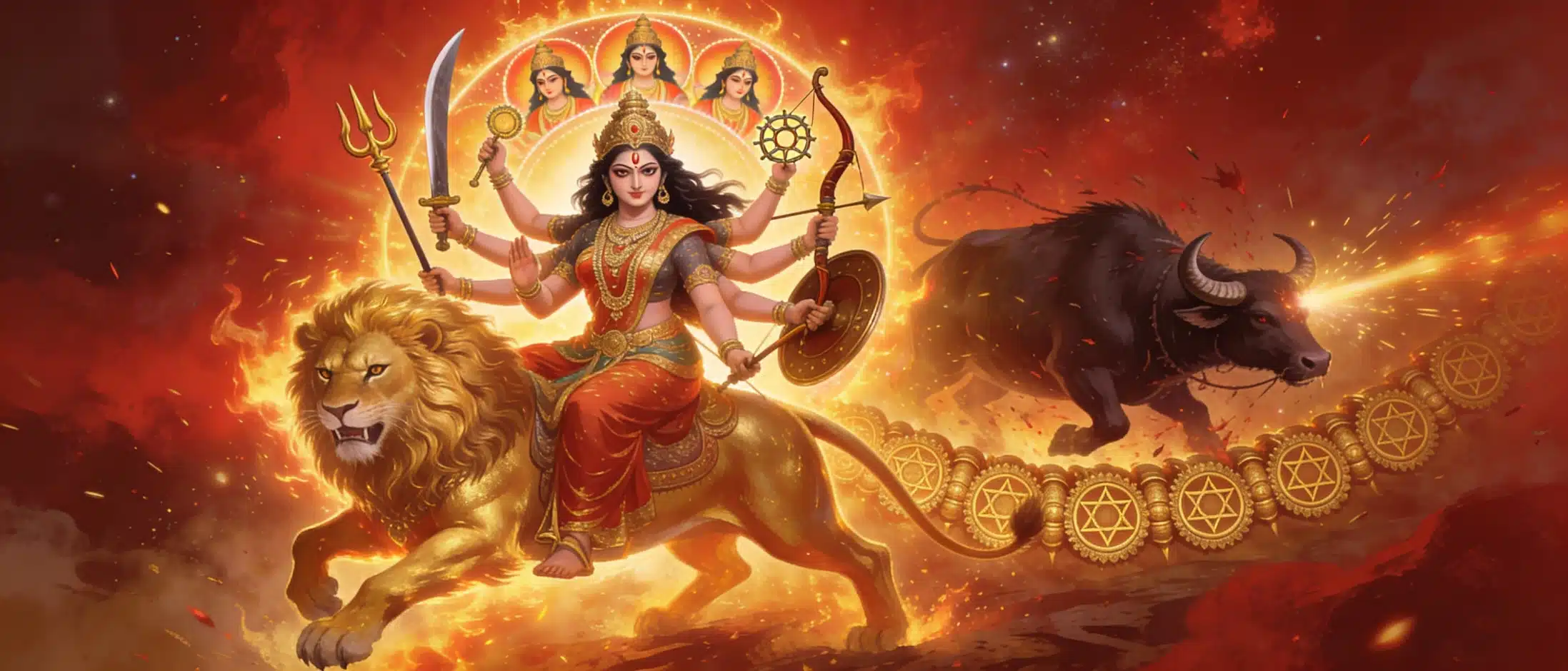
Mahiṣāsura Mardinī, formed from the combined radiance of all the gods.
Written by Pandit Sahadev, Vedic priest and pandit in charge of ceremonies at Radha Govinda Math, Traiskirchen
Durgā Pūjā in the Śākta tradition rests on the Devī Māhātmya, the seven hundred verses preserved within the Mārkaṇḍeya Purāṇa and known independently as the Durgā Saptaśatī. The text is treated not as a narrative to be read but as a Mantra to be recited, with its own preliminary limbs, its own seed syllables and its own prescribed count. Understanding that is the difference between attending the observance and keeping it.
What follows sets out the doctrinal position, the structure of the text and the method of its recitation, the nine forms and what may honestly be claimed for the scheme that maps them, the two quite different observances that share the name, the sequence of the days, and the practical question of how the calendar falls for a household in Europe.
What the Śākta tradition claims for the Devī
The popular framing makes her the consort of Śiva or a regional deity of the eastern subcontinent. Śākta theology says something considerably stronger: she is the Absolute. Not a power among powers but the ground from which the powers arise, the energy that precedes manifestation, that animates the gods, and that withdraws the cosmos at the close of a cycle.
The name derives from a root indicating a fortress or a place difficult of access. She is the refuge of those who keep Dharma and the impassable barrier against what opposes it. At the deepest level the texts name her Mahāmāyā, the power of appearance that holds the unliberated in the world. Yet the same power, propitiated, discloses itself as Mahāvidyā, the knowledge by which the appearance is seen through. The one who binds is the one who frees, and the whole tradition turns on that identity rather than on any resolution of it.
The Vedic root: the Devī Sūkta
The claim has a Vedic anchor, which matters because the worship is often dismissed as a later Purāṇic development. Ṛgveda 10.125, the Devī Sūkta, is spoken in the first person by the Ṛṣikā Vāgāmbhṛṇī, daughter of the sage Ambhṛṇa, and it is the goddess speaking through her.
She declares that she moves with the Rudras and the Vasus, that she bends the bow for Rudra to strike, that she brings forth the father at the summit of this world, and that she pervades all worlds while touching the sky with her crown. Nothing in the hymn is petitionary. It is a declaration of identity with the whole, spoken in the voice of the speech-principle itself, and it is why the Śākta tradition can claim continuity with Śruti rather than descent from it. The Devī Sūkta is recited before the Saptaśatī in most transmissions for precisely this reason.
Suratha and Samādhi: why the text begins where it does
The Saptaśatī opens not with the Goddess but with two men in distress, and the frame is doctrinally load-bearing rather than ornamental.
King Suratha has lost his kingdom to enemies and to the treachery of his own ministers. Samādhi, a merchant, has been driven out by his wife and sons for his wealth. They meet at the hermitage of the sage Medhas, and both find that their minds remain fixed in longing for the very people and possessions that betrayed them. Suratha still worries whether his elephants are well cared for. Samādhi still wishes his family well.
Their question to the sage is the question of the entire text: knowing the attachment is irrational, why does the mind not release it? Medhas answers that this holding is the direct working of Mahāmāyā, that it binds the wise and the ignorant alike, and that what is needed is not a stronger effort against the illusion but recourse to the one who casts it. Everything that follows, all three accounts of the Goddess in battle, is offered as the answer to two men asking why they cannot stop wanting what has already destroyed them.
The text does not begin with a cosmic battle. It begins with a king who cannot stop worrying about his elephants, and the tradition holds that this is the same problem at a smaller scale.
The three Caritas
The seven hundred verses divide into three Caritas, three accounts, and the division is structural rather than editorial. Each has its own presiding form, its own Guṇa, its own seer and meter, and its own seed syllable.
The Prathama Carita is chapter one alone. Madhu and Kaiṭabha arise while Viṣṇu sleeps upon the cosmic waters, and Brahmā praises Yoganidrā, the sleep that holds him, to withdraw so that Viṣṇu may wake. The presiding form is Mahākālī and the Guṇa is Tamas. For the practitioner this is inertia and the ignorance that will not lift by effort, since the one bound cannot wake himself.
The Madhyama Carita runs chapters two through four. Mahiṣāsura, invincible to any male deity by boon, has taken the seat of Indra, and the gods release their combined radiance, from which Durgā takes form. The presiding form is Mahālakṣmī and the Guṇa is Rajas. The demon is ungoverned ambition and appetite, and the invocation of Mahiṣāsura Mardinī is the request that this be severed in oneself.
The Uttama Carita runs chapters five through thirteen and is the longest. Śumbha and Niśumbha are defeated with the emanation of the Mātṛkās and of Kālī, and at the decisive moment the Goddess withdraws all her emanations back into herself, telling Śumbha that she is alone in the world and there is no second. The presiding form is Mahāsarasvatī and the Guṇa is Sattva. The obstruction here is spiritual pride, the subtlest of the three, and the teaching is exact: it is not overcome by any power but dissolved in non-duality.
The Bīja Mantras and the three deities
Each Carita carries a seed syllable, and this is the most technical feature of the text and the one most often left out of accounts of it.
Aiṃ is the Bīja of the first Carita, the syllable of Sarasvatī and of speech. Hrīṃ is the Bīja of the second, the Māyā seed. Klīṃ is the Bīja of the third, the seed of attraction associated with Kālī. Together they compose the Mantra by which the text as a whole is approached.
Each Carita also has its stated Ṛṣi, its meter and its presiding deity, declared in the Viniyoga spoken before recitation: Brahmā as seer of the first with Mahākālī as its deity, Viṣṇu of the second with Mahālakṣmī, and Rudra of the third with Mahāsarasvatī. A reciter states these before beginning, in the same way the Ṛṣi and meter of any Mantra are stated, because the tradition does not permit a Mantra to be spoken without acknowledging through whom it came.
How the Saptaśatī is actually recited
The seven hundred verses are not recited on their own, and a household should know this before undertaking the practice. Three limbs precede them and one follows.
The Kavaca, the armor, invokes protection over the parts of the body. The Argalā, the bolt, opens what is closed. The Kīlaka, the pin, releases the seal that the tradition holds was placed upon the text by Śiva to restrict its use. The tradition is explicit that recitation without these limbs does not carry, and the Kīlaka in particular is described as removing an actual impediment rather than serving as a preface.
Before the recitation proper comes the Devī Sūkta or the Rātri Sūkta, then the Nyāsa placing the seed syllables and the limbs of the text upon the body, then the Dhyāna verses for the Carita to be recited. Afterward come the Siddha Kuñjikā Stotra and the closing Kṣamā prārthanā, the request for pardon for whatever was misspoken.
On the count, transmissions differ and a household should take its own. Common patterns over the nine nights include one complete recitation of all thirteen chapters daily, or the division of the text across the nights, or a full recitation on each of the three principal days. Where the full text cannot be recited, the Siddha Kuñjikā is prescribed in several transmissions as standing in its place, which is a provision worth knowing rather than a shortcut to be assumed.
The Navadurgā, and an honest word about the chakra scheme
The nine forms worshipped across the nine nights are named in the Devī Kavaca and are these, in order: Śailaputrī, daughter of the mountain; Brahmacāriṇī, the ascetic; Candraghaṇṭā, bearing the crescent as a bell; Kūṣmāṇḍā, from whose slight smile the cosmic egg is said to have issued; Skandamātā, mother of Skanda; Kātyāyanī, born in the hermitage of the sage Kātyāyana and the form that slays Mahiṣa; Kālarātrī, the dark night; Mahāgaurī, the radiant; and Siddhidātrī, giver of attainment.
The scheme that assigns each form to a chakra, ascending from the base to the crown across the nine nights, is widely taught and worth naming for what it is. It is a devotional and yogic overlay of relatively recent currency, not a correspondence found in the Devī Māhātmya or in the Kavaca that names the nine. An article claiming Śāstric grounding should not present it as classical. That said, nothing about it is objectionable, it is coherent within its own frame, and a practitioner who finds it useful may keep it. What the older sources give is the sequence of nine forms and their iconography, and that is enough to be going on with.
Two observances under one name
This confuses European households constantly, because families from different regions describe quite different things using the same words.
The Bengali and eastern Durgā Pūjā centers on a clay image of the Goddess with her four children, made new each year, worshipped for the principal days and immersed at the close. It runs formally from Ṣaṣṭhī to Daśamī, opens with Bodhana, the awakening of the Goddess in the bilva tree, and treats the whole as a visit: she arrives, is received, and departs.
The Smārta and western Navarātrī centers on the Kalaśa established on the first tithi and maintained nine days, with a different one of the nine forms worshipped each night and no clay image. In the south the observance takes further distinct forms, including the arrangement of figures in the home and the worship of implements and instruments near its close.
Both are complete and neither is a deviation. A household should keep the form of its own tradition rather than a composite, and should establish which that is before engaging an officiant, since the preparation differs materially.
The days of the Pūjā
The principal observance is the Śāradīya Navarātrī, in the bright fortnight of Āśvina, falling in late September or October. A second, the Vāsantī Navarātrī, falls in Caitra in spring and is the older of the two in the reckoning of the texts. The autumn observance is called the Akāla Bodhana, the untimely awakening, because Rāma is held to have invoked the Goddess out of season before the battle at Laṅkā.
Mahālayā, on the new moon preceding, closes the fortnight of the ancestors and marks the beginning of the Devī’s approach. Ṣaṣṭhī brings Bodhana and the unveiling of the image where one is used. Saptamī brings the installation of the nine plants bound together as the Navapatrikā and the infusion of life into the image. Aṣṭamī is the day of the fullest worship. Navamī carries the principal oblation. Daśamī is Vijayā Daśamī, the day of departure, of immersion where an image is used, and of the exchange of greetings that closes the observance.
Sandhi Pūjā
The most charged moment of the observance is not a day but a junction. Sandhi Pūjā is performed across the final twenty-four minutes of the Aṣṭamī tithi and the first twenty-four minutes of the Navamī, forty-eight minutes in total, and it is at this junction that the Goddess is held to have taken the form of Cāmuṇḍā to destroy Caṇḍa and Muṇḍa.
A hundred and eight lamps are lit and a hundred and eight lotuses offered in the fuller observance. The timing is not approximate. It is computed from the tithi, and the tithi is computed for the location, which is exactly why it cannot be taken from a calendar printed for Kolkata and used in Vienna.
Households outside Bhārata miss this junction more often than any other element of the observance, usually because the timing was taken from an Indian almanac. The remedy is simple: have the tithi computed for your own coordinates, and settle the hour with your officiant well before the day.
The mechanics of the rite
The rite proceeds under the Śākta Āgama and requires an officiant holding the transmission for these Mantras, whose formation is described in the account of the lineage a priest stands within.
It opens with the Saṅkalpa, declared by the householder, naming the time, the place, the household and the purpose. Then the Kalaśa Sthāpana: a vessel filled with water, with the prescribed herbs, soils, grains and metals, mango leaves at the mouth and a coconut above, established at its station and invoked with the Āvāhana Mantras so that it becomes the seat of the Goddess for the duration. Beside it the Akhaṇḍa Jyoti, the lamp that is not allowed to go out through all nine nights, which is a practical undertaking in a household and should be planned for rather than improvised.
Daily worship follows the sixteenfold service, each offering carrying an inward sense alongside the outward one: the seat that makes room, the water that clears, the sandal and flowers, the incense, the lamp, the food returned. The recitation of the Saptaśatī culminates for many households in the Caṇḍī Homa, in which the verses are offered into fire, with oblation made at intervals through the text and the full final oblation at its close. The conduct of such fire rites is treated in the account of Pūjās and Homas.
Keeping Navarātrī in Europe
The doctrinal question is settled quickly and the practical ones are the real difficulty. The Devī Māhātmya locates the Goddess as the intelligence within all beings and the substance of the world, so no geography excludes her, and the rite holds where it is correctly performed. What distance asks for is more care rather than less.
Four specifics matter. First, the tithis are computed for the location, so Ṣaṣṭhī through Daśamī and above all the Sandhi junction fall at Vienna’s own reckoning, not at an Indian one, and the difference is frequently several hours. Second, the autumn observance lands in late September or October, which places Aṣṭamī and Navamī inside a European working week in most years, so the household should determine early which observances it can keep at their proper hour and which must be adjusted. Third, the unbroken lamp needs a plan for nine days in an apartment, and a contained oil lamp in a safe station with someone responsible for it is the ordinary arrangement. Fourth, where a Homa forms part of the observance, the fire and the building’s rules should be settled before the day.
Where the seasonal observances and the wider body of the Hindu Saṃskāras are kept with this kind of attention, nothing is lost by the distance. The Kalaśa established at the right tithi in Vienna is the Kalaśa the texts describe.
Nine nights, three accounts, one Goddess who binds and frees by the same power, asked to unweave what she wove.
ahaṃ rudrebhir vasubhiś carāmy ahaṃ ādityair uta viśvadevaiḥ ।
ahaṃ mitrāvaruṇobhā bibharmy ahaṃ indrāgnī ahaṃ aśvinobhā ॥
I move with the Rudras and the Vasus, with the Ādityas and all the gods. I bear both Mitra and Varuṇa, I bear Indra and Agni, I bear both the Aśvins.
Ṛgveda 10.125.1 · Devī Sūkta
The verse does not ask. It states, and the grammar is what carries the doctrine: not that the gods are served by her but that she bears them. A tradition that opens its worship with a hymn in which the Goddess declares herself the support of Indra and Agni has already answered the question of her rank before any Purāṇa is opened. Everything in the Saptaśatī, and everything performed across the nine nights, is an elaboration of a claim the Ṛgveda had already put in her own mouth.
For further study: on the three Caritas, the Bīja Mantras and the preliminary limbs, the Mārkaṇḍeya Purāṇa containing the Devī Māhātmya; on the Vedic declaration of the Goddess, Ṛgveda 10.125; with the Śākta Stotras and the Kavaca, Argalā and Kīlaka gathered at Sanskrit Documents and scholarship on goddess worship through the Oxford Centre for Hindu Studies.
© 2026 AUSTRIAVIENNAPUJA.COM · SANĀTANA DHARMA IN EUROPE
Preserving authentic Vedic and Āgamic transmission across the European continent