Vivāha | The Agrarian Rite Among the Vines
Indian Wedding in Tuscany: The Harvest Rite
What the marriage Mantras actually ask for, why a farming landscape answers them, and the practical work of keeping the rite in Tuscany: the estates, the season, the Muhūrta problem nobody mentions, the Italian legal position, and the cost.
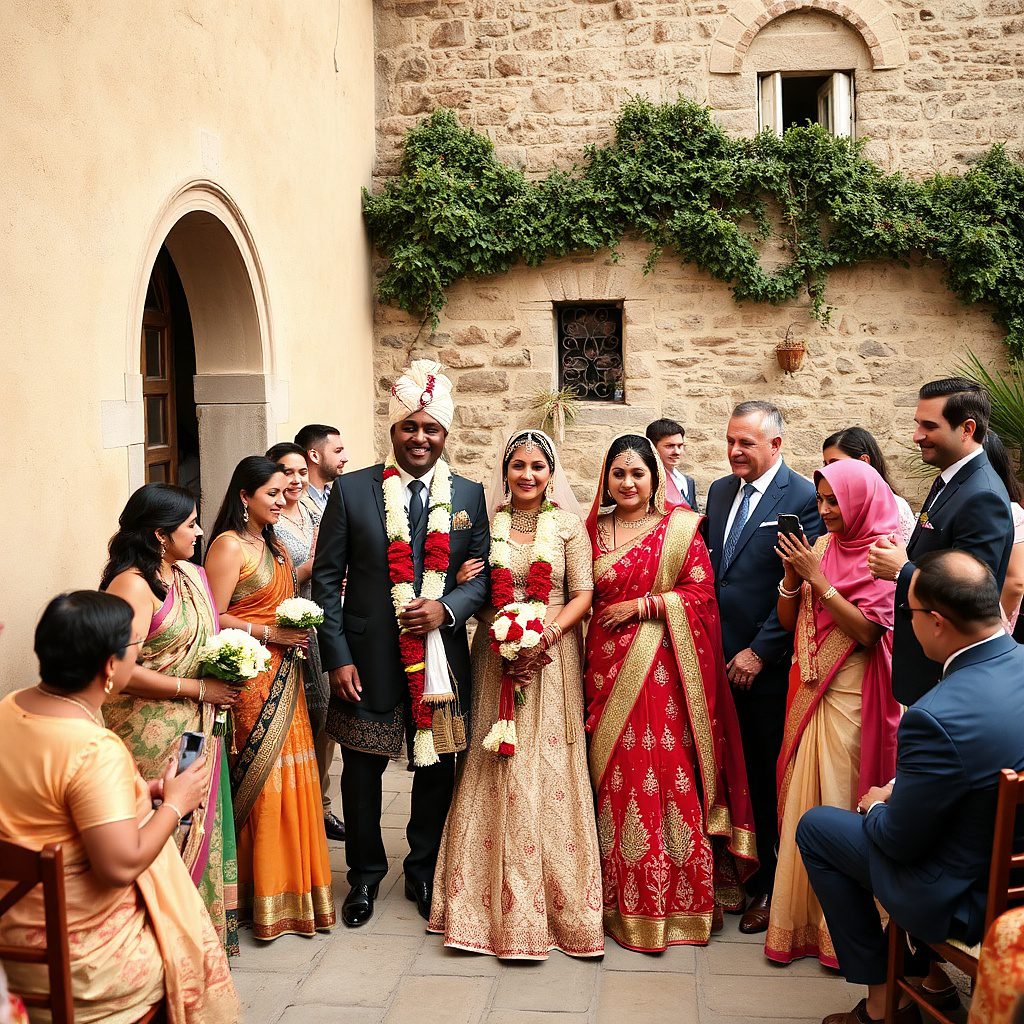
Agni established at a Tuscan estate, the offerings prepared and the rite under way.
An Indian wedding in Tuscany sets a rite composed inside an agricultural year into a landscape that has never stopped keeping one. That is not a decorative observation. The older strata of the marriage service ask, in unambiguous words, for sap, for vigor, for livestock, and for the seasons to hold their order. These are the petitions of people whose continuance depended on a harvest, and they were not written as metaphor. Tuscany is one of the few places in Europe where a family can make those petitions while standing inside a working agricultural economy rather than a preserved image of one. The vines are cropped for wine that is sold. The olives are pressed in November. The estates are farms before they are venues.
Most treatments of a Hindu wedding in Tuscany begin with the scenery and reach for the rite afterward as ornament. The order is worth reversing. If one reads what the Gṛhya Sūtras actually prescribe, and reads the Mantras in Sanskrit rather than in the smoothed English that circulates, the agrarian character of the Vivāha stops being an interpretive flourish and becomes the plain sense of the text. A Tuscan celebration is then not a pretty backdrop for an Indian ceremony. It is a rite returned, briefly, to the kind of world it came out of.
A Rite Composed Inside an Agricultural Year
The domestic rites are set down in the Gṛhya Sūtras, the manuals that govern the household fire and everything performed at it. The Pāraskara Gṛhya Sūtra, which regulates the Vivāha for households of the Śukla Yajurveda, does not treat marriage as a separate genre of observance. It sits in the same manual, often within a few sections, as the rite performed at the first plowing, the offering at the threshing floor, the observance kept when the new grain is first eaten, and the seasonal offerings that mark the turn of the year. The wedding is one item in a calendar of agricultural and domestic acts, and it borrows that calendar’s vocabulary throughout.
Even the name of the Vedic branch carries the theme. The commentator Sāyaṇa derives Vājasaneya, from which the Vājasaneyī Saṃhitā takes its name, from vāja in the sense of grain, the Ṛṣi liberal in grain. Whether or not one accepts the etymology, it indicates how naturally the tradition associated its ritual vocabulary with sustenance. The doctrinal architecture of the marriage rite itself, its sequence and its internal logic, is set out in the dedicated treatment of the Vivāha Pūjā.
Iṣe tvā, Ūrje tvā: The First Words of the Yajurveda
Both surviving streams of the Yajurveda, the Śukla and the Kṛṣṇa, open with the same two phrases: iṣe tvā, ūrje tvā, for sap thee, for vigor thee. The formula is spoken while a branch is cut, and the passage that follows concerns the cows, their milk, their freedom from disease, and closes by asking protection for the livestock of the sacrificer. The entire Veda of ritual formulae, the Veda from which the priest’s operative Mantras are drawn, begins with a pastoral utterance made over fodder.
This matters at a wedding because the first two steps of the Saptapadī, the seven steps that complete the marriage, are those same two words. Ekam iṣe, one for sap. Dve ūrje, two for vigor. When a couple takes the first two of the seven steps, they are reciting the opening line of the Yajurveda, a line first spoken over a cut branch in a field. The Vivāha does not merely resemble an agrarian rite. At its most decisive moment it quotes one.
The marriage is sealed with the same words that open the Veda of sacrificial formulae, and those words were first spoken in a pasture.
The Lāja Homa and the Bride’s Handful of Grain
The central offering of the wedding is the Lāja Homa, made with lāja, grain parched over heat until it bursts, ordinarily rice or barley. The Pāraskara Gṛhya Sūtra assigns the pouring to the bride’s brother, or to whoever stands in that relation where there is no brother: he fills her joined hands, and she offers the grain into Agni, in several traditions with the groom’s hands resting over hers. The accompanying verses ask for the long life of her husband and the flourishing of her own kin, so that the offering carries a petition running in two directions at once, toward the household being founded and back toward the household being left.
One detail repays attention. What is offered is not raw seed but grain already parched, already made edible. The rite does not offer potential. It offers realized nourishment, the harvest brought to the point where it sustains someone. Read that way, the Lāja Homa is not a prayer that the couple may one day have enough. It is a prayer offered out of sufficiency already in hand, which is the posture the tradition consistently prefers for its petitions. A September estate in Chianti, with the fruit coming off the slopes while the grain goes into the fire, states that posture more clearly than any indoor venue can.
The Seven Steps, as the Texts Actually Have Them
The list of seven vows that circulates in English, nourishment, strength, prosperity, happiness, children, seasons, friendship, is a smoothed rendering. The Sanskrit is more specific and, for the present purpose, more interesting. Pāraskara gives the sequence as ekam iṣe, dve ūrje, trīṇi vratāya, catvāri mayobhavāya, pañca paśubhyaḥ, ṣaḍ ṛtubhyaḥ, with the seventh addressed to the bride as companion, sakhe saptapadā bhava, and the formula “may Viṣṇu lead thee” appended at each step. The Āśvalāyana recension, followed by Ṛgvedic households, differs only slightly, and reads sakhā saptapadī bhava.
Two of these deserve to be read without softening. The fifth, pañca paśubhyaḥ, is commonly given in English as a prayer for children. The word is paśu, and in the Sūtra literature it means livestock: cattle, the measure of a household’s substance. English renderings shift it to progeny because the agricultural sense embarrasses a modern ceremony. The sixth, ṣaḍ ṛtubhyaḥ, is a vow toward the seasons, and it is not figurative either. The couple undertakes to live in accord with the turning year, which for the households that composed this rite meant sowing, waiting, and reaping when the year said so and not when it suited them.
The recensions differ because the Gṛhya tradition is not a single script. Which wording is correct depends on which Śākhā the family belongs to, and a competent officiant follows the family’s own branch rather than a generic order assembled from several. This is a fair question to put to any priest before the day is fixed, and the training that stands behind such a distinction is described in the account of the Vedic lineage a Hindu priest stands within.
The Stone and the Unmoving Star
Two further acts in the sequence bear on where in Tuscany a family holds the rite. In the Aśmārohaṇa the bride sets her foot upon a stone while the verse asks that she be firm as that stone against whatever presses on the household. Tuscan estates are built of stone quarried within sight of themselves, and there is a plain rightness in performing this act on ground of that kind rather than on a hotel floor.
The second is Dhruva darśana and the viewing of Arundhatī, performed after nightfall, in which the couple is shown the pole star and the faint companion star in the Great Bear, the one immovable and the other inseparable. These require a visible sky. In a lit ballroom or a city courtyard the act is narrated rather than performed, which is a quiet loss most families never notice. The Chianti and Val d’Orcia hills carry little light pollution, and on a clear night in late spring or early autumn both are genuinely visible. That is a substantive argument for a rural estate over an urban one, and worth raising with the venue when the evening schedule is discussed.
Where in Tuscany the Rite Sits Best
The Florence countryside, within thirty to forty-five minutes of the city, holds historic estates that combine access to Florence with the quiet of the surrounding hills. Staff at these properties are generally familiar with the Maṇḍapa and with a contained ceremonial fire. Venue hire commonly falls between thirty and sixty thousand euros, with a full-service celebration of one hundred to one hundred and fifty guests between fifty and one hundred thousand.
Siena and the Chianti hills are the stronger choice where the agrarian landscape is meant to be the setting rather than the view. Villas here sit within working vineyards, harvest activity visible from the celebration itself, and on many estates the owning family lives on site. Venue hire commonly runs twenty-five to fifty-five thousand euros, full service forty to ninety.
The wider countryside, including the Val d’Orcia and the Maremma, offers manor houses and Renaissance properties available for exclusive weekend hire, frequently with accommodation on the grounds. Venue hire twenty to fifty thousand euros, comprehensive arrangements thirty-five to eighty. Exclusive hire gives a multi-day celebration a self-contained quality a shared property cannot. The criteria by which a European property should be judged for a rite of this kind are set out separately in the note on choosing a European venue, and the wider Italian picture in the account of Hindu wedding ceremonies in Italy.
These figures are indicative ranges for early planning only. They vary considerably by property, season, and guest count, and should be confirmed directly with the venue and suppliers.
Reaching the Tuscan Countryside
Florence has its own airport, serving short-haul European routes, and Pisa, roughly ninety minutes from the Chianti country by road, carries a wider range of connections. Guests arriving from further afield generally come through Rome or Milan and continue by fast train to Florence, which most find a more restful arrival than a connecting flight. A guest list assembled from several countries will converge through more than one of these, so naming the intended airport plainly on the invitation prevents a good deal of confusion.
Once in Tuscany the estates sit along hill roads that public transport reaches only loosely, so transfers between lodging and venue are better arranged for the party than left to individual guests, particularly after dark on unlit country roads. A property with rooms on the grounds for the immediate families and nearby agriturismi for the wider party keeps that burden light, which is a reason to weigh accommodation when the venue is chosen rather than after.
The Days Before the Wedding Day
The Haldi, the Mehndi, and the Sangeet, the turmeric anointing, the henna evening, and the night of music, are where two families that may have met only briefly actually become acquainted. Tuscan villas with gardens and interior courtyards accommodate them readily: the Mehndi wants shaded seating for several hours, the Sangeet wants sound and an open aspect toward the slopes, the Haldi an enclosed room. Three points should be settled with the estate in advance: whether multi-day programming is welcome at all, whether decoration may remain in place between events, and the local limits on amplified music after a given hour. Answers vary sharply between properties, and the variation decides what the schedule can hold.
The Feast and the Tuscan Table
A rite that offers parched grain into the fire is properly followed by a meal, and few regions in Europe set a vegetarian table as readily as this one. The Tuscan kitchen rests on the same materials the rite honors: bread, oil, beans, grains, the vegetables of the season, the fruit of the vine. A request for a vegetarian feast that respects both the family’s tradition and the produce of the surrounding country is not an imposition here, because meatless cooking of real substance is native to the region rather than an accommodation reluctantly made.
Most families engage an Indian caterer for the dishes the occasion requires and let the estate supply the Tuscan elements alongside: the breads, the antipasti of vegetables and oil, the local fruit, wine for those who take it. The two kitchens sit together more comfortably than one might expect, both being old, seasonal, and unhurried. The point to settle early is whether the property requires its own catering partner or permits an outside caterer, since this varies from estate to estate and determines what is possible. It belongs in writing before the contract is signed.
What Italian Law Actually Provides
It is widely and wrongly stated that Italy recognizes no Hindu marriage and that only a civil ceremony before an Italian registrar has legal force. The position is more particular than that. Under the intesa between the Italian Republic and the Unione Induista Italiana, Sanatana Dharma Samgha, approved by Legge 31 dicembre 2012, n. 246, the Republic recognizes civil effects in marriages celebrated before a minister of that body who holds Italian citizenship, provided the act is transcribed into the civil registers following the publications at the comune. The registrar issues a nulla osta stating that the celebration will follow the Hindu order, the minister attaches it to the marriage act drawn up in two originals immediately after the ceremony, transmits one within five days, and the registrar transcribes it. The marriage takes civil effect from the moment of celebration even where transcription is delayed.
The practical consequence for most international couples is nonetheless unchanged, and for a specific reason: the statute requires a minister of that particular body holding Italian citizenship. A priest traveling from Austria or from India to conduct the Vivāha does not satisfy that condition, however complete his Śāstric qualification. Such couples generally complete the civil marriage in their country of residence beforehand, which leaves the Tuscan day free of administration. Where a family does wish to pursue civil effect in Italy, the route exists and is worth raising early with the comune, since the publications and the nulla osta run on their own timetable. Requirements are amended from time to time and should be confirmed with the comune or a qualified professional; this is general information and not legal advice. The position across other European jurisdictions is treated separately in the account of Hindu wedding legal recognition in Europe.
The Tuscan Year Against the Vedic Calendar
Here two calendars pull against each other, and most guides to a Tuscan wedding mention only one of them. The Tuscan season favors May through October. May brings the gardens into full flower at eighteen to twenty-four degrees. June through August are warmest and busiest, July the driest and dearest. September and October are the harvest months, when the region is most itself and prices ease considerably. April and November are cooler, more variable, quieter, and cheaper.
The traditional Muhūrta calendar answers differently. Vivāha is generally avoided during Cāturmāsya, the four months running from Devaśayanī Ekādaśī in Āṣāḍha to Prabodhinī Ekādaśī in Kārtika, which in Gregorian terms falls roughly from July into November. It is also avoided during an Adhika Māsa, during Dhanurmāsa when the Sun occupies Sagittarius, and during the combustion of Guru or Śukra, since the presence of those two grahas is held to be required for the rite. The months the tradition favors, chiefly Vaiśākha, Jyeṣṭha, Māgha, and Phālguna, place the workable overlap with the Tuscan season in late April, May, and the first half of June, with a narrower window reopening in late November.
This is the practical tension a family should know about before deposits are paid. The cheapest and most beautiful Tuscan months are frequently the ones the Śāstra sets aside for marriage. Regional traditions vary in strictness, and the final determination rests on a computed Muhūrta rather than on a general rule, calculated for the coordinates of the actual estate and not for Indian time. The rules governing which months are open at all, and why Guru and Śukra can close a window without warning, are set out in the account of electing the Vivāha Muhūrta. Families who intend a harvest-season celebration should have that calculation made before the venue is booked rather than after, since a date that cannot be sanctioned is an expensive thing to discover late.
What a Tuscan Celebration Costs
Tuscany offers strong value relative to its standing. A modest celebration of fifty to seventy-five guests at a rural estate runs roughly thirty to fifty thousand euros. A mid-range celebration of one hundred to one hundred and fifty guests at a historic villa runs roughly fifty to eighty-five thousand. A premium celebration above one hundred and fifty guests at a prestigious villa or castle with extensive grounds runs roughly eighty-five to one hundred and fifty thousand. Shoulder months carry the best rates, though as noted above the calendar question should be settled before value alone decides the date.
Settle Before the Estate Contract Is Signed
Confirm in writing that the property permits a contained open flame, including the offering of grain into it, since the Lāja Homa produces some smoke. Confirm the estate hosts the full multi-day program and what its limits are on evening music. Establish whether an outside caterer is permitted. Have the Muhūrta computed for the estate’s coordinates before the date is fixed. Ask the officiant which Gṛhya recension he follows for the Saptapadī, and confirm it matches the family’s Śākhā. Settle the civil marriage at home unless the Italian route under the intesa is being pursued deliberately.
Planned in this order, a Tuscan wedding becomes one of the more coherent forms the Vivāha can take in Europe. The correspondence is not sentimental. The rite asks for sap, for vigor, for livestock, and for the seasons to keep faith with the household. It asks these things in a landscape whose entire working life is organized around the same requests, made in a different language and answered by the same year.
The grain offered into the fire and the fruit ripening on the hillside are two forms of the same petition.
annaṃ na nindyāt. tad vratam.
annaṃ na paricakṣīta. tad vratam.
“Let him not disparage food: that is the observance. Let him not reject food: that is the observance.”
TAITTIRĪYA UPANIṢAD 3.7.1 AND 3.8.1 · BHṚGUVALLĪ
These are two separate instructions, given in consecutive sections as Bhṛgu ascends through his inquiry, and each closes with the same three syllables: tad vratam, that is the observance. Not an attitude toward food but a vow concerning it, ranked alongside the disciplines by which Brahman is approached. A family standing in a Tuscan vineyard at the close of September is among people who have kept a version of that vow for a very long time, without ever having read the text that states it.
Primary sources: the Pāraskara Gṛhya Sūtra on the Vivāha, the Lāja Homa and the Saptapadī; the Taittirīya Upaniṣad with the commentaries of Śaṅkara, Sureśvara and Sāyaṇa; Vedic texts at Sanskrit Documents; and, on the Italian legal position, Legge 31 dicembre 2012, n. 246.
© 2026 AUSTRIAVIENNAPUJA.COM · SANĀTANA DHARMA IN EUROPE
Preserving authentic Vedic transmission across the European continent