Vivāha | Walking Through the Rite
Hindu Wedding Ceremonies in Italy: What Actually Happens
A plain walk through what unfolds during a Vedic wedding kept on Italian ground: each part of the rite named, what it is for, why the sequence runs as it does, and how it adapts gently to the realities of a Tuscan estate or a lakeside villa.
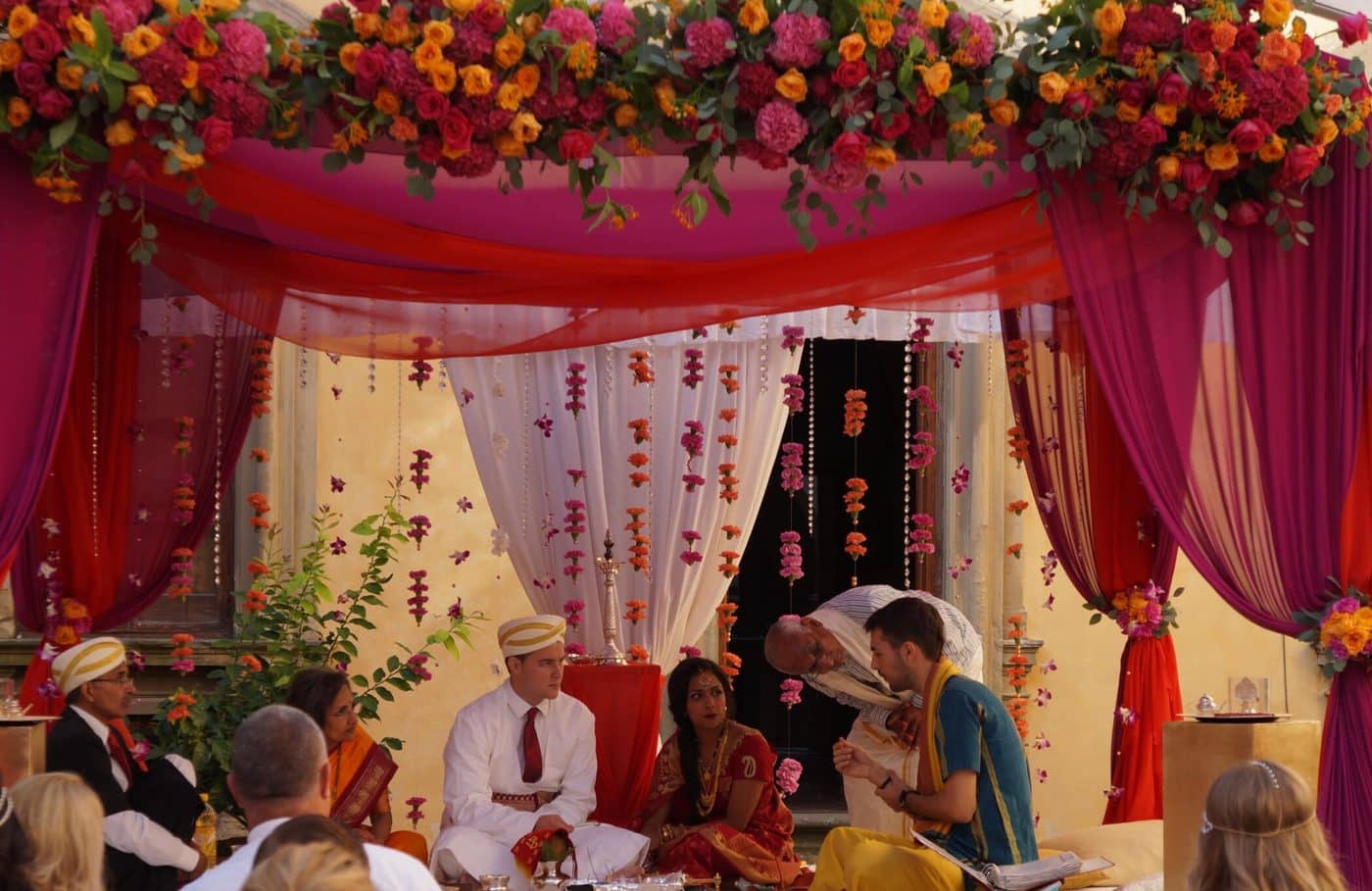
If you are planning or attending one of the many Hindu wedding ceremonies in Italy held each year, this page walks you through what actually unfolds beneath the canopy on the day. The Vedic wedding has its own internal logic, several centuries old, which once known makes the whole sequence much easier to follow. Without that map, even a deeply moving rite can feel like a beautiful succession of unfamiliar gestures whose meaning never quite settles for the watcher. With it, the wedding becomes a coherent unfolding you can take part in rather than observe from the side.
What follows is the standard sequence as it is generally kept, with notes on how each element adapts to the realities of an Italian setting, a Tuscan estate, a Lake Como villa, a Roman palazzo, a Sicilian masseria. Family traditions vary slightly, and a good Pandit will adapt to your own regional customs and explain each part to the gathering as it happens.
Before the Wedding Day Itself
An Italian wedding rarely begins and ends in a single afternoon. Because most guests have traveled a long way and the estate is held for several days, the wedding proper is usually framed by other gatherings: an evening of music and welcome as the families arrive, a henna afternoon, and often a turmeric or blessing rite the morning before. These are not the Vedic wedding itself, but they shape the days around it, and the self-contained Italian estate, a Tuscan agriturismo or a Como villa held exclusively, is what lets the whole sequence flow on one property without anyone shuttling between hotel and ceremony.
It also helps to know that the shape of the wedding is settled with the Pandit in advance, not improvised on the day. Before the rite, a thoughtful Pandit asks about the family’s own regional tradition and any particular customs the couple wishes kept or adapted, agrees which parts will be explained aloud and in which language, and confirms the timing so that the central act falls within the auspicious hour. The day itself then unfolds as something prepared and understood rather than watched in puzzlement, which is the whole aim of knowing the sequence below.
Opening: Gaṇeśa Pūjā and Setting the Space
The wedding opens with a short rite to Gaṇeśa, the elephant-headed deity called on at the start of any important undertaking, asking for obstacles to be set aside. A small image or symbol is placed on a low table; offerings of flowers, rice, fruit, and a flame are made; the Pandit recites the verses. This takes a few minutes and prepares the space and the gathering for what follows. In an Italian villa setting this opening often takes place in a sheltered courtyard or garden corner, where the morning quietness suits the rite well.
A consecrated brass or copper vessel of water, topped with leaves and a coconut, is then installed as a quiet center throughout the rite, and water from it is used at various points. The Pandit then formally declares the date, the place, and the names of the families, anchoring the ceremony in time and in this particular gathering at this particular hour on Italian soil. The deeper meaning of the rite that all this prepares for is set out at the Vivāha Pūjā.
Once you know the order and the meaning of each part, the whole sequence reads naturally. The wedding has its own internal logic; it only seems opaque without the map.
Welcoming the Groom and Joining the Families
The groom is welcomed formally by the bride’s family with a small hospitality rite called the madhuparka, a mixture of honey, yogurt, and water offered in a ceremonial cup. This is among the most ancient gestures in the tradition, the way a respected guest has always been received, and it marks the moment the two families come together rather than meeting as separate parties. In an Italian estate setting this often happens at the entrance to the canopy or at the threshold of the property, with the bride’s family lined up to receive the groom’s party formally.
The kanyādāna follows: the bride’s father or guardian formally entrusts her to the groom, placing her hand in his. The word means “the giving of the daughter,” and it is worth understanding rightly: in its original spirit it is a gesture of blessing and entrusting between two families, not a transaction. Today many families adapt the language and the gesture to express the equal joining of two adults coming together, and a thoughtful Pandit works with the couple beforehand to find the form of words that suits them.
The Sacred Fire
The sacred fire, the heart of every Vedic wedding, is now kindled in a small contained vessel at the center of the canopy. The Pandit invokes Agni, the sacred fire personified, as witness to what is about to happen. From this point onward the fire burns through the rest of the rite, and the central acts of the wedding take place in its presence. The fire cannot be replaced by a symbolic or electric flame, since it is the witness before whom the vows are sworn.
A practical note on Italian settings. Most country villas, agriturismi, and estate properties accommodate the fire readily in their gardens or courtyards; the property usually requires advance notice and sensible safety provision, a fire-resistant base, awareness of wind direction, a small water source nearby, but rarely refuses. Indoor fire in a hotel ballroom or palazzo needs explicit written permission, proper ventilation, and a safe contained vessel; the Pandit handles these arrangements with the venue directly. The fuller treatment of the fire offering is at Homa and the sacred fire.
The Taking of the Hand and the Offering of Grain
The groom takes the bride’s right hand in his, the pāṇigrahaṇa, “the taking of the hand,” while the Pandit recites the old Vedic verses that mark the joining. The mantra spoken at this moment is among the oldest continuously recited formulae in any living tradition, and it is the moment the wedding is sealed by gesture and word, before the fire as witness.
Then comes the lāja-homa, in which the bride, with the groom’s quiet support and often the help of her brother or a sibling, offers puffed rice into the fire. The offering is small and simple, but it carries the prayer for prosperity and well-being in the life ahead. The grain falls into the flame and is taken up by Agni, who in the older understanding carries every offering to its proper destination among the cosmic powers.
The Seven Steps
The saptapadī, the seven steps, is the central act. The couple walks together around the fire, pausing at each of the seven steps for a particular blessing: nourishment, strength, prosperity, well-being for the household, children, the right rhythm of the seasons in life, and lifelong friendship between them. In the older understanding, the marriage is completed at the seventh step rather than at the exchange of vows or the giving of the hand: the seven steps together are what constitute the bond.
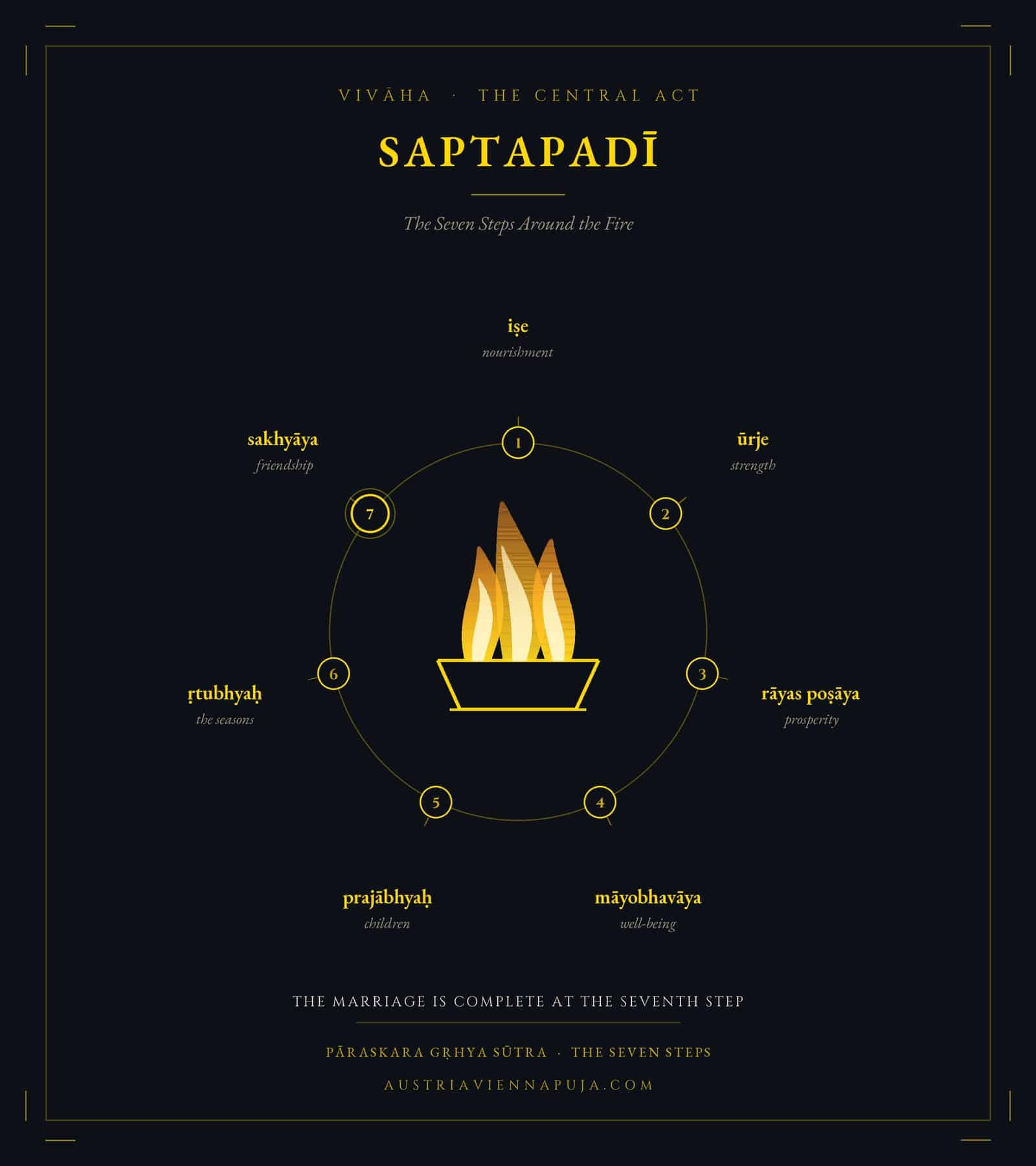
The seven steps and the blessing asked at each, the marriage completed at the seventh.
This is the part of the rite most worth understanding as it happens, since it is the heart of the whole wedding. A good Pandit names each step aloud as the couple takes it, in a language the gathering understands, so that everyone present can follow what is being asked for and joined. A canopy raised in an Italian setting, with the cypresses behind, or the lake before, or the old stone walls of a Tuscan farmhouse around, often gives this moment a particular quietness.
The Closing
After the seventh step, the couple is shown the dhruva, the Pole Star, or if the ceremony is held during the day, its symbolic equivalent, as the image of constancy: the one star that does not move while the others wheel through the night sky. The blessing asks that the union be similarly steady through the long turning years to come. The Pandit then offers the closing verses and the assembled elders give their āśīrvāda, the elders’ blessing, to the couple. The fire is gently brought to its close. The rite as such is finished; what remains is the celebration that follows.
Kept in full and unhurried, the whole sequence runs to around two hours, though families shorten or lengthen the surrounding elements to suit the day. A Pandit who has explained each part as it came leaves a gathering that has not merely watched a beautiful ceremony but understood a sacred act, which on Italian ground, among guests many of whom are seeing such a rite for the first time, is much of what makes the day land.
The Part the Guests Play
A Vedic wedding is not a performance watched from rows of seats but an occasion the whole gathering enters, and this matters especially in Italy, where a good number of those present, Italian friends, colleagues, the partners of relatives, may never have seen such a rite before. The canopy is open on its sides by design, so the gathering encircles rather than faces the couple, and the fire at the center is visible to all. The elders have a defined place, coming forward at the close to give their blessing; the bride’s brother has his part in the offering of grain; and the wider company is invited, at the marked moments, to shower the couple with petals or rice and to add their own good wishes. The rite is built to be shared, not merely observed.
This is why the Pandit’s explaining of each step as it comes does so much for the day. A gathering that understands what the seven steps ask for, or what the grain offered into the fire means, is a gathering that participates in the asking rather than waiting politely for the unfamiliar to pass. On an Italian estate, where the mixed company is part of the occasion’s particular warmth, this turns what could be an opaque ceremony for half the guests into something the whole room enters together. The couple is married not in front of their people but in the midst of them, which is the older understanding of what a wedding is for.
A Word on the Law
A plain note: Italy recognizes only the civil marriage performed before a registrar as carrying legal status; the Vedic ceremony is a separate observance and does not by itself produce legal recognition. For couples not resident in Italy, the legal step is almost always simpler done at home before traveling, since the Italian civil process for foreigners requires apostilled documents, certified translation, and a brief residency formality, and the specifics change from time to time and should be confirmed with the relevant authority rather than assumed; this is general information and not legal advice. Plan for both, settle the legal matter early, and the wedding day in Italy carries no anxiety about paperwork. The wider Italian destination context is at the Hindu Indian wedding in Italy.
Each gesture has a name and a meaning. Once you know them, the rite reads naturally, and you can take part rather than watch from outside.
ihaiva stam mā vi yauṣṭam
śatahimāḥ saubhagāya jīvatam
“May you abide here together, never parted; may you live a hundred autumns in good fortune.”
ṚGVEDA 10.85.42 · THE MARRIAGE HYMN
The old blessing asks for a hundred autumns lived together, and that is finally what the whole rite is for: not the choreography of gestures, beautiful though they are, but the quiet joining of two lives into one shared rhythm across the long years ahead. A wedding kept on Italian ground, in a Tuscan villa above the vineyards, on a terrace overlooking Lake Como, in a courtyard of a Sicilian masseria, walks through this same sequence on a day of unusual significance. When the gathering knows what each part means, the rite stops being a spectacle held at a respectful distance and becomes what it was always meant to be: a shared occasion in which everyone takes some real part, blessing the couple and witnessing the moment two lives become one.
The verse cited here is from the marriage hymn of the Ṛgveda, with the sequence of the seven steps following the Pāraskara Gṛhya Sūtra, the wedding texts gathered at Sanskrit Documents, and scholarship on the rites through the Oxford Centre for Hindu Studies.
© 2026 AUSTRIAVIENNAPUJA.COM · SANĀTANA DHARMA IN EUROPE
Preserving authentic Vedic transmission across the European continent