Vivāha | A Year of Preparation
Indian Wedding in Portugal: A Practical Guide for the Year Ahead
A working guide to keeping a Vedic wedding in Portugal: how the year of preparation unfolds, when to settle each major decision, what tends to go wrong, and the honest practicalities of planning a celebration far from where most guests will travel from.
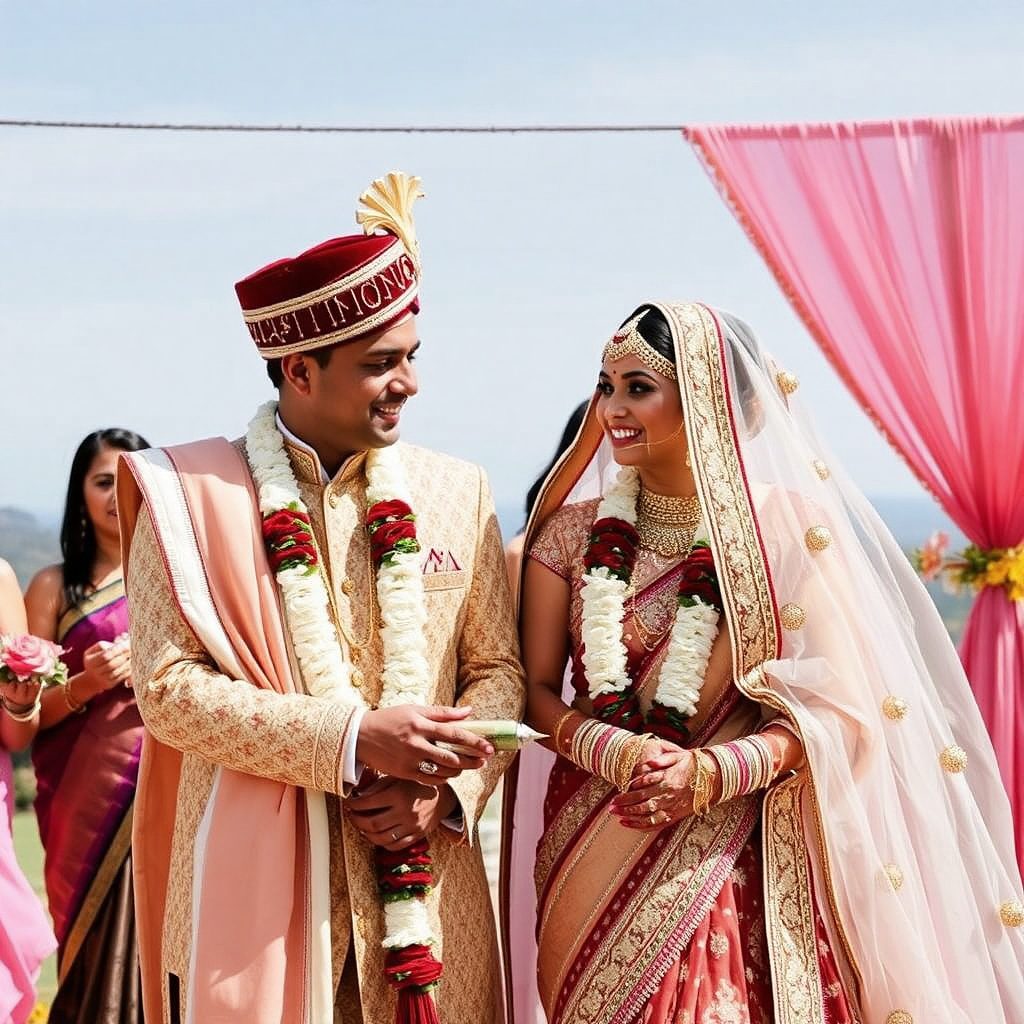
This is a planning guide for couples and families who have chosen, or are considering, an Indian wedding in Portugal and want to know what the work ahead actually looks like. It is not a meditation on the country’s beauty, which has its own page, nor a treatise on what a Vedic wedding means in itself. It is the plain practical companion: how the year before the day breaks down, what to settle first, what can wait, what tends to go wrong, and how to keep the whole long preparation in good order so the day itself arrives without panic.
A Portuguese celebration deserves a year, and the families who keep such a day most gladly are those who give it one. The country rewards patient planning rather than improvisation: the best venues book early, the right priest needs notice, the seasonal weather has windows that suit and others that do not, and the legal arrangements have a particular shape. Walk through the year with deliberation and Portugal gives back a celebration of rare quality. Try to compress it into a few months and the day, though it will happen, carries strain that careful planning would have prevented.
Twelve Months Out: The Few Decisions That Decide Everything
A year ahead, only a few decisions matter, but they matter very much, because everything else falls into place around them. The first is the part of Portugal: the Douro valley with its terraced vineyards and grand quintas, the Lisbon region and the palatial estates of Sintra and Cascais, the Algarve coast with its warmer climate and seaside properties, or the deep countryside of the Alentejo with its working estates and old stone houses. Each suits a different mood, and the choice is best made by feel rather than checklist, ideally with a visit to two or three contrasting regions before settling.
The second early decision is the season, which in Portugal narrows naturally. Late spring through early autumn, roughly May to October, offers reliable warm dry weather across the country; midsummer, July and August, brings real heat in the south and the inland regions, which can be uncomfortable for guests unused to it, so the shoulder months of May, June, September, and early October tend to be most pleasant. The third is the priest, since a Vedic wedding wants someone genuinely qualified to keep it, and the right priest should be engaged in conversation early so that the auspicious window for the marriage can be settled before any venue is booked. For the deeper meaning of the rite all this prepares for, the treatment of the Vivāha Pūjā is worth reading before the planning begins.
A year well used produces a day that arrives without strain. A year compressed produces a day that happens with worry. The work is the same; the experience of it is not.
Nine to Twelve Months: Venue, Date, and the Auspicious Window
In the nine-to-twelve-month window the venue is found and confirmed, and the date is settled within it. The order of these matters: talk to the priest first, establish the favourable window for the marriage within whatever season the family prefers, and only then commit a venue to a specific date inside that window. The very common and very avoidable error is to book a beautiful property first and then ask the priest to bless whatever date the property had free, only to discover the date sits poorly in the tradition’s own reading. Settle the window with the priest, then approach venues with three or four candidate dates from inside it, and the two pieces fit together without friction.
A venue visit, if it can be arranged, is worth the trouble. Photographs flatter; in person a property reveals its real proportions, its acoustics, the actual outdoor space available for the canopy and the sacred fire, and the genuine character of the surroundings. Two or three visits, ideally to contrasting properties in different regions, settle the choice with a confidence that no remote booking can match. The wider account of what to test any property against is set out in the guide to choosing a European venue, which lists the practical questions to ask before any deposit is paid.
Six to Nine Months: Guests, Lodging, and the Legal Step
Six to nine months out, the guest list is finalised and travel notifications go out, since Portugal asks real travel of most attendees and the longer the warning the better. Lodging is settled around the venue: many Portuguese estates have rooms on the property for the immediate families, but the wider gathering will need nearby hotels or rentals, and these book up early in the peak season. A planner who knows the region helps greatly here; one estate may have its own quiet arrangement with a nearby village hotel, another may sit alone with the nearest accommodation half an hour away, and these practical realities shape how the days flow.
This is also the right window to settle the legal side, which is straightforward but needs attention. Portuguese civil law recognises only the civil marriage performed before a registrar as creating legal status; the Vedic ceremony is a separate observance and does not by itself produce legal recognition. For non-Portuguese couples the civil registration is almost always simpler done at home before travelling, since a Portuguese civil marriage requires translated and apostilled documents and a presence requirement, which is workable but adds layers. The specifics change from time to time and should be confirmed with the relevant authority rather than assumed; this is general information and not legal advice. Settle the legal step early at home, and the Portuguese celebration is then purely the wedding the family came for.
Three to Six Months: Catering, Suppliers, and the Shape of the Days
In the three-to-six-month window the choices become more concrete: the catering is settled, the priest is briefed in detail on the family’s traditions and any particular preferences, the music and photography are booked, the flowers and decoration are arranged. Indian catering in Portugal has become genuinely good over the past decade, with caterers working from Lisbon and Porto able to travel the whole country, and the local Portuguese kitchen, with its abundance of vegetables, herbs, and good oil, blends with Indian cooking into a vegetarian feast that pleases the family’s traditions and the local guests alike.
This is also when the shape of the days is settled: the music evening on arrival, the henna afternoon, the turmeric morning, the marriage itself, the reception, the leave-taking. A self-contained estate is the great gift of the Portuguese setting here, letting the whole sequence flow on one property across several days without anyone shuttling between hotel and venue. The priest helps with the timing of each part, both for its own internal rhythm and so that the marriage falls within its auspicious window on the chosen day. The full treatment of the wedding’s deeper meaning is set out in the page on a Hindu wedding in Portugal, which is the companion to this more practical guide.
The Final Months: Fittings, Confirmation, and the Sacred Fire
In the last three months the clothing is finalised, the guest accommodation confirmed, the suppliers reconfirmed, and a final venue walk-through arranged with the principal players. The single most important practical detail at this stage is the sacred fire, the heart of the marriage rite, which the priest sets up with the property’s owners on arrival. Most country estates and outdoor properties accommodate a contained open fire in their gardens or courtyards readily, particularly outside the height of summer; indoor fire is more restricted and needs the property’s explicit written agreement well in advance. Confirm the fire arrangement in writing, with both indoor and outdoor options described, before signing any final contract.
The last few weeks tend to ask little from a family who has worked the year deliberately. The pieces are in place; the suppliers are confirmed; the priest knows what is wanted; the guests know when and where; the legal matter is settled at home. What remains is the gentle work of presence: arriving early, being among family, and entering the days themselves with attention rather than anxiety. A well-prepared celebration carries itself; a hurried one wears its preparation on its face. The aim of the long planning is precisely this: that the day, when it comes, feels less like an event being managed and more like a celebration being lived.
What Tends to Go Wrong
A year is long enough that the same few mistakes recur, and naming them plainly is the cheapest way to avoid them. The first, already mentioned but worth repeating because it is the most common, is booking the venue before settling the auspicious window with the priest, which forces an awkward choice later between the property and the proper day. Reverse the order and the problem never arises. The second is underestimating how much travel Portugal asks of guests coming from across Europe and beyond, and giving them too little notice; the further people must come, the earlier they need to know, and a save-the-date sent a year out costs nothing and prevents much.
The third recurring error is leaving the sacred fire to the end. Families assume the venue will simply allow it, and most outdoor properties do, but the written permission, and especially the arrangement for an indoor flame should the weather turn, is far easier secured at the contract stage than negotiated in the final weeks. The fourth is treating the legal registration as an afterthought, then scrambling with apostilles and translations close to the day. Each of these is small in itself and entirely avoidable, and each, left unattended, becomes the one piece of grit in an otherwise smooth year. A family that settles these four early gives itself a preparation almost free of friction.
A year used well produces a day arrived at without strain. The long preparation is the gift the wedding itself receives.
samrājñī śvaśure bhava
samrājñī śvaśrvāṃ bhava
“Be a queen in the home of your new father, a queen in the home of your new mother.”
ṚGVEDA 10.85.46 · A WEDDING BLESSING
The old wedding blessing speaks to what the whole long planning is finally in service of: not the day itself, lovely though it is, but the life that begins on it. A wedding kept well in Portugal, prepared across an unhurried year, with each choice settled in its time and nothing left to last-minute strain, sends a couple into that life with the steadiness it deserves. The Douro hills or the Sintra forests or the Algarve shore provide the frame; the family, gathered for those few days from across the world, provides the witness; and the rite, kept with care by a priest who knows his work, joins the two lives into one. Begin early, settle each thing in its proper season, and the day, when it arrives, will arrive as it should: gladly, in good order, among people gathered with love.
The verse cited here is from the marriage hymn of the Ṛgveda, with the wedding texts gathered at Sanskrit Documents and scholarship on the rites through the Oxford Centre for Hindu Studies.
© 2026 AUSTRIAVIENNAPUJA.COM · SANĀTANA DHARMA IN EUROPE
Preserving authentic Vedic transmission across the European continent