
Vivāha · Across the Wider Continent
Four Regions, and How to Choose Between Them
A hub guide to keeping a Vedic wedding somewhere on the European continent: the four broad regional zones to choose between, how to weigh family logistics against atmosphere, and the standing matters that apply wherever the canopy is raised.
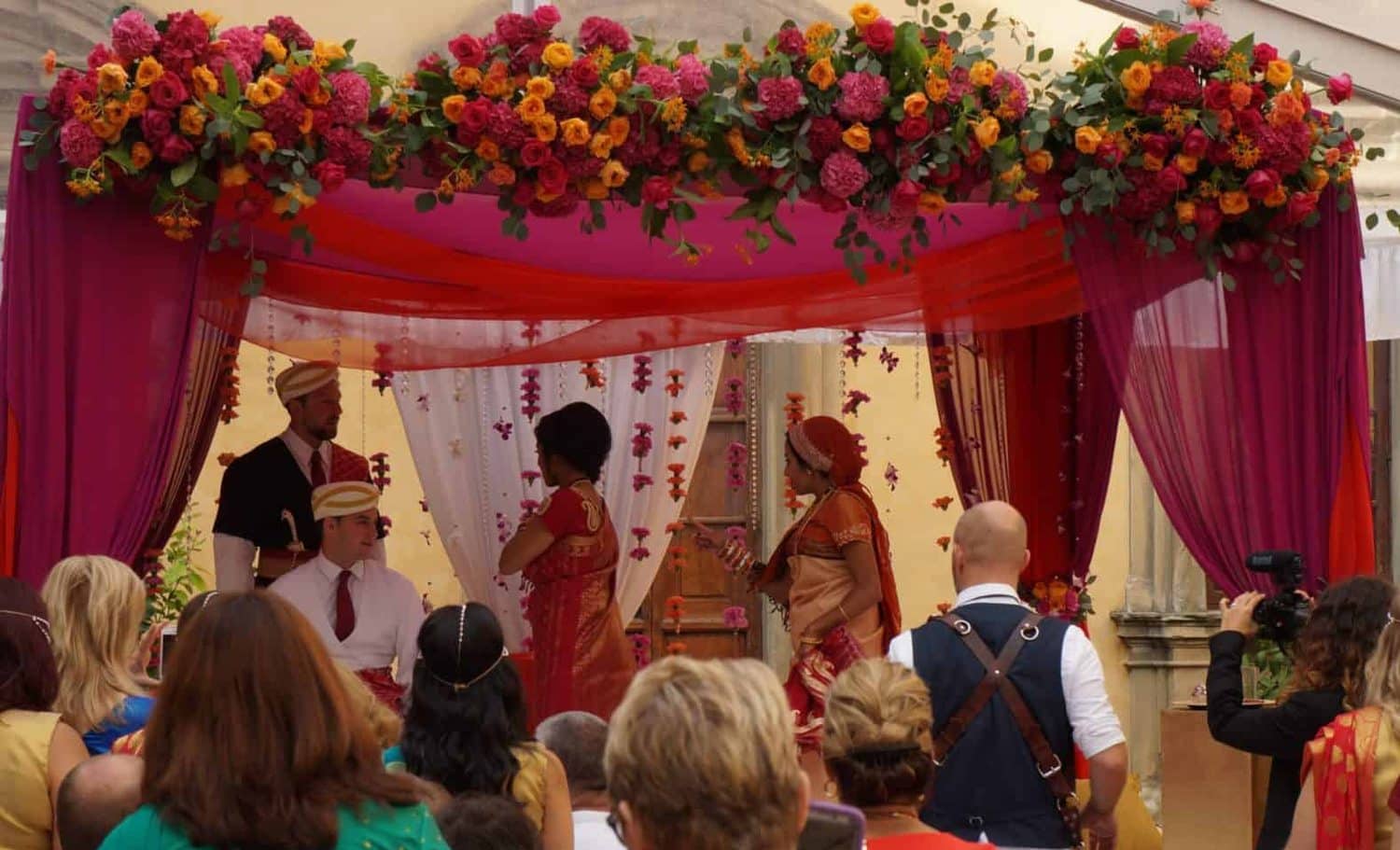
The maṇḍapa raised against a villa wall, the assembly gathered close about the ground of the rite.
A Hindu wedding in Europe faces the unusual challenge of choosing across a continent rather than within one country. Most families considering this route arrive at the question with relatives spread across Vienna, London, Frankfurt, Milano, and other European hubs, plus older relatives flying in from India or further afield, and the question of where on the continent to converge becomes part of the planning rather than a settled fact. This page is a hub overview to help you think that choice through: the four broad regional zones available, what each suits, and the practical matters that cross all of them.
One honest point at the outset. The continent has become a common setting for Indian destination weddings over the past two decades, and the venue infrastructure across most of it has matured accordingly. The Pandit network has grown alongside it, the catering and floristry and audio-visual trades have learned what an Indian program asks for, and the civil authorities in most countries have established working procedures. None of this makes the work simple, but the friction that existed a generation ago has largely been smoothed away. The choice you face is a choice among good options rather than a search for the one workable place.
The Alpine and Central Zone
The first regional zone covers Austria, Switzerland, southern Germany, and the alpine fringes of northern Italy. Its defining qualities are imperial-era palace venues, especially in Vienna, Salzburg, and the Swiss heritage cities, alpine lake estates, and a culture of orderly ceremonial accommodation that takes friction out of planning. The legal and venue infrastructure works smoothly, the multilingual hospitality trade handles Indian programs confidently, and the central European position keeps travel gentle for relatives scattered across the continent.
This zone suits couples who want measured dignity and easy logistics for an international gathering. The trade-off is climate: the alpine and central zone has a shorter outdoor season than the Mediterranean countries, so weddings here cluster between May and September, and a covered alternative has to be held in reserve even in high summer. Further detail on the Austrian setting specifically is set out in the account of a Hindu wedding in Austria.
Four regional zones, each with its own character. The right one is the zone that matches what you want the days to feel like and that your gathered relatives can reach without hardship.
The Mediterranean Zone
The second zone is the Mediterranean: Italy, Greece, southern France, Catalonia, the Iberian south, together with the islands of the Aegean and the western Mediterranean. Its defining qualities are the long warm season from May through October, the depth of historic ceremonial settings, Tuscan villas, Greek island estates, Catalan masies, Provençal mas, and the maritime light that gives an outdoor ceremony a quality nothing else on the continent quite matches. This is the most established zone for Indian destination weddings and has the deepest vendor infrastructure for them.
The Mediterranean suits couples drawn to outdoor celebration, to longer multi-day programs at self-contained estate properties, and to sea, vineyard, or olive grove as the visual surround. The trade-off is midsummer heat, which is hard on elderly relatives and on a fire-tended rite conducted in the open at midday, and peak-season pricing at the more famous addresses, the Amalfi coast, the Côte d’Azur, Santorini. The fuller comparison across this zone is set out in the survey of Hindu wedding destinations in Europe.
The Atlantic Zone
The third zone is the Atlantic fringe: Portugal, the Atlantic coast of France, and the British Isles. Its defining qualities are the oceanic setting, a cooler and longer-lit summer, and a quality of light along the coast that draws couples wanting a wedding which feels expansive rather than ornamental. Portugal in particular has emerged over the past decade as a leading destination for Indian weddings, with the quintas of the Lisbon hinterland and the Douro valley offering the multi-day estate setting at noticeably gentler pricing than the western Mediterranean.
The Atlantic zone suits couples drawn to sea-coast atmosphere and to a quieter aesthetic than high-Mediterranean glamour. The trade-off is weather: the Atlantic is more variable than the Mediterranean, and an indoor contingency has to be planned in full rather than sketched, including where the fire will be lit if the garden is unusable. The fuller treatment of the leading option in this zone is set out in the account of a Hindu wedding in Portugal.
The Northern Zone
The fourth and newest zone covers Scandinavia, the Baltic countries, and northern Germany. The Indian community here has grown steadily over the past decade and the venue inventory has developed with it. Its defining qualities are the long midsummer light, where a rite in late June can be held outdoors into the late evening under daylight, the sober architectural beauty of the Hanseatic and Nordic settings, and a culture of practical thoroughness that removes friction from complex planning.
The northern zone suits couples drawn to quietness and atmosphere rather than spectacle, and it works particularly well for smaller and more intimate gatherings. The trade-off is the short season, with the outdoor window running from roughly mid-June through August, and the cost of bringing relatives from further south. The long daylight is worth a moment’s thought in its own right, since it widens the range of evening hours in which an auspicious window can fall without the rite being conducted after dark.
Doing the Travel Arithmetic First
Most families settle this question on atmosphere and then discover the logistics. It is worth reversing that order, at least for a first pass. Count the gathering by origin rather than by headcount: how many will fly from India, how many from within Europe, how many from North America or the Gulf. The zone that minimizes the total burden of travel is often not the zone that photographs best, and the difference becomes visible only once the list is written down.
Two details govern more than distance on a map. The first is direct-flight availability from the Indian metros into the nearest hub, because a connection with a long layover is harder on an eighty-year-old relative than two additional hours of direct flying. The second is the transfer at the far end. A property within ninety minutes of one arrival airport simplifies everything that follows, while a remote estate two hours beyond that turns every arrival into a separate logistical problem and every late flight into a missed event.
The quieter constraint is beds. A multi-day program means guests sleep near the venue, so the accommodation inventory within a short radius often decides the venue before taste has any say in the matter. An estate that sleeps forty in a region with little else nearby will not hold a gathering of a hundred and forty, however beautiful it is. Establish that number early, because it eliminates more candidates than any other single question.
Where the Season Meets the Muhūrta
Here lies the tension particular to this continent, and it is the one families most often meet too late. Each zone has a narrow outdoor season. The Muhūrta, the auspicious window within which the rite is to be performed, is not chosen to suit a venue calendar; it is calculated, and it is calculated for the coordinates and local time of the place where the fire will actually be lit. A window computed for one country does not transfer to another, and a date that carries no window carries no rite, however fine the property.
The complication is that the prime European outdoor months overlap a period many traditions set aside. In much of North Indian practice the Vivāha is not performed during the four months of Cāturmāsya, running from Devaśayanī Ekādaśī to Prabodhinī Ekādaśī, which falls across roughly July to early November, and the intercalary Adhika Māsa is likewise avoided. That covers a good part of the season when a Mediterranean or Atlantic garden is at its best. Practice is not uniform: several southern traditions apply different criteria, and the paddhati a family follows governs the matter rather than any general rule stated here.
The practical consequence is simple. Settle the question of dates with the officiating Pandit before a venue contract is signed, not after. Families generally resolve it in one of three ways: by taking a window earlier in the season, from spring into the first part of July; by accepting a covered or indoor setting later in the year, when the light is lower and the crowds have gone; or by following their own tradition’s criteria where those permit a date the general rule would exclude. Any of the three works. What does not work is choosing the property first and asking about the Muhūrta afterward.
The Fire, and What the Property Must Agree To
The sacred fire is the one requirement no European venue can be assumed to have thought about. Most outdoor estate properties accommodate a small contained fire in their gardens readily, and many have done so before. Indoor fire is a different matter and is far more restricted, since smoke detection and sprinkler systems respond to it, and it needs the property’s explicit written permission together with an agreed safety provision.
Ask for both arrangements, indoor and outdoor, and get both in writing before any contract is signed. A property that permits the fire only in the garden has, in effect, made your rite dependent on the weather, and in the Atlantic and northern zones that is a real exposure rather than a theoretical one. Ask also about ground protection outdoors, since a scorched lawn is a predictable dispute at settlement, and confirm who on the property’s staff will be present and what they expect to be told beforehand.
The Civil Step, Which Differs by Country
In almost every European country the Vedic ceremony does not by itself constitute a civil marriage. The registration before the local registrar is the act the state recognizes, and the Vivāha is a separate religious observance with its own authority. There is at least one significant exception within the zones described above. In England and Wales a marriage may be solemnized in a place of worship registered for marriages, which can include a Hindu temple, provided notice has been given and a registrar or an authorized person registers the marriage. A destination ceremony held at a country estate or villa in that jurisdiction is not covered by this, since such a property is not a registered building, so the general rule still applies to the kind of wedding this page is about.
For couples not resident where the celebration will be held, the civil step is almost always simpler settled at home before traveling. Requirements differ from country to country, differ between regions within a country, and change without announcement, so they must be confirmed with the registry office that will receive the file rather than assumed; this is general information and not legal advice. The documents, the apostille position, and the order of operations that causes families the least difficulty are set out in full in the account of Hindu wedding legal recognition in Europe.
Four zones, many countries within them. The right choice is the one that matches what you want and what your family can reach, not the one that photographs best.
samānī va ākūtiḥ
samānā hṛdayāni vaḥ
“May your purpose be one; may your hearts be one. United, may you fare well together.”
ṚGVEDA 10.191.4 · FROM THE HYMN OF CONCORD
The old hymn of concord asks that the hearts be one and the purpose be one, and it names what a wedding is finally for: not the chosen country, however lovely, but the long shared life that begins on the chosen day. The continent supplies the setting and the family supplies the gathering. What the rite itself requires travels unchanged from one zone to the next: the trained voice, the kindled fire, the intention declared in the Saṅkalpa, and a date on which the window is genuinely open. Settle those four, and the question of where becomes what it should always have been, a matter of preference rather than of validity.
The verse cited here is from the Ṛgveda, with the texts gathered at Sanskrit Documents and scholarship on the rites through the Oxford Centre for Hindu Studies.
© 2026 AUSTRIAVIENNAPUJA.COM · SANĀTANA DHARMA IN EUROPE
Preserving authentic Vedic transmission across the European continent