Paramparā | A Founding Generation
Keeping the First Rites of a Young Community
What it means to serve a community keeping its observances for the first time, why an hour from Vienna changes what is practically possible, the fire in a Bratislava flat, and the Slovak rule that fixes the legal question permanently.
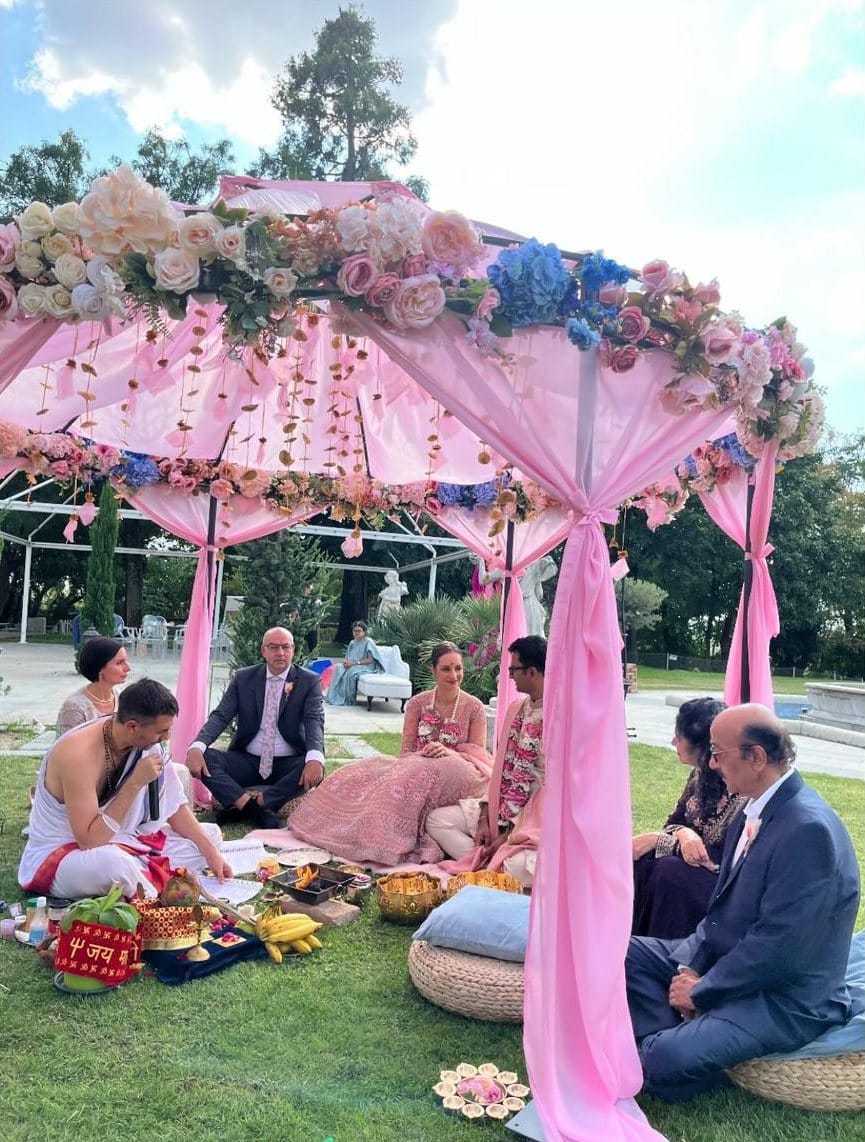
The canopy raised, the fire established, both families seated within arm’s reach of it.
Engaging a Hindu priest in Slovakia is a different proposition from engaging one in Germany or Italy, and the difference is not only size. Those countries hold communities several decades old, with temples, associations, and a settled sense of how things are done. The Hindu families of Bratislava and the other Slovak towns are, in the main, a founding generation. Most arrived within the last two decades. There is no temple. There is no registered religious body. Whatever pattern of observance the community has, it is making now.
That shapes the work in ways worth setting out plainly. A wedding kept here, a child named here, a new home blessed here, these are not one more instance of something the community has done many times. They are the first of their kind for the people present, and they become the pattern the next family follows. This page covers what that means in practice, what Bratislava’s position an hour from Vienna makes possible, how the fire is handled in a Slovak apartment, and the one legal fact that will not change in any family’s lifetime.
Why the rite does not weaken with distance
Families in a small community sometimes carry a quiet worry that what they keep here is a reduced version of the real thing, kept properly somewhere else. The tradition answers this directly, and the answer is worth understanding rather than merely being reassured about. The Sanskrit word paramparā means one after another. It names the succession through which sacred knowledge passes from teacher to disciple, generation upon generation, in an unbroken line. In this tradition authority is never self-generated. A priest’s qualification to perform a rite comes from his place in such a line: his teacher received it from his teacher, who received it from his, backward through the generations.
The consequence is that this kind of authority is portable in a way institutional authority is not. It resides in the person who received it rather than in a building or a territory, and it travels wherever he travels. Add to this the Saṅkalpa, the declaration with which every rite opens, which names the exact hour and the exact ground of the performance and so draws that ground into the rite. A Bratislava apartment named in the Saṅkalpa is the site of the observance in the full sense the tradition intends. What makes a rite whole is the qualified officiant, the correctly spoken Mantra with its accent intact, the consecrated fire, and the intention of the household. All four travel. None of them is Slovak or Indian.
The tradition does not reside in a place. It resides in the line of those who have received it rightly, and it travels wherever they travel.
An hour from Vienna, which changes what is possible
Bratislava’s position is the practical fact that makes proper observance straightforward here, and it is unusual. The city sits roughly an hour from Vienna by road or rail, closer to another country’s capital than any other capital in Europe. Budapest is two and a half hours, Prague four. Vienna’s airport is nearer to central Bratislava than many European capitals’ own airports are to their centers.
For a household this means something concrete. A family in Bratislava, Košice, Nitra or Žilina is not choosing between an unqualified officiant nearby and no officiant at all. A priest based in Vienna reaches Bratislava more easily than he reaches parts of Austria, which makes it possible to arrive the day before a significant occasion, to see an unfamiliar venue before it must be used, and to treat a modest household rite as worth the same preparation as a large wedding. In a community without a temple, that accessibility does most of the work a temple would otherwise do. The wider pattern of this travelling service is described in the account of the Vedic Pandit in Europe.
The rites a young community keeps first
Across the years a household calls on a priest for the rites of childhood, the naming of a newborn, the first feeding of solid food, the first ceremonial cutting of the hair, and where a family keeps it, the Upanayana that opens formal study. There is the Vivāha, the most elaborate of all, kept before the established fire. There is the blessing of a new home on entering it, the seasonal observances through the year, and the rites of remembrance by which a household honors its dead.
In a founding-generation community two of these carry an extra weight. The Upanayana, which entrusts a child to formal study of the tradition, is in a diaspora setting the rite that founds the very continuity the parents hope to pass on, and it is often the first one any family here has kept. And the rites of remembrance press hardest, because in a young community the older generation frequently lies buried in another country while their descendants live in this one, and the Śrāddha offerings are the means by which that distance is bridged rather than simply endured. The full account of the household observances is set out in the treatment of the sixteen Saṃskāras.
The fire in a Slovak apartment
Most observances here happen in a flat rather than on an estate, and the fire is the practical matter to settle first. A Homa produces real smoke from ghee and wood, and Slovak apartment buildings carry smoke detection and house rules like any others in central Europe. This is not a reason to avoid the fire. It is a reason to plan it, and the arrangements are simple once considered.
A balcony, terrace or courtyard resolves the question entirely where the season allows, and is the best answer from late spring through early autumn. Indoors, a small contained vessel raised off the floor, strong cross-ventilation, a reduced quantity of offering material, and the building management told beforehand will normally pass without difficulty. Check the house rules, since many buildings restrict open flame on balconies and in common areas. Where a larger observance is planned, a hired room with the fire agreed in writing is the cleanest route. The tradition itself provides for sensible adaptation of quantity, so a smaller fire is a smaller fire and not a lesser rite. Speak to the immediate neighbors beforehand, which costs nothing and prevents almost every difficulty. The meaning of the offering itself is set out in the account of Homa and the sacred fire.
Where the materials come from
A rite needs more than an officiant. It needs the Sāmagrī: the ghee, the specific woods, the grains, the kuśa, the vessels, the substances proper to whichever observance is being kept, and in a country without a Hindu infrastructure these are not found on a Saturday morning. Bratislava has a small number of Asian and Indian grocers, which will cover some of the kitchen items and very little of the ritual ones.
Here Vienna’s proximity earns its keep a second time. The city an hour away has long-established Indian provisioning, and a priest working across the border routinely brings what cannot be had locally while telling the family plainly what to obtain fresh nearby, which is usually the flowers, the fruit, the milk and the rice. The division should be settled in the first conversation rather than assumed, because an omission discovered on the morning of a Nāmakaraṇa cannot be repaired in Bratislava and can be repaired in Vienna only if someone thought of it the day before. For a household keeping its first observance, this is the single most useful question to ask: what are you bringing, and what am I getting?
Slovak law, and the rule that will not change
Slovakia is often described as recognizing only civil marriage. That is not accurate, and the accurate version is more useful. Slovak law gives full civil effect to a marriage celebrated in religious form, on equal footing with a civil ceremony, provided it is conducted by a church or religious society registered with the Ministry of Culture. Eighteen bodies hold that registration. A marriage before their clergy is a legal marriage. A marriage before the clergy of an unregistered group is not, and the couple must complete a separate civil ceremony.
Hindu communities are not among the eighteen, and here is the part families should understand rather than merely accept. Registration in Slovakia requires fifty thousand adult citizens or permanent residents, each submitting a declaration with their identity number and home address. That threshold was raised from twenty thousand in 2017, and no new religious group has been registered under it since. Slovakia’s entire Hindu population is a tiny fraction of that figure. The requirement is not a hurdle this community might one day clear; it is arithmetically out of reach, permanently.
The practical consequence is clean and worth planning around without resentment. In Slovakia the civil marriage and the Vedic rite are always two separate acts, and always will be. Complete the civil marriage at the matričný úrad, the registry office, or at home before travelling if you are coming in for the occasion, and let the Vivāha be the wedding the family came for. Requirements change and should be confirmed with the relevant office or a qualified professional rather than taken from any page, this one included; what is written here is general information and not legal advice. How the position differs country by country is set out in the account of Hindu wedding legal recognition in Europe.
What to settle before fixing a date
Raise the date early, before it is fixed against a venue, flights and the diaries of relatives coming from abroad. The Muhūrta for an important rite is calculated from the local horizon of the place of performance rather than chosen freely or borrowed from an Indian almanac, and bringing the family’s preferred day and the favorable window into agreement is small work done early and awkward work done late.
Beyond the date, three things. Settle where the fire will stand, indoors or out, with a fallback for the day the weather turns. Settle the civil marriage, which in Slovakia is always separate. And ask the priest whether he will explain each stage as it comes, which matters more here than in an older community, since a Slovak partner, a Slovak-raised child, or friends from the neighborhood are frequently in the room meeting the tradition for the first time. Giving the Mantra in its proper form while making its sense available is faithful to the tradition rather than a concession, because the older teaching enjoins the understanding of a rite as well as its keeping.
A community keeping its first observances is not keeping a lesser version of them. It is beginning the memory that the next generation will inherit.
evaṃ paramparā-prāptam imaṃ rājarṣayo viduḥ
sa kāleneha mahatā yogo naṣṭaḥ paraṃtapa
Received in this way, through the succession, the royal sages knew it. By the long passage of time that yoga was lost here, O scorcher of foes.
BHAGAVAD GĪTĀ 4.2
The verse is usually quoted for its first half, the succession through which the knowledge came down. The second half is the part that belongs on this page, because it says the succession can fail: by the long passage of time the teaching was lost. Transmission is not automatic. It continues only where someone keeps it and someone receives it, and a community in its founding generation stands at exactly that point. The first Upanayana kept in Bratislava, the first Nāmakaraṇa, the first marriage sealed before the fire in a Slovak room, are not modest versions of something grander happening elsewhere. They are the link being made, in this place, at this time, by the people present.
The verse cited above is Bhagavad Gītā 4.2; on the domestic rites in their textual form, the Pāraskara Gṛhya Sūtra; with primary texts gathered at Sanskrit Documents and scholarship on transmission and the household rites through the Oxford Centre for Hindu Studies.
© 2026 AUSTRIAVIENNAPUJA.COM · SANĀTANA DHARMA IN EUROPE
Preserving authentic Vedic transmission across the European continent