
Vivāha | The Register and the Rite
Where the Registrar Ends and the Fire Begins
On the wedding rite and the marriage register: why the Vedic ceremony was never built to register anything, what European registrars actually ask for, and the order of operations that spares a family the most trouble.
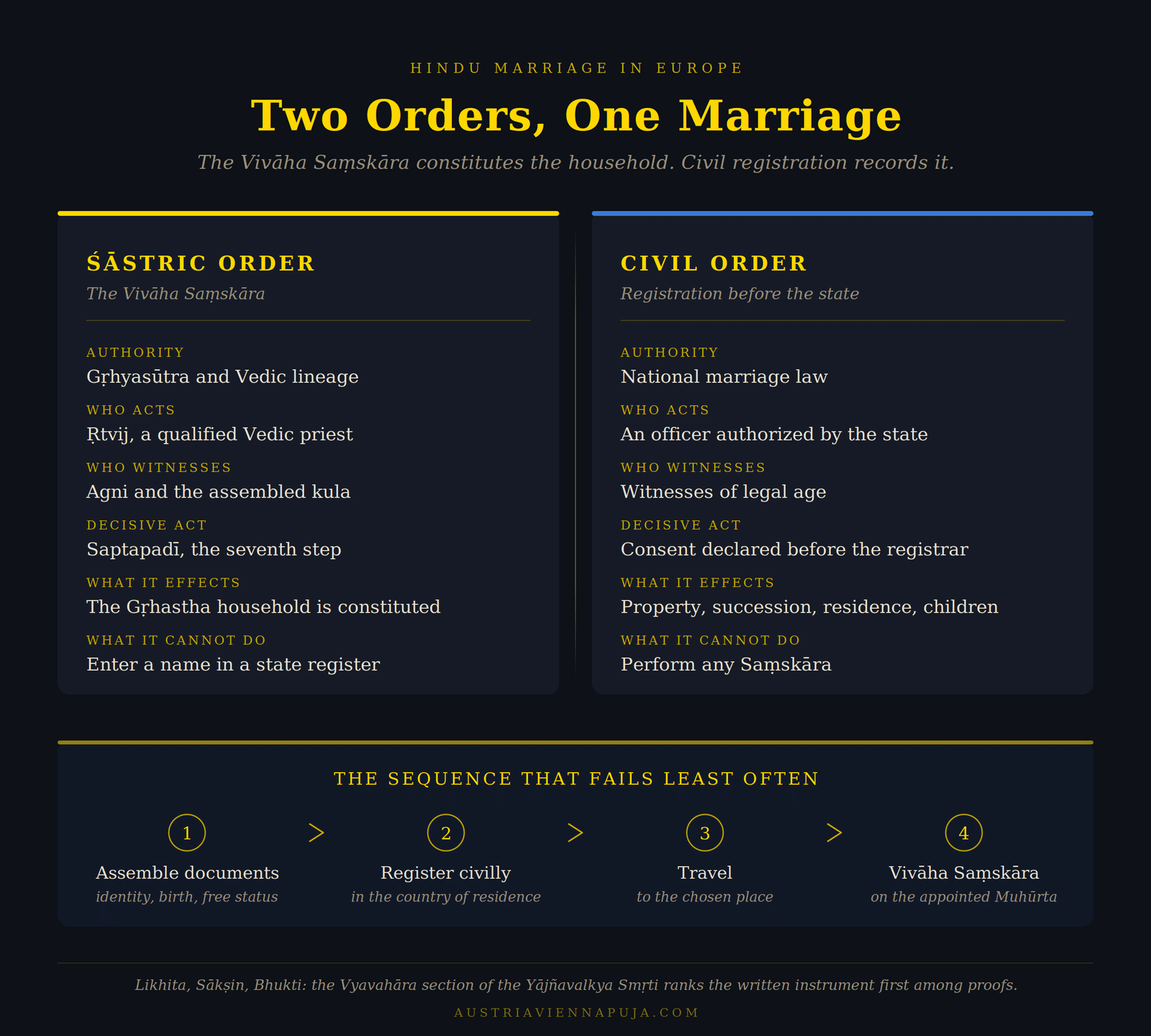
Two orders, two authorities: the rite constitutes a household, the register records that one exists.
Written by Pandit Sahadev, Vedic priest and pandit in charge of ceremonies at Radha Govinda Math, Traiskirchen
A family plans the wedding for a year. The venue in Tuscany or on Santorini is held, the flights are paid for, the relatives are coming from three continents, and then somebody asks a question nobody thought to ask. After the seven steps are walked, will the two of them actually be married? In almost every European country the answer is that they will be married in the eyes of their tradition and not yet in the eyes of the state. Hindu wedding legal recognition in Europe runs on a track of its own, separate from the ceremony, and the two have to be arranged separately.
This is usually met with dismay, and sometimes with a suspicion that the host country is being unfriendly. It is neither. The Vedic marriage rite was never built to register anything, and the tradition never asked it to. What follows sets out why that is so, what a European registrar is generally looking for, and the sequence that causes families the least difficulty. The legal material here is deliberately general. Rules differ between countries, they change, and they have to be confirmed with the office that will actually handle the file. None of it is legal advice.
Two Answers to Two Different Questions
Every marriage in Europe stands in two orders at once, and each answers a question the other cannot. The state asks whether two people of legal age and free status declared their consent in front of an officer it authorized to hear it. When that happens, the marriage produces effects the state controls: property, inheritance, residence permits, tax, the legal position of children. The tradition asks something else entirely. It asks whether the Vivāha Saṃskāra was performed with the right fire, the right verses, and the right sequence of acts. When that happens, the rite produces effects of its own: two people become a household, able to keep a domestic fire and carry a lineage forward.
Neither authority can answer for the other. A registrar has no way to certify that the seven steps were walked, and would not know what he was certifying if he tried. A priest has no power to enter a name in a public register, and the tradition never gave him one. This is not a conflict between two claims on the same territory. It is two offices doing two different jobs, and the confusion arises mainly because in India the two are often handled so close together that they look like one act.
What the Wedding Rite Actually Does
The Gṛhya Sūtras, the manuals governing the domestic rites, treat Vivāha as the ceremony that opens the householder’s life and with it the duty to keep a fire at home. The rite is less about joining two people than about establishing a household: a unit that can offer into the fire, receive guests, feed the ancestors, and carry a line forward.
Everything in the ceremony works toward that. At the taking of the hand the groom speaks a verse that names what the act is for. Parched grain is offered into the fire by the bride with the groom’s hands resting beneath hers. And at the seventh step of the Saptapadī the rite reaches what the tradition treats as its completion, the point beyond which it cannot be undone. The sequence and the meaning of each act are set out in the account of the Vivāha Pūjā.
Notice what the seventh step does and what it does not. It completes a Saṃskāra. It changes the standing of two people and of a family. It does not create an entry in an administrative record, and the literature that prescribes the rite contains no provision for one. There was nothing, in the world those texts describe, for such a record to be kept in.
Why a Certificate Is Not a Foreign Imposition
Families sometimes feel that being asked for paperwork is a European intrusion on a tradition that knew only fire and witnesses. The tradition’s own law says otherwise. The Yājñavalkya Smṛti, in its section on juridical procedure, lists three kinds of proof a court will accept: likhita, the written document, sākṣin, the testimony of witnesses, and bhukti, long possession or enjoyment. The written document is placed first. A tradition that ranks documents at the head of its own law of evidence is not a tradition hostile to certificates.
What it does hold apart is the difference between making a thing and proving it. The Saṃskāra makes the marriage. Proof is a separate matter, and in a village it was carried by the fire and by the people who watched, because a settled community remembers who married whom. A family that has moved to Vienna or Lisbon no longer has that community to hand, and the state’s register supplies what the village used to. Read this way, the certificate is doing the work the Śāstra assigned to likhita, and a couple who obtain one are acting inside their own tradition rather than conceding to somebody else’s. Where Vivāha sits among the other passages of a life is set out in the account of Saṃskāras and ceremonies in the Hindu tradition.
Agni does not record a marriage. Agni makes one. A register does the opposite, and neither can do the other’s work.
What a Registrar Needs to See
Whatever the country, a registrar is checking a short list of facts. That each person is who they say they are. That each is old enough and legally capable. That neither is still bound by a marriage or a registered partnership. That they are not related within a prohibited degree.
The documents that prove these are broadly the same everywhere. A passport or national identity card for identity. A birth certificate for age and parentage. And a certificate of no impediment, also called a certificate of free status or of capacity to marry, issued by the authorities of the country of nationality or residence, confirming the person is free to marry. Where an earlier marriage has ended, a final divorce decree or a death certificate is needed, and where the divorce was granted abroad, some registries want separate proof that it is recognized locally.
Two features of these documents catch families out more than anything else. Most registries accept civil status documents only if issued recently, often within a few months, so a birth certificate obtained early in the planning can expire before the file is submitted. And the certificate of free status usually carries a waiting or publication period at the issuing end, which means the document proving you are free to marry can itself take weeks to arrive.
Apostilles, and the Rule Most Advice Has Missed
A document issued in one country and shown to officials in another normally has to be authenticated first. The usual instrument is the 1961 Hague Convention, under which a designated authority in the issuing country attaches an Apostille. It is worth knowing exactly what that certifies: the signature, the office held by the person who signed, and the seal or stamp. It says nothing at all about whether the contents are true. The Convention and the list of competent authorities are set out in the Apostille Section of the HCCH. Where a country is not party to it, the slower route of consular legalization applies instead.
Here is the part most wedding advice online has not caught up with. Since February 2019, Regulation (EU) 2016/1191 has exempted a defined set of public documents from the apostille requirement when they move between EU member states. The covered categories include birth, marriage, and capacity to marry and marital status. The regulation is explicit that it governs the authenticity of the document and not the recognition of its contents, which remains a matter for the receiving country’s own law. National details are published on the European e-Justice portal.
The exemption works only between member states. A document issued in India, the United Kingdom, Switzerland or the United States falls outside it entirely and still needs an Apostille or legalization. That is the position most families in this situation are actually in, and it is why the sensible move is to check where each document in the file was issued rather than assume a single rule covers all of them.
Translation, and the Trouble With Names
A registrar cannot use a document he cannot read. Where it is not in an official language of the country, a translation is generally required, and it usually has to be sworn or certified, or produced by a translator on a list the authorities accept. A translation made by a capable relative is normally refused however good it is. Between EU member states the same regulation eases this by offering optional multilingual standard forms, attached to the original as a translation aid, though not every state issues a form for every category.
The quieter problem is spelling. Indian names written in Latin script across three or four documents, issued in different decades by different offices, often differ: a vowel here, the order of given and family name there, an initial that appears on one paper and not another. A registrar comparing a passport against a birth certificate against a free status certificate is entitled to treat two spellings as two people. This is worth auditing a year ahead, because fixing a discrepancy means going back to the office that issued the document, and that is never quick.
Notice, Residence, and Being Present
Beyond paper, most countries add three conditions. There is usually a notice or publication period, during which the intended marriage is announced so that anyone with an objection can raise it, counted in weeks rather than days. There is often a residence or presence requirement, meaning one or both parties must have been in the country for a set period, or must appear in person at the registry to give notice before the ceremony. And there is almost always a requirement that both be physically present at the civil act itself, with witnesses of legal age, since marriage by proxy is not generally available in Europe.
A couple living in one country and marrying in another has to satisfy all three in the destination. In practice that means two journeys rather than one, and the first of them falls at a point in the calendar when nothing else about the wedding is ready.
Why the Register Is Simpler at Home
A file assembled for the registry in the country where you already live is a domestic file. Your identity documents are current there. Your residence is registered there. The language of the paperwork is usually the language of the office. Where a foreign document is needed, it crosses one border.
The same file handed to a registry in a country where neither of you lives becomes an international file. Every part of it has to be authenticated for a foreign reader, translated again, and interpreted by an official with no prior relationship to the issuing authorities, who will resolve any doubt cautiously. The work does not double. It multiplies.
Then there is what happens when something is refused. At home you correct it over a fortnight and go back. A thousand kilometers away, four days before a ceremony that a hundred and forty people have flown in for, you cannot correct it at any price. Settling the civil act at home turns a disaster into an inconvenience, and that is the whole of the argument. It has nothing to do with which country anyone prefers. Families still choosing where to hold the ceremony will find the regional considerations set out in the survey of Hindu wedding destinations in Europe.
The Order That Works
Register at home, quietly, with two witnesses, some weeks or months before travel. Then perform the Vivāha Saṃskāra at the chosen place on the chosen Muhūrta, with the whole Gṛhya sequence intact and nothing shortened for administrative convenience.
Some families hesitate here, feeling that signing a register first anticipates the marriage. It does not. The civil act creates a legal status. It performs no Saṃskāra, changes nothing ritually, and takes nothing away from what the fire will later do. If it helps, think of the register as recording an intention that Agni afterward consecrates. The Muhūrta is calculated for the ceremony, never for the appointment at the registry office.
What the priest needs is entirely separate from what the registrar needs: the Gotra and Nakṣatra of both parties for the Saṅkalpa, the names of the fathers and grandfathers where the lineage is invoked, a date and an hour, a place where a fire can lawfully and safely be lit, and the Samagrī. He does not ask to see civil papers and has no standing to inspect them. Where a family asks whether the rite may be held before the civil act is done, the answer is that the Saṃskāra is valid on its own terms whenever it is properly performed. The formation and lineage behind a qualified officiant are described in the account of the Vedic lineage of Pandit Sahadev.
Where Plans Usually Go Wrong
Six mistakes account for most of the trouble, and every one of them is avoidable a year out.
- Assuming the ceremony registers the marriage. This is the costly one, and it often surfaces much later, in a residence permit application, a tax filing, or a hospital consent form.
- Getting the apostille rule backwards. Families frequently apostille EU documents that no longer need it, then present an Indian or British document without one.
- Collecting documents too early. A certificate obtained a year ahead may fall outside the validity window, and the whole authentication chain has to be repeated.
- Leaving name spellings until the file is submitted. Variants across passport, birth certificate and free status certificate read as different people, and only the issuing office can put them right.
- Treating the venue coordinator as a legal authority. Coordinators are often excellent on logistics and rarely current on civil status law. Only the registry or the consulate can confirm what the file needs.
- Forgetting to register a foreign marriage at home. Where the civil act is performed abroad after all, the certificate usually has to be transcribed with the authorities where you live before it has any effect there.
A Note on Scope
Everything above concerning civil registration is general. Marriage law, document requirements, validity periods, notice rules and authentication all differ between countries, differ between regions within a single country, and change without announcement. Before a date is fixed or money is spent, confirm the requirements with the registry office that will receive the file, with the relevant consulate or embassy, or with a lawyer in the country concerned. This is general information and not legal advice, and nothing here should be relied on in place of that confirmation.
Settle the register in the country where you live. Then walk the seven steps wherever you choose, with nothing left to attend to but the fire.
sakhā saptapadā bhava
sakhāyau saptapadā babhūva
“Be my companion through these seven steps. In seven steps we have become companions.”
ĀŚVALĀYANA GṚHYA SŪTRA · VIVĀHA PRAKARAṆA
The seventh step asks for friendship, and the Gṛhya Sūtras place the completion of the marriage exactly there. It is worth noticing what the tradition chose to make decisive. Not a signature, not a list of witnesses, not a document, but two people walking seven steps together and arriving, at the last of them, as companions. A register in a town hall records that a marriage exists. It was never able to say what the marriage is, and the rite was never asked to do the register’s work.
The account given here rests on the domestic-rite literature of the tradition, principally the Āśvalāyana Gṛhya Sūtra, with the law of proof taken from the Vyavahāra section of the Yājñavalkya Smṛti; the civil requirements are drawn from the official sources linked above, and scholarship on the Vedic marriage rite is available through the Oxford Centre for Hindu Studies.
© 2026 AUSTRIAVIENNAPUJA.COM · SANĀTANA DHARMA IN EUROPE
Preserving authentic Vedic transmission across the European continent