Priest | Service in the Eternal City
A Hindu Priest in Rome: Two Eternities, One City
On serving Rome’s Hindu households: the two meanings the word eternal carries in two old traditions, the city’s deep memory of the sacred flame, the dispersed Lazio community, and the practical realities of keeping a Vedic rite in a Roman building.
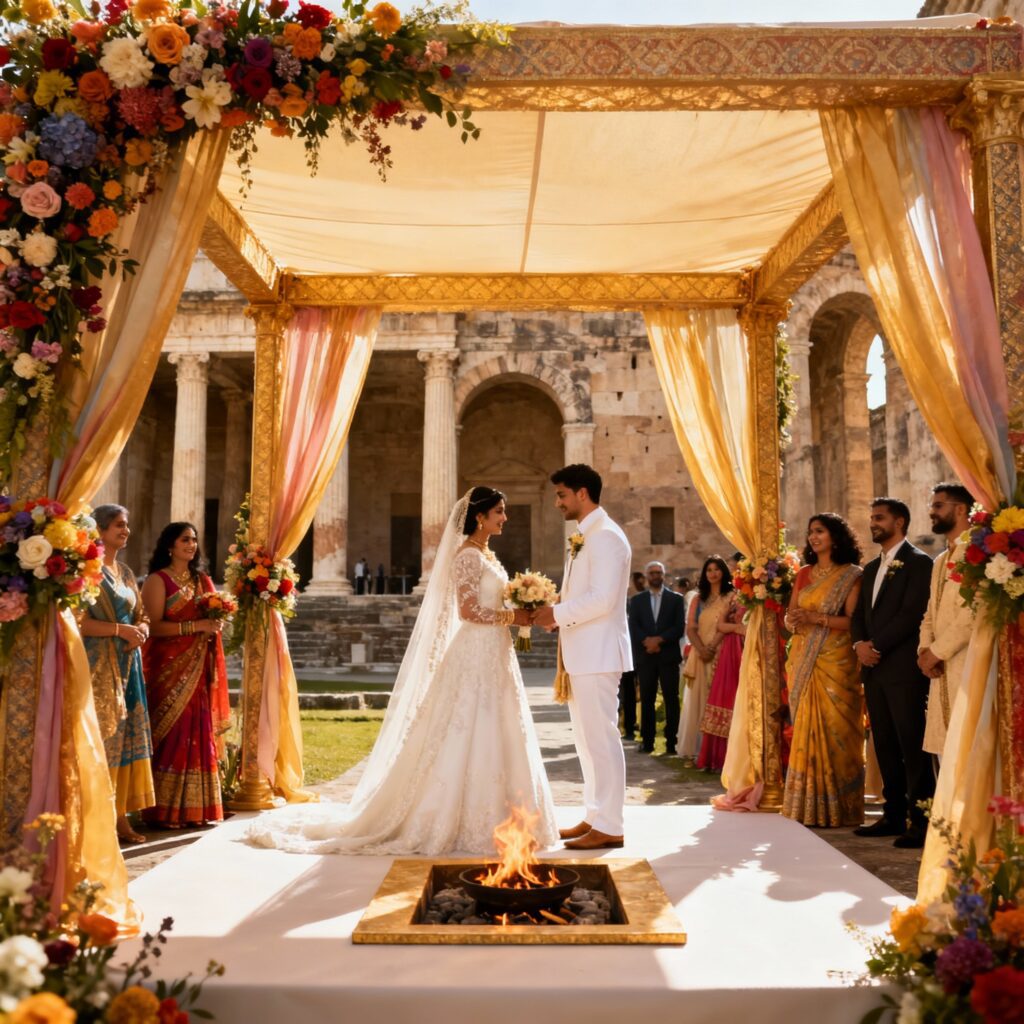
Rome and the Hindu priest share an odd verbal coincidence. The Romans have called their city eternal for two thousand years, and the Vedic tradition calls itself Sanātana, eternal. Two old civilisations, two confident uses of the same word, and they do not mean quite the same thing by it. For Rome, eternity is a civic boast: this city has endured while empires rose around it and collapsed, while faiths displaced one another within its walls, while languages came and went. The Vedic word means something stranger, not a claim about how long the tradition has lasted but the conviction that what it describes, the cosmic order and the structure of things, was never founded and cannot end. The two eternities do not collide; they occupy different floors of the same building.
The practical consequence of the Vedic sense is what matters for a family living here. If the order the rites address simply is how things are, then the rites belong to no single country and are fully kept wherever they are performed properly. A Hindu family in Rome can therefore keep the whole of its tradition in this city, and this page is about how that is done, and about the quiet hospitality the city extends to it.
A Catholic City That Knows How to Receive a Rite
Rome is, by long habit, cosmopolitan, and Italian Catholicism, for all its doctrinal seriousness, recognises another tradition that takes ritual seriously when it meets one. A Hindu wedding held in a Roman garden is not regarded as foreign in the way an Indian wedding in a strictly secular capital might be. The neighbours close their shutters politely, the venue staff find appropriate vessels for the offerings, the Italian florists arrange the marigolds without comment, and the priest gets on with the rite. There is a quiet civility in this that is hard to put into words but easy to feel on the day.
It helps that the dominant tradition here is itself ceremonial. Roman Catholicism keeps a liturgical year, venerates many figures, consecrates flames in its own churches, and treats the body of the rite as carrying real weight. None of this makes the doctrines compatible, and no honest priest pretends they are, but it does mean the Romans understand instinctively why one would build a small fire in a garden for a wedding. Two traditions that each take the sacred seriously recognise each other across the difference of their teachings, and the recognition is mutual, polite, and limited, which is exactly what it should be.
The Romans understand instinctively why one would build a small fire in a garden for a wedding. The doctrines stay distinct; the recognition is mutual, and that is enough.
A Note on the Old Roman Fire
There is a small historical detail here that is quietly moving. The pre-Christian Romans kept a perpetual public flame in the Forum, tended by the Vestals, and they held its continuity bound up with the city’s own; for the flame to go out was reckoned a grave matter indeed. The Romans also believed, like the Vedic ritualists half a world away, that getting the words of a rite wrong invalidated it, and their priestly colleges were as exacting about correct pronunciation as the Veda is about its accents. The parallel is not identity, and the two traditions were never the same, but the coincidence is real.
I prefer the modest reading of it. The soil of Rome was prepared, very long ago, by a culture that revered the kindled flame and the carefully spoken word, and the current Catholic sensibility of the city descends in part from that older one. So when a priest establishes Agni in a Roman home and chants the correct verses over it, he does something the deep memory of this city would, if it could remember, find unsurprising. A flame in a contained vessel on a Roman terrace, kindled with Sanskrit, draws no particular astonishment from the city around it. The Roman fire has, in its own way, long been ready. The deeper meaning of the fire offering is set out at the Vedic Homa.
The Scattered Lazio Community
There are several thousand Hindus in Rome and the surrounding Lazio, but they are not concentrated. The community is spread across the residential districts to the north, the modern quarters to the south, the diplomatic and expatriate areas, and the older neighbourhoods near the centre, and there is no central temple. People meet in homes, in arranged spaces, in halls. This is in fact the older Hindu pattern, well before the great temple cultures rose, when the household was the sacred centre and the priest came to it.
A priest serving Rome works in that old way, travelling across the city to where a family lives, bringing the ceremonial items in a case, establishing the fire in whatever the venue permits, conducting the rite, and leaving the home a little more its own for what has been kept there. Each home where the fire has been honoured becomes, for that family, a sacred place, not in some abstract sense but in the specific, lived sense of being somewhere a real fire has burned for a real reason. The home blessing in particular has a layered quality in Rome, where apartments often carry a great deal of history of their own, and the rite is treated in full in the account of the Gṛha Praveśa.
The dispersal shapes the practical side of engaging a priest as much as the spiritual one. Because no single neighbourhood holds the community, a family does not inherit a local officiant by proximity, as it might near a temple in India, but chooses one and arranges for him to come. This is, on reflection, a freedom rather than a hardship: the family is not bound to whoever happens to be nearest but may weigh a priest on his training and his fitness for the particular rite, and arrange the day around the right person rather than the closest one. The reach across the city, and across the country, is what makes that choice real.
The Practical Side in a Roman Building
Roman apartments and halls have their conditions. Some buildings allow an open contained flame and some do not, though many can accommodate it with the right vessel, proper ventilation, and a sensible conversation with the venue in advance. The chanting and music are managed to respect the neighbours. One detail too often overlooked deserves naming: the auspicious hour for a rite must be calculated for Rome’s own coordinates rather than borrowed from an Indian almanac, since the reckoning of the favourable window depends on local sunrise. The heavens above the Tiber are the same heavens the tradition reads, with adjustment only for the longitude.
One serious note about weddings. Italy recognises only the civil marriage performed before a registrar as carrying legal status, and the Vedic ceremony, however complete in its own register, does not by itself produce a legally recognised marriage. For couples not resident here, the legal step is usually simpler done at home before travelling, since the Italian civil process for foreigners requires apostilled documents and certified translation and is a real administrative undertaking; the specifics change from time to time and should be confirmed with the relevant authority rather than assumed, and this is general information and not legal advice. Settled at home in advance, the wedding day in Rome is then free of paperwork entirely, which is much the better way. The wider context of priestly service across the country is examined in the page on a Hindu priest in Italy.
The Shape of a Roman Wedding Day
A wedding kept in Rome takes one of two broad forms, and they ask different things of the planning. The first is the city wedding proper, held at a garden venue, a historic villa within the municipal area, or a hotel with suitable outdoor space, with guests housed across the central hotels and the celebration unfolding over an afternoon and evening. This suits the couple who want the city itself as part of the occasion, its restaurants and its sights filling the days around the rite. The second is the estate wedding kept just outside the city, in the Lazio countryside or the hills toward the Castelli Romani, where a property can be held for several days and the whole programme flows on one ground.
Either way the Vedic rite at the centre runs unhurried at around two hours when kept in full, and a priest familiar with Rome helps shape the surrounding days, the welcome evening, the henna afternoon, the celebration that follows, around that centre and around the auspicious hour. The early conversation that settles the venue’s permission for the fire, the calculation of the hour for Rome, and the legal matter at home is what frees the day itself to be lived rather than managed, and a priest who treats those arrangements as part of his own office lifts the weight of them from the family.
A Word for Families Planning a Rite in Rome
Confirm with the venue, in writing, that an open contained flame is permitted in the chosen space, and what it requires by way of vessel, placement, and ventilation. That single conversation prevents most of the day’s possible complications. Ask that the auspicious hour be calculated for Rome’s own coordinates rather than read off an Indian figure. Settle the legal marriage at home before travelling. The rest, the timing, the household arrangements, the ceremonial items, the priest brings or guides you on.
A city that has known the sacred flame for two thousand years takes in one more fire kindled within it, by a family come from very far away, without surprise.
agne naya supathā rāye asmān
viśvāni deva vayunāni vidvān
“O Agni, lead us by the good path to prosperity; knower of all our ways, lead us well.”
ĪŚĀ UPANIṢAD 18 · THE PRAYER TO THE FIRE
The prayer is plain. It asks the fire to lead the household by the good path, the path of right conduct and well-being, and to do so with knowledge of all the ways a household might go. Kindled in a Roman apartment, in a small contained vessel, on an ordinary afternoon between conversations with the venue manager and the catering staff, the same fire receives the same prayer it has received for as long as anyone in this tradition has been making it. The fire does not know it is in Rome, and the prayer does not either. Only the family knows, and for the family, that knowing is part of why the day matters.
SCHOLARLY REFERENCES
Primary and academic sources: the Īśā Upaniṣad, with primary Sanskrit texts at Sanskrit Documents, and scholarship on Hindu household ritual through the Oxford Centre for Hindu Studies.
© 2026 AUSTRIAVIENNAPUJA.COM · SANĀTANA DHARMA IN EUROPE
Preserving authentic Vedic transmission across the European continent