Priest | Lineage and Fit Ground
A Hindu Priest in Italy: What Real Training Means
What genuine priestly qualification consists of and how a family can judge it, the warning signs of one who only looks the part, the practical realities of an Italian rite, and why the Italian land receives a Vedic ceremony as readily as it does.
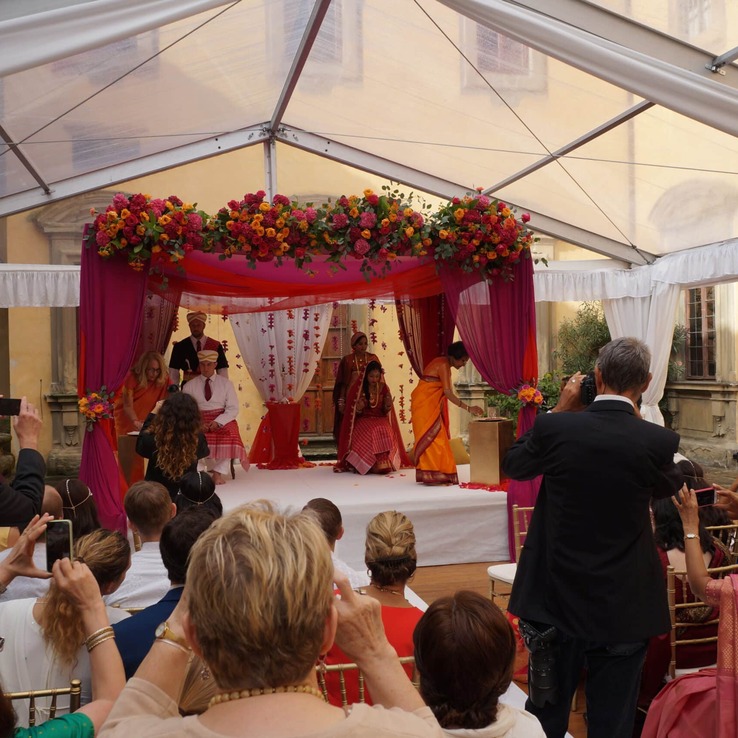
Choosing a Hindu priest in Italy is, in the end, an act of trust, since the person engaged will keep a family’s most important occasions, the wedding, the welcoming of a child, the blessing of a home. The question that matters most is therefore not who is nearest or cheapest but who is genuinely qualified, and qualification in this tradition is a precise thing with old criteria. A family that understands those criteria chooses well; a family that does not may engage someone who looks the part and lacks the substance. This page is about the substance: what real training consists of, how to recognize it, the signs that betray its absence, and why the Italian setting is fit ground for what it carries.
What Genuine Qualification Consists Of
The tradition has always asked several things of its priests, and they are worth knowing before any engagement. The first and weightiest is real training, received over years from a teacher who himself stood in a line of teachers, so that the sacred verses are carried as a living transmission rather than gathered from a printed text. This lineage is not a credential to be displayed; it is the thing that places a priest within the current of the tradition rather than at its margin, and it is what allows the Mantras to be wielded as instruments rather than recited as decoration. A priest cut off from such a line may pronounce the words correctly and still not stand where the tradition asks its officiant to stand.
Two further conditions complete the picture. The priest should himself have undergone the formative rites that qualify a person to perform them for others, since the tradition does not permit one to confer what one has not received. And he should maintain his own daily discipline, the regular round of observance through which a priest’s fitness is held to be sustained, because the tradition rests the efficacy of what he performs for others on the integrity of his own practice. A family is entitled to ask gently about all three, and a priest worth engaging answers such questions gladly rather than with defensiveness. The training, lineage, and years of service of the one who serves these families across Europe are set out in the profile of Pandit Sahadev.
Lineage is not a credential to display. It is what places a priest within the current of the tradition rather than at its edge.
A Priest Who Knows Your Family’s Own Custom
One mark of genuine depth deserves particular notice, because it is easy to overlook and hard to fake. The tradition is not uniform. The way a rite is kept varies by region and by family line, and a priest truly steeped in it knows that a North Indian household, a South Indian household, a Gujarati or a Bengali family each keep their observances somewhat differently, drawing on different inherited customs in the detail of the ceremony. A priest who asks about a family’s own background and adapts the rite to it, rather than applying a single standard ceremony to every comer, is showing the kind of knowledge that only long training provides.
This is worth watching for in a first conversation. Does the priest ask where your people come from and how they have kept these rites, or does he simply describe one ceremony he performs for everyone alike? The former is the mark of real depth; the latter, of a generic approach that may not honor your particular inheritance. The difference shows most at a wedding, where regional variation is at its most visible, and a family marrying in Italy is right to confirm that the priest will keep the form proper to their own line. The fuller doctrinal account of the marriage rite, within which these variations sit, is given in the study of the Vivāha Pūjā.
The Signs of One Who Only Looks the Part
If the marks of a genuine priest are quiet, the signs of an unqualified one are worth naming plainly, because they are easy to miss when a family is far from home and short of options. The clearest is evasiveness about training. A priest who turns every question about his teachers and his line back toward his popularity, his confidence, or his fee is telling a family something by what he steps around. Genuine training is spoken of naturally and without strain; its absence tends to hide behind generalities.
A second sign is rigidity, the officiant who performs one identical ceremony for every household and cannot, or will not, shape it to a particular family’s tradition, since real knowledge is supple where a memorized routine is fixed. A third, and the most serious, is carelessness with the things that actually make a rite valid: a priest content to treat the sacred fire as optional, to put a symbolic flame in place of a real one, or to wave away the auspicious hour as a detail, is one who does not grasp, or does not respect, what the rite requires. None of these signs has anything to do with polish. A smooth and charming officiant can show every one of them, and a plain, modest one none, which is exactly why a family does well to weigh substance over manner.
Why the Italian Ground Receives the Rite
There is a quiet harmony between a Vedic rite and the Italian land, because Italy is a country that has always taken sacred place seriously. Its hill towns are crowned with shrines, its cities built around great places of worship, its countryside scattered with chapels and wayside altars. The instinct that a particular spot can be holy, that a rite belongs to a place and consecrates it, runs deep in the Italian soil. A Vedic ceremony kept here is not an alien thing imposed on indifferent ground; it meets a land already attuned to the sacred, and families often feel the fittingness of that meeting without quite naming it.
The doctrines of the two traditions remain wholly distinct, and no honest priest pretends otherwise. But a culture that reveres sacred place recognizes seriousness of that kind in another, and the Italian welcome to a Hindu rite rests on a long memory of treating ceremony as carrying real weight. This is the deeper reason a fire kindled in a Roman garden or a Tuscan courtyard draws no astonishment from the country around it: Italy understands, instinctively, why one would build a small fire and chant over it for a wedding. The wider regional picture of where these families live and how a priest reaches them is mapped in the guide to a Hindu Pandit across Italy.
The Practical Realities of an Italian Rite
Once a family has found a priest they trust, a few practical matters are worth settling early, and a genuinely experienced priest raises them himself rather than leaving them to surface late. The first is the sacred fire, which a real rite requires. The country villas, agriturismi, and historic estates where so many Italian weddings are held generally accommodate a contained outdoor fire in their gardens or courtyards without difficulty, the estate managers being well used to it; an indoor fire, in a city apartment or a hotel ballroom, is the more restricted case and needs the property’s written permission together with proper ventilation, since the offerings produce fragrant smoke a building’s systems must account for. A priest who handles this conversation with the venue directly, rather than handing it to the family, is showing the same competence his training implies.
The second is the legal point, which spares a family worry later. Italy recognizes only the civil marriage performed before a registrar as carrying legal status; the Vedic ceremony is the religious heart of the occasion and does not by itself produce legal recognition. For couples travelling in for an Italian wedding, the registration is usually simpler settled at home before the journey, since the Italian civil process for foreigners involves apostilled documents and certified translation. These requirements change from time to time and should be confirmed with the relevant authority rather than assumed; this is general information and not legal advice. With that done in advance, the Italian day is free to be the rite and the celebration alone. The spring and autumn months suit the Italian climate best for an outdoor ceremony, the high summer being hot across much of the peninsula, and a date raised early with the priest can be weighed against both the season and the auspicious hour.
Explaining the Rite to the Gathering
A particular gift in the European setting, easily undervalued, is a priest who helps the gathering understand what is unfolding. An Italian wedding or home blessing will often include guests, and family members, who do not know the tradition and cannot follow a ceremony conducted in an ancient language they have never heard. A priest who explains the meaning of each part as it happens, in a language the gathering follows, turns a beautiful but opaque performance into something everyone present can genuinely share, and Italian friends seeing such a rite for the first time leave understanding what they witnessed rather than merely admiring it.
This explanatory care is not a modern dilution but a recovery of something the tradition always valued, the understanding that a rite shared with comprehension is fuller than one merely watched. So it is worth asking a priest directly whether he will narrate the ceremony as it proceeds and help the family take a real part in it. A priest who takes this seriously understands that the occasion exists for the family’s genuine participation and the gathering’s real understanding, not for the display of his own performance.
Beyond the Wedding: The Rites a Family Keeps
Families often first engage a priest for a wedding, but a household settled in Italy will have need of him at other thresholds too, and it is worth knowing what those are before the occasion arrives. A child born to the family is named through the proper rite within its first days; the small ceremonies of early childhood follow at their appointed times; a new home is consecrated when a family moves into it; the festivals of the year are kept with worship and fire offerings; and, when an elder dies, the last rites and the offerings that follow must be conducted properly, often at very short notice.
This is the practical case for choosing carefully rather than expediently. A priest engaged once for a wedding, and found to be genuinely trained, becomes the one a family calls for everything that follows, and over the years he comes to know the household, its regional customs, and its particular line. That accumulated familiarity is worth a great deal, and it is why the question of qualification deserves the attention this page gives it. The full range of the worship and fire offerings a household may call for is set out in the account of the Pūjās and Homas.
Questions Worth Asking First
Ask how the priest was trained and from whom, since genuine training is long and received in an unbroken line. Ask whether he asks about your family’s own regional custom and adapts to it. Ask whether he will explain each part of the ceremony in a language your guests follow, and confirm that a real consecrated fire will be kindled with the venue’s permission. A well trained priest welcomes all of this, because the household is entitled to know whom it is inviting into the founding moments of its life, and the asking is itself part of preparing for the day.
The Italian earth beneath the rite does not diminish it. A land that has always honored sacred place receives it gladly.
ā no bhadrāḥ kratavo yantu viśvataḥ
“Let noble thoughts come to us from every side.”
ṚGVEDA 1.89.1
The old prayer that noble thoughts may come from every side carries a generous spirit fitting for a tradition kept in a new land. The Veda never imagined the sacred as bound to one soil; it welcomed what was good from wherever it came and trusted that the holy could be honored under any sky. A Vedic rite kept in Italy lives out that openness, an ancient tradition meeting a country with its own long reverence for sacred place, and a family settled along the peninsula may keep the whole of its inheritance there in full, through a priest whose training lets him carry it rightly.
Primary and academic sources: the Ṛgveda, the priestly and household-rite texts gathered at Sanskrit Documents, and scholarship on the priestly tradition through the Oxford Centre for Hindu Studies.
© 2026 AUSTRIAVIENNAPUJA.COM · SANĀTANA DHARMA IN EUROPE
Preserving authentic Vedic transmission across the European continent