Pandit | The Lombard Plain
A Hindu Pandit in Milano: Lombardy and the Lakes
Vedic priestly service for the Indian households of Milano and the Lombard plain, the lake villas of Como and Garda, the two quite different occasions the region asks for, the handling of the sacred fire in a Lombard property, and how the rite reaches you from Vienna.
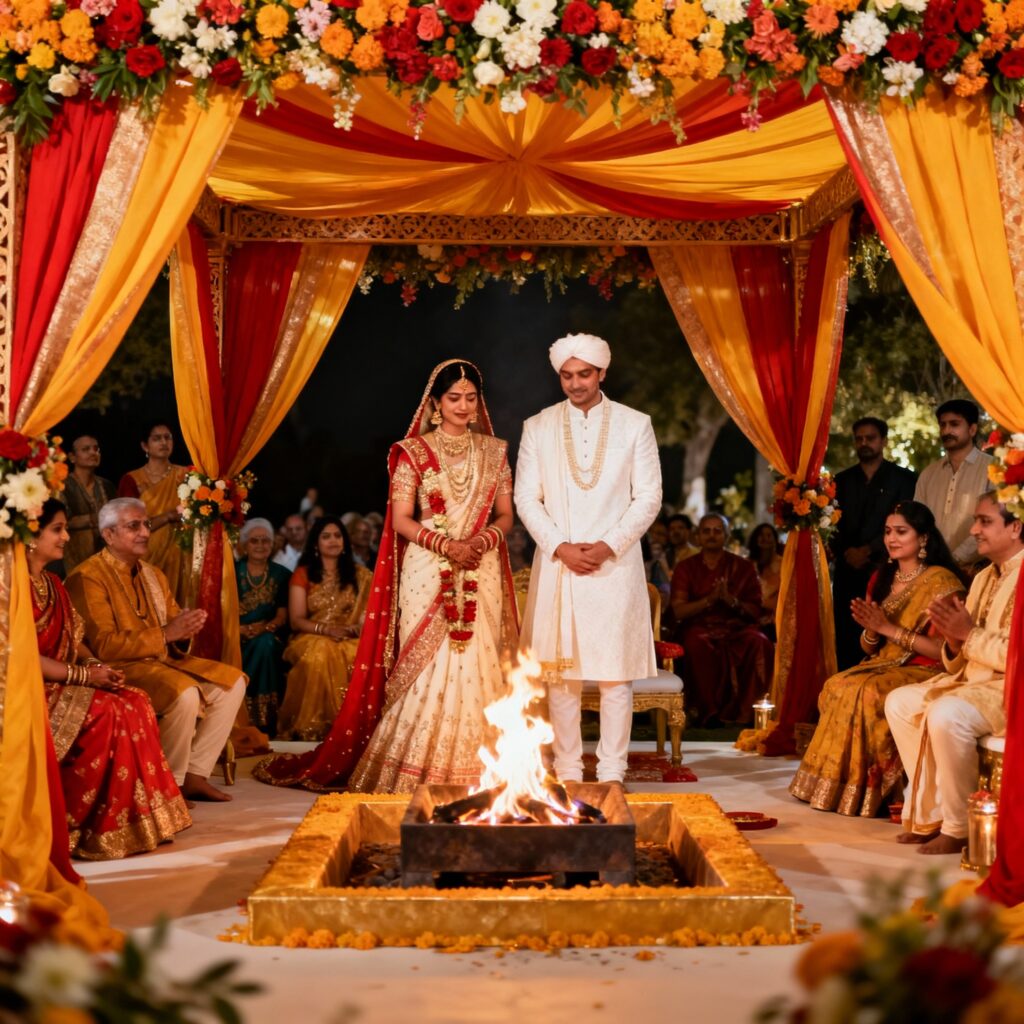
For most Lombard households, engaging a Hindu Pandit in Milano is the practical matter of finding someone properly trained who can reach the home on the day that matters. The Indian community of Milano is not small. It gathers around the finance houses of Porta Nuova, the design studios and fashion ateliers between Brera and the Tortona quarter, the engineering and pharmaceutical firms of the hinterland, and the research faculties of the Politecnico and the Bocconi. From this professional core it spreads across the whole Lombard plain, into Monza and the Brianza, toward Bergamo, Brescia and Pavia, and north into the lake towns of Como and the western shore of Garda. A Pandit who serves a community this scattered travels to where the family lives rather than waiting at a fixed altar.
This page is written for the family weighing whom to invite into the home for an important occasion. It sets out the shape of the Lombard community and its lake country, the two distinct kinds of occasion the region produces, the practical detail worth settling early, how to judge whom you are engaging, and the plain logistical fact of how a priest of full training reaches Milano without the compromise that so often attends a rushed local arrangement.
The Lombard Setting and the Lake Country
Milano anchors the economic life of the Italian north and holds the densest concentration of Indian professionals anywhere in Lombardy, working across finance, fashion, industrial and product design, supply-chain logistics, and the corporate and academic sectors of the city. Family life follows the work outward: a young couple establishing themselves near Città Studi, a settled family in the green belt of the Brianza north of Monza, parents and grandparents drawn together from across Europe for a wedding or a naming. The geography of the community is real, and the rite must meet it where it stands rather than expecting it to gather in one place.
North of the city the lake country shapes an altogether different kind of occasion. The historic villas along Lake Como, around Bellagio, Cernobbio and the Tremezzina shore, and the gardened estates of Garda and Maggiore, draw a steady season of destination weddings. Families gathered from London, Vienna, the Gulf and India choose these shorelines precisely because the setting holds a dignity worthy of the rite. A Pandit working the region must be at ease in both worlds, the household Saṃskāra kept quietly in a Milano flat and the multi-day wedding staged at a lakeside villa with two large families present, and the arrangements each demands differ considerably. The fuller picture of a wedding on the water is set out in the guide to an Indian wedding at Lake Como.
A short flight from Vienna, the rite carried to the Lombard home. The same priestly service, whether the journey is a street away or across the Alps.
Two Occasions the Region Produces
The Lombard calendar of a Pandit divides cleanly into two. The first is the quiet household rite kept in the city: the naming of a newborn, the first feeding, the blessing of a new apartment as a young family moves in, the rites of remembrance, the seasonal devotions of the year. These are kept indoors or in a small garden, with the household gathered, and they are frequent in Milano as professional families establish themselves and wish to consecrate the thresholds of their life rightly. The Gṛha Praveśa in particular is asked for often, as new apartments across the city are taken up and the families wish to honour the dwelling before they settle into it.
The second is the lakeside wedding, the most elaborate observance of all, kept before the sacred fire with both households present and the programme commonly extending across several days. In Lombardy this is staged as often at a Como or Garda villa as in the city, and it asks a quite different order of preparation: larger materials, an outdoor canopy on an exposed terrace, coordination with an estate manager, and the timing of a long rite around the auspicious hour. A Pandit familiar with both registers moves between them through the season. The wider Italian wedding context is treated in the page on a Hindu wedding in Italy.
The Sacred Fire in a Lombard Property
The fire is the heart of any Vedic rite and the chief practical detail worth settling early, and in Lombardy the answer differs sharply by setting. The villas and estate properties of Como, Garda and the countryside generally accommodate a contained open fire in their gardens or courtyards without difficulty; the estate managers along the lakes are by now well used to hosting the rite, and the regulatory framework respects established religious practice where sensible safety provision is made. The garden wedding, in short, is rarely an obstacle.
Indoor fire is the more restricted case, whether in a Milano apartment or a hotel ballroom, and it needs explicit written permission from the property together with proper ventilation and a safe contained vessel for the flame, since the offerings produce fragrant smoke that a building’s detection system must account for. A good Pandit handles this directly with the venue rather than leaving it to the family, knowing the precise questions to put to a Como villa coordinator or a Milano building administration. The materials of the rite are sourced through the established Indian provisioning channels of the city and, where a lakeside wedding calls for more, carried prepared from Vienna. The deeper meaning of the fire offering itself is set out at Homa and the sacred fire.
Reaching Milano from Vienna
A plain word on how the work arrives, since it is what makes a priest of full training available to a Lombard household at all. The direct flight from Vienna to Milano is under ninety minutes, and the rail connection through the Brenner and the Lombard line is a comfortable alternative for families who prefer the ceremony materials to travel by road. In practice this means a Milanese or Lombard family can secure a properly trained Pandit without depending on whoever happens to be nearest, and without the compromise that a rushed local arrangement so often carries. The journey is short, the date is held firmly, and for a significant occasion the Pandit arrives a day ahead, both to rest and to see an unfamiliar venue before it must be used.
This reach is why distance need not narrow a family’s choice. The nearest available officiant is not always the right one, and a region as well connected to Vienna as Lombardy allows a family to weigh a priest on his training and his fitness for the particular rite rather than on proximity alone. When you discuss the arrangement, raise the practical points plainly: who bears the cost of travel and a night’s lodging, whether the Pandit will study the venue before the day, and what he carries against what is sourced locally. A Pandit who treats these as part of his own office, rather than the family’s burden, is showing the care his training implies.
Choosing Whom to Engage
Since the Pandit will be invited into the home for the most important occasions of a family’s shared life, choosing one deserves more thought than picking whoever is nearest or recommended in passing. A few gentle questions in a first conversation reveal a great deal. Ask how the Pandit was trained and from whom, since genuine training in this tradition is long and is received from a teacher who himself learned from a teacher in an unbroken line. Ask whether he has worked across European venues before, because experience matters greatly when the setting is a Como terrace, a Milano courtyard, or an estate kitchen rather than the familiar surroundings of home. Ask whether he will explain the meaning of each part of the ceremony as it unfolds, which matters particularly at a lakeside wedding where many guests, Italian friends and colleagues among them, will be present at a Vedic rite for the first time.
A well-trained Pandit answers such questions gladly and without defensiveness, and none of them is impertinent. The household is entitled to know whom it is inviting into the founding moments of its life, and a Pandit who has nothing to hide regards the asking as proper rather than intrusive. The wider role of the Pandit who carries this work across the continent is set out in the account of the Vedic Pandit in Europe.
A Word on Civil Marriage
For weddings, one note spares families later worry. Italy recognises only the civil marriage performed before a registrar as carrying legal status; the Vedic ceremony is the religious heart of the occasion and does not by itself produce legal recognition. For couples travelling in for a Como or Garda villa, the legal registration is usually simpler settled at home before the journey, since the Italian civil process for foreigners involves apostilled documents and certified translation, and the specifics change from time to time and should be confirmed with the relevant authority rather than assumed; this is general information and not legal advice. Couples already resident in Lombardy handle it directly with their own Comune. The broader pattern of this travelling service across the continent is set out at the Hindu Pandit in Europe.
A scattered community across the Lombard plain, kept by one who travels between its homes. The rite goes where the families live.
vāstoṣpate prati jānīhy asmān
svāveśo anamīvo bhavā naḥ
“Lord of the dwelling, acknowledge us; be a kind threshold to us, free of affliction.”
ṚGVEDA 7.54.1 · THE HYMN TO THE LORD OF THE DWELLING
The old hymn to the guardian of the dwelling asks the simplest thing a household can ask, that the home receive its people kindly and hold them free of harm. A Milano apartment near the Navigli, a country house in the Brianza, a villa above the water at Bellagio, becomes for the hours of an observance a place of full sacred dignity, and that dignity travels with the Pandit who carries it to the door. The Lombard region holds many such roofs now, and the older work of going where families live continues among them with the same quiet steadiness, whether the journey begins a street away or with a short flight across the Alps.
SCHOLARLY REFERENCES
Primary and academic sources: the Hymn to Vāstoṣpati in the Ṛgveda, the household-rite literature gathered at Sanskrit Documents, and scholarship on the domestic rites through the Oxford Centre for Hindu Studies.
© 2026 AUSTRIAVIENNAPUJA.COM · SANĀTANA DHARMA IN EUROPE
Preserving authentic Vedic transmission across the European continent