Vivāha | A Lakeside Planning Guide
Indian Wedding in Lake Como: A Priest’s Guide
The villas, the fire permission, the wind that crosses the water, the Italian legal step, and the Muhūrta reckoned for Como’s own sky rather than for India’s.
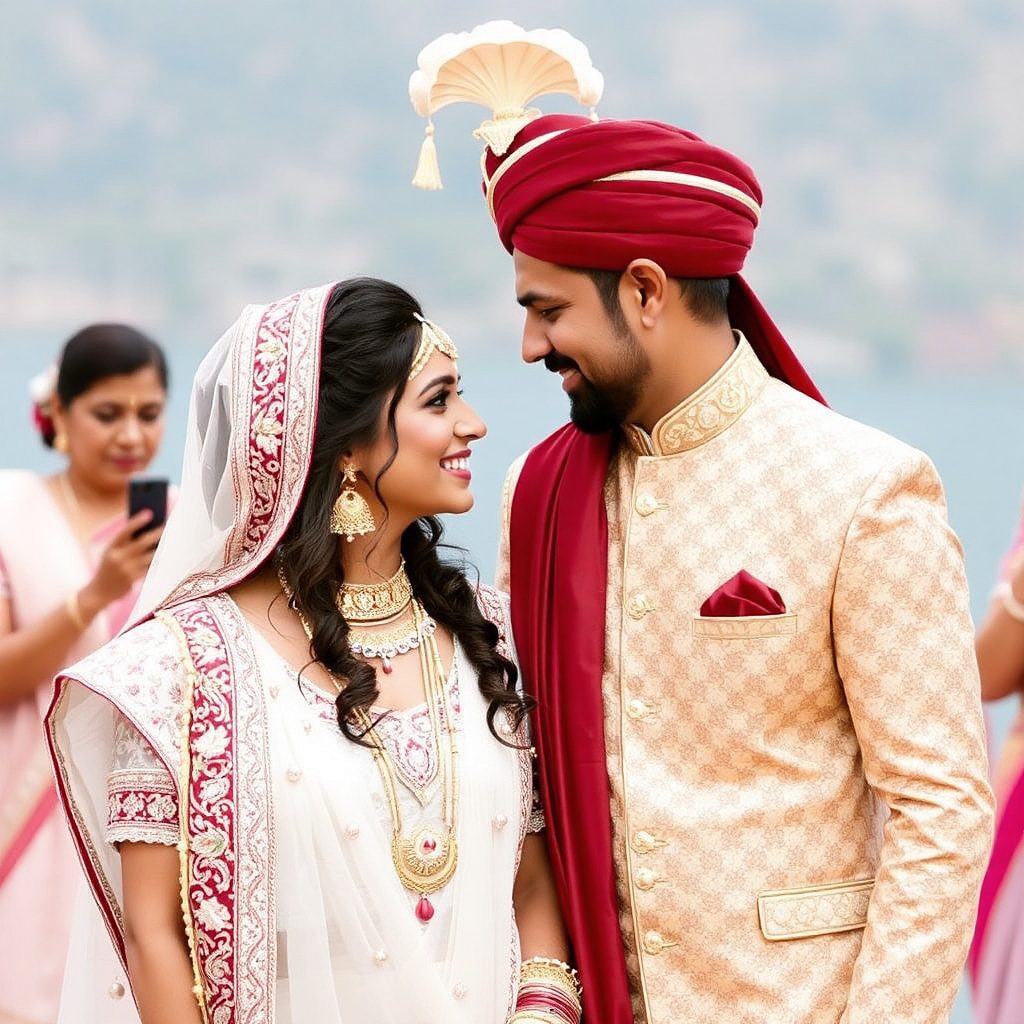
The Vivāha kept before the consecrated Agni at a villa on the lake.
An Indian wedding in Lake Como rewards careful preparation more than almost any other European setting, and exposes the lack of it just as quickly. The lake lies where the Lombard plain meets the southern rampart of the Alps, and the villas along its shore were built by families who understood ceremony centuries before the word destination attached itself to weddings. Bellagio, Varenna, Como town, the quieter eastern shore: each gives back something different to the same rite. What follows is written from the officiant’s side of the fire, which is to say from the side answerable for whether the Saṃskāra comes out whole.
The difference between a Como wedding that works and one that merely photographs well is rarely visible on the day. It is settled six months earlier, in a written answer about open flame, in a catering clause, in the question of where on this particular lake this particular guest list will actually fit, and in whether the auspicious hour was calculated for longitude nine degrees east or for a meridian a continent away. Settle those and the day carries itself. Leave them and no view, however celebrated, repairs the experience.
The Rite in Its Proper Sequence
Vivāha is a Saṃskāra, a consecration, and among the sixteen it is the one that constitutes a household. It does not celebrate an affection already present; it makes two people into a single ritual unit competent to maintain a domestic fire and to discharge the obligations that follow from it. The sequence is set down in the Gṛhya Sūtras, the Pāraskara and the Āśvalāyana above all, and it has an internal logic that the day’s timetable must respect.
The Agni is established and consecrated as the witness of everything that follows. Gaṇeśa is worshipped and the day itself declared pure. The groom is received with the Madhuparka. The bride is given in Kanyādāna and her hand taken in Pāṇigrahaṇa, with the verse gṛbhṇāmi te saubhagatvāya hastam, I take your hand for good fortune. Offerings are made in the Vivāha Homa. In the Lāja Homa the bride offers parched grain into the flame. The couple circles the fire in Agni Pariṇayana. In Aśmārohaṇa the bride sets her foot upon a stone, that her steadiness may be like it. Then the Saptapadī, the seven steps, each with its own petition: nourishment, strength, prosperity, happiness, progeny, the seasons, and the friendship that is the seventh and binding one. The Dharmaśāstra is explicit that the marriage becomes irrevocable only when the seventh step is completed. The evening may close with the darśana of Dhruva and Arundhatī, the fixed star and the faithful companion. The doctrinal account in full is set out in the treatment of the Vivāha Pūjā.
Two consequences follow for planning. The fire is not a decorative element that a venue may substitute with something safer; without a properly established flame there is an appearance of a wedding and not the rite. And the sequence takes time. Ninety minutes is brisk. Three hours is normal where a family keeps the full observance. A schedule that allots forty minutes between the photographs and the meal has not understood what it is scheduling.
The villa hires you the property. The Agni and the seven steps make the marriage. Secure both, in that order.
Choosing Where on the Lake
Como is shaped like an inverted Y, its two southern legs meeting near Bellagio. The character of the water changes with that geography, and so does the character of a wedding held beside it.
Bellagio, on the central promontory, is the most celebrated and the most costly: historic villas, terraced gardens dropping to the water, views along both arms of the lake, and a town accustomed to ceremony long before destination weddings became a category. Indicative figures run from forty to eighty thousand euros for venue hire alone, and seventy to a hundred and forty thousand for a full-service celebration of a hundred to a hundred and fifty guests. Como town and the central southern shore offer much of the same at somewhat gentler rates and with better availability, roughly thirty-five to seventy thousand for the venue and sixty to a hundred and twenty for full service, with shorter transfers from Milan. Varenna and the eastern shore are quieter, less crowded and often more personal in service, at thirty to sixty and fifty to a hundred respectively. Private villas taken exclusively for a weekend, frequently with accommodation on the grounds, run thirty-five to seventy-five for the property and fifty-five to a hundred and thirty for comprehensive arrangements.
A villa held exclusively gives the days a coherence that hotel celebrations seldom achieve, since the Mehndī, the Sangīt and the wedding morning all unfold in one place without convoys between them. Como also permits something no inland venue can offer: arrival by water. Where a villa has its own jetty, the Baraat may come across the lake by boat rather than by road, which solves the procession problem that narrow shore roads otherwise create. The broader survey of Italian possibilities is at the Hindu Indian wedding in Italy page.
The figures above are indicative ranges for early budgeting and vary considerably by property, season and guest count. Confirm current rates directly with each venue and supplier.
Can a Sacred Fire Be Kindled at a Lake Como Villa?
At many properties yes, at some only outdoors, and at a few not at all. This single question prevents most of the difficulties a Como wedding can encounter, and it must be answered in writing before any contract is signed.
The historic villas are frequently protected properties, and their obligations regarding fire, smoke and alteration of the fabric are stricter than a general venue policy suggests. The staff at the established Como estates have hosted enough Hindu weddings to understand the question immediately; their answers differ, and the difference decides the venue. Ask for four things specifically: that a contained open flame in a sanctioned vessel is permitted for the rite; where on the property it may be placed; whether an insulating base and sand bed will satisfy their requirements over stone, timber or lawn; and, if the ceremony is indoors, what ventilation they require, since ghee and camphor produce real smoke and a closed hall with painted ceilings is rarely the right room for it.
Put the permission in the contract rather than in an email thread. Staff change between the booking and the wedding, and a clause survives a change of manager in a way that a friendly assurance does not.
The Wind, the Maṇḍapa and the Audibility of the Mantra
Lake Como has two daily winds that its sailors have relied upon for centuries, and a lakeside fire has to be placed with both in mind. The Tivano descends from the north in the early morning and usually settles by the middle of the morning. The Breva rises from the south around midday and strengthens through the afternoon, often considerably. A maṇḍapa set on an open southern terrace at three o’clock in the afternoon is placed in the strongest air of the day, and a fire that gutters, smokes sideways and has to be shielded by hands mid-rite is a distraction the family will remember.
The remedy is placement rather than equipment: back the vessel to a wall, a hedge or the closed side of the canopy, keep the open faces of the maṇḍapa away from the prevailing quarter for the chosen hour, and prefer a morning slot on the exposed terraces. The same wind carries away sound. Over open water and moving air, recitation that would fill a hall at home reaches no further than the front row. Where the ceremony is outdoors and the guests are many, a discreet microphone for the officiant is not a concession to spectacle; it is what allows the Mantra to be heard by the two people for whom it is being spoken.
The Days Around the Rite
A full program usually comprises three gatherings across two or three days: the Haldī or turmeric rite, the Mehndī evening, and the Sangīt of music and dance. None of these is the consecratory ceremony; they belong to the social and familial life of the marriage rather than to its Śāstric substance, and understanding that distinction keeps the proportions right when the schedule tightens. On Como they suit the villas unusually well, with gardens for the Mehndī, a lakeside terrace for the Sangīt, and an enclosed room for the Haldī.
When confirming a property, ask whether it can host events across successive days, whether separate spaces exist for each, whether decoration may be set up and left in place between them, and what the local rules on amplified music after dark require. That last point is sharper here than elsewhere. Sound travels far across still water at night, the villages sit close to the shore, and municipal limits on evening music are enforced. A Sangīt that must end at eleven is a different evening from one that may run to one in the morning, and it is better to know which you have booked.
Bringing the Guests to the Lake
Como is among the easier Italian destinations to assemble a guest list at. Milan Malpensa and Linate lie within roughly an hour to ninety minutes of most of the lake, Bergamo Orio al Serio serves much of the low-cost European network, and Malpensa in particular takes direct flights from across Europe and beyond, so relatives converging from several countries arrive without elaborate routing. Families arriving through Milan and wishing to keep observances in the city before traveling north will find the arrangements described on the Hindu pandit in Milano page.
The point to plan around is that the lake, beautiful as it is, slows movement once you are on it. The shore roads are narrow, winding and slow in season, and crossing from one arm to the other is frequently faster by passenger ferry than by car, though the ferry timetable thins outside the summer months and does not serve a late-night return. A villa with accommodation on or near the grounds, or a tight cluster of properties within a few minutes of one another, saves hours of shuttling across a three-day program. Choosing the venue for its logistics rather than for its photographs alone is what produces an unhurried few days.
Is the Hindu Rite Legally Recognized in Italy?
Not by itself. Italy treats the civil marriage performed before an Italian registrar as the act with legal effect. The Vivāha, however complete in its own register, does not by itself produce a marriage that Italy or a couple’s home country will recognize in law, and the two should be understood as separate acts rather than as one event with two descriptions.
Civil marriage in Italy for non-residents is entirely possible, and it is an administrative undertaking: apostilled birth certificates, sworn translations into Italian, a declaration of no impediment completed in person at the Comune, the physical presence of both partners in Italy, a sworn interpreter at the ceremony where neither partner speaks Italian, two witnesses, and an appointment with the Civil Registry arranged well in advance. Interpreter availability in high summer is limited and should be secured early. Requirements change and differ between municipalities; confirm them with the relevant Comune or a qualified professional rather than assuming them, since what follows here is general information and not legal advice. Most couples not resident in Italy find it simpler to complete the civil formality at home before traveling, leaving the Como day clear of paperwork. The wider European picture is set out in the treatment of legal recognition of the Hindu wedding in Europe.
The Muhūrta Must Be Reckoned for Como’s Sky
This is where a wedding on the lake most often goes quietly wrong, and where the error is invisible to everyone but the priest. A Muhūrta is not a time of day carried in a Pañcāṅga like a fixed appointment. It is a configuration, and the elements that determine it, the Lagna rising on the eastern horizon, the position of the Tithi and Nakṣatra at that place at that moment, the inauspicious intervals to be avoided, are all functions of where on the earth you stand.
Como sits near nine degrees east and forty-six degrees north. Indian Standard Time is reckoned from eighty-two and a half degrees east. A Pañcāṅga computed for Bhārata therefore reports the transitions of Tithi and Nakṣatra at Indian clock times, and the intervals derived from sunrise, Rāhu Kāla among them, are derived from an Indian sunrise. Transposed to the lake without recomputation, they are simply the wrong hours. The latitude compounds it: at forty-six degrees north the summer day runs from before half past five in the morning until after nine in the evening, so the division of the daylight that yields the day’s auspicious and inauspicious segments produces intervals of a length no Indian reckoning would give. The Saṅkalpa, which names the place and the time of the rite, must name coordinates that were actually used in the calculation.
The same latitude offers something back. Dhruva, the pole star, stands some forty-six degrees above the northern horizon here, and the Saptarṣi never set, so the darśana of Dhruva and Arundhatī that closes the Vivāha is easily kept on a clear night. In June it must simply be set late, since the sky at this latitude does not darken sufficiently until well after ten. Ask the officiant plainly, before engaging him, for which coordinates the Muhūrta will be computed. The answer is diagnostic.
Season and the Lake’s Year
Como keeps a four-season climate, milder than the Mediterranean coast but distinctly continental in its rhythm. The usable window runs from April to October.
April and early May bring fresh growth, mild air and a lake still relatively empty. Late May and June are warm and beautiful as the crowds build. July and August are the peak in every sense: the warmest weather, the longest light, the highest prices, the tightest availability, and afternoon thunderstorms that form over the foothills with little warning, which is an argument for a covered contingency space and for a morning ceremony rather than a late-afternoon one. September and early October are the shoulder favored by those who have planned here before, with settled weather, low golden light on the water and noticeably better rates. From the middle of October the properties begin to close, the light shortens, and an outdoor ceremony becomes difficult to commit to with confidence.
Before the Venue Contract Is Signed
Six Matters to Settle in Writing
One, that the property permits a contained open flame for the rite, with the placement and base requirements stated. Two, that it will host the full multi-day program and that decoration may remain in place between events. Three, the catering arrangement, since many Italian venues impose a preferred supplier and Hindu requirements vary widely. Four, the municipal limit on amplified music after dark. Five, that the officiant is qualified in the Gṛhya tradition and will compute the Muhūrta for Como’s coordinates. Six, that the civil marriage will be completed at home before traveling. With these six resolved, the remainder of the planning tends to resolve itself.
The Choice That Determines What the Day Is
Of every decision a Como wedding involves, the officiant is the one that determines whether what takes place is a Hindu wedding in the full sense or a beautiful event arranged to resemble one. A venue can be exchanged, a season adjusted, a guest list trimmed. The priest carries what no other supplier brings to the property: the transmitted Mantra with its accent intact, the competence to establish and consecrate the Agni, and the judgment to fit the rite to the family before him without abbreviating what may not be abbreviated. That competence is not self-conferred; it descends through a line, and what that line consists of is set out in the account of the Vedic lineage a Hindu priest stands within. Engage him first and build the day around what the rite requires. The reverse order, attempted often enough, never quite closes.
The villas and the lake are gifts. The Agni and the seven steps are the wedding. Plan well, and the gift and the rite meet as they should.
ihaiva stam mā vi yauṣṭam
viśvam āyur vyaśnutam
Remain here together; be not parted; attain the full span of life as one.
ṚGVEDA 10.85.42 · THE MARRIAGE BLESSING
That petition is what the rite finally asks for. Remain together; reach a full life as one. Whatever else has gone into the day, the villa, the water, the months of arrangement, the photographs that will be looked at later and remembered selectively, the marriage rests on what was spoken over the fire and on the seventh step that sealed it. Como is a beautiful place at which to begin a long life together. The consecration does the rest.
For further study on the marriage rite and its sequence, the Pāraskara Gṛhya Sūtra, with primary texts at Sanskrit Documents and scholarship through the Oxford Centre for Hindu Studies.
© 2026 AUSTRIAVIENNAPUJA.COM · SANĀTANA DHARMA IN EUROPE
Preserving authentic Vedic transmission across the European continent