Vighneśvara | The Lord of Thresholds
Significance of Ganesh Chaturthi: Vighneśvara
What the title Vighneśvara actually means, how the image is read as a text, why the Vedic verse used to invoke him was not composed for him, and what the immersion is really doing.
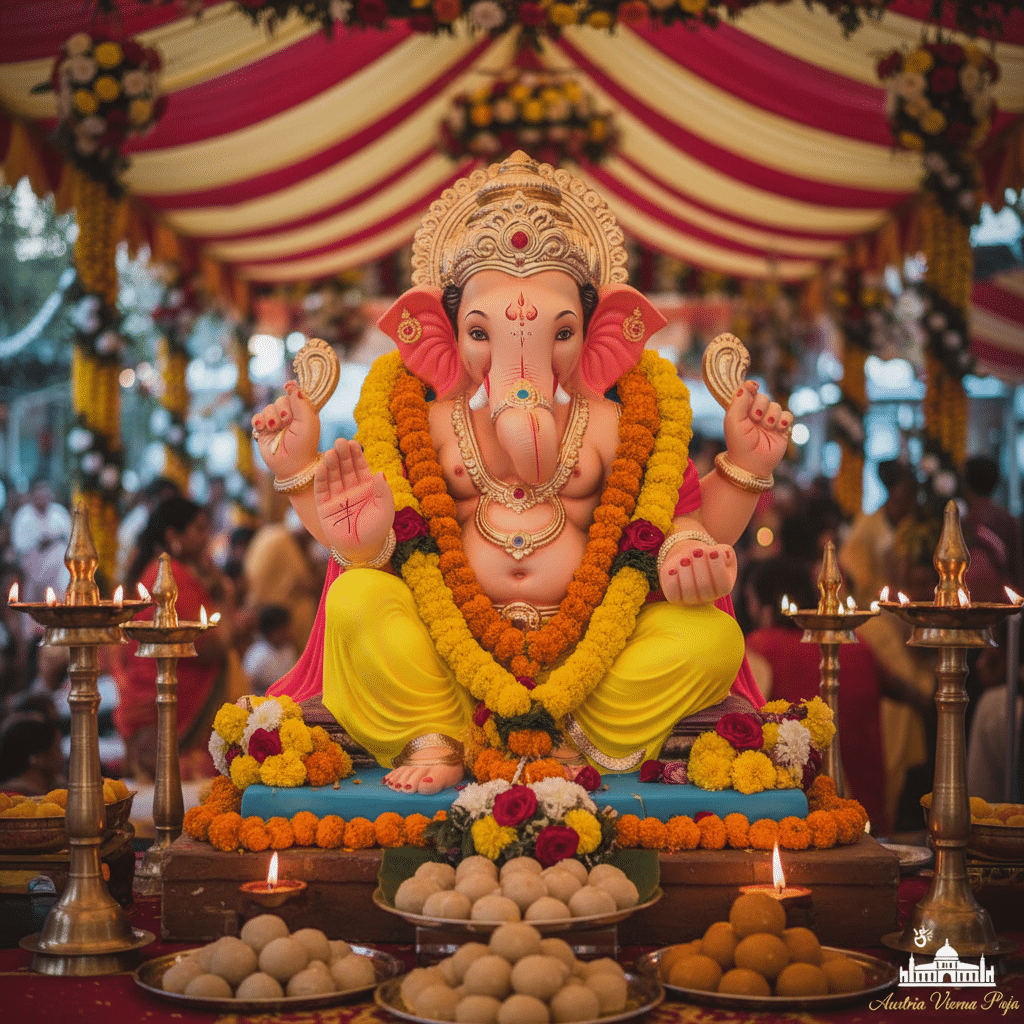
The image seated, garlanded and lamp-lit, for the days of the festival.
Before any undertaking of consequence the tradition turns first to one Devatā, and the significance of Ganesh Chaturthi lies in what that precedence actually means. The festival falls on the fourth Tithi of the bright fortnight of Bhādrapada, which places it in late August or September, and runs for ten days to Anantacaturdaśī. For that span the image is installed, served, sung to, and then carried to water and dissolved.
Two easy readings are worth refusing at the outset. The first treats the festival as folk color, pleasant but shallow. The second treats the elephant-headed form as a charming myth and nothing more. In this tradition the form of a Devatā is not a portrait but a kind of writing, every feature a considered statement, and the festival is that writing unfolded across ten days. What follows reads the title, the form, the Vedic verse, and the immersion, in that order.
Vighneśvara: Lord of Obstacles, in Both Directions
The familiar title is Vighneśvara, ordinarily rendered the remover of obstacles. The Sanskrit says something else. Vighna is the obstacle and īśvara is the lord of it, and he is lord of obstacles in both directions: he removes them for the sincere and sets them before the careless. The parallel title Vighnarāja carries the same sense. An obstacle, on this understanding, is not simply a misfortune to be resented. It is a guardian posted at the threshold of an undertaking, testing the seriousness of whoever approaches and turning back those who would rush in unprepared.
The deeper teaching, then, is not that he clears every difficulty from the path. It is that he grants the discernment to meet difficulties rightly: to know which obstacles are guardians to be heeded and which are barriers to be passed, and to proceed with judgment rather than force. This is why he is worshipped before every other Devatā, before the Goddess, before Viṣṇu, before Śiva his own father. The precedence is a statement about the order of things: that nothing worthy begins except from understanding, and that the inner obstacles of confusion and haste must be cleared before any outer aim is pursued.
He is not the remover of obstacles but their lord, which means he also sets them. An obstacle is a guardian at a threshold, and the gift asked of him is the judgment to tell one kind from the other.
The Guardian at the Door
The origin narrative says the same thing in story form, and it is worth telling plainly rather than gesturing at. Pārvatī, wishing to bathe undisturbed, formed a boy from the substance of her own body and set him at the door with the charge to admit no one. He kept that charge so completely that when Śiva returned and sought entry, the boy refused him. In the conflict that followed the boy’s head was struck off. Pārvatī’s grief was such that the world could not be restored until he was, and the head of the first creature found, an elephant, was set upon him and life returned. He was then given precedence over all the hosts, the gaṇas, and the name Gaṇapati with it.
Read carelessly this is a violent curiosity. Read attentively it is exact. He was born a guardian of the door and remains one. He was destroyed by the very force he was set to withstand and was restored greater than before. And the head he received is not a punishment but the emblem of what he had shown: unhesitating fidelity to a charge. The obstacles he embodies stand at the entrance to every venture, not to punish, but to keep the heedless from harming themselves by rushing through.
Reading the Form
Every feature is a sentence. The elephant head signifies wisdom and the capacity for steady, deep thought, the elephant being an emblem of memory, of strength, and of the power to move through dense difficulty without panic. The great belly signifies the capacity to contain and digest everything life brings, the pleasant and the unpleasant alike, without being overturned by either. The trunk, which can uproot a tree and also lift a single blade of grass, signifies the union of great power with great delicacy, force or the lightest touch as the moment requires.
Even the vehicle is a teaching. The Mūṣika, the mouse, is the restless gnawing appetite, the small hunger that multiplies and consumes in the dark, and it is shown mastered and set to service beneath the lordship of wisdom rather than left to rule. And the offering beloved of him, the Modaka, is named from moda, delight: that which gives joy. The sweetness of realized understanding is not a metaphor imposed on the dumpling afterward. The word itself carries it. Read together the features compose a single portrait of the wise person as the tradition imagines them, containing the world without being overwhelmed by it, powerful and gentle at once, master of their own small hungers.
The Verse That Was Not Written for Him
The invocation chanted at the opening of almost every rite is gaṇānāṃ tvā gaṇapatiṃ havāmahe, and it is genuinely Vedic: Ṛgveda 2.23.1, from the second Maṇḍala, ascribed to the Ṛṣi Gṛtsamada. But the Devatā of that Sūkta, as the traditional index gives it, is Brahmaṇaspati, the lord of the sacred word, identified with Bṛhaspati. The verse was not composed for the elephant-headed form, whose iconography belongs to a later period, and an honest account should say so rather than let the point be discovered as an embarrassment.
What follows from that is not what the skeptics suppose. The tradition determines the use of a Mantra by viniyoga, its appointed application, and viniyoga is fixed by the tradition that employs the Mantra, not solely by the Devatā named in the index. A verse addressing the lord of the gaṇas, praising him as the seer among seers and the foremost king of the sacred utterances, was received by later tradition as the proper invocation of Gaṇapati, and that reception is itself authoritative within the system that made it. The verse is doubly apt: gaṇa means both a host or company and a group of sacred utterances, and both senses hold.
So the correct answer to the question of whether Gaṇeśa appears in the Veda is neither a flat yes nor a flat no. The name and the function are Vedic. The form is Purāṇic. The tradition joined them deliberately, and understanding how it did so tells one more about the working of Mantra than any simpler answer would. The same principle governs the whole of the ritual literature, and is set out further in the account of Hindu Pūjā in the Vedic and Tantric traditions.
Prāṇa Pratiṣṭhā: The Seating of the Presence
The festival opens with the installation of an image, in the home or in a public pavilion, and this is not the placing of a statue. Through Āvāhana, the invitation, and Prāṇa Pratiṣṭhā, the establishing of the living breath, conducted by a qualified officiant with the prescribed Mantras, the Devatā is asked to dwell within the fashioned image for the duration. What was clay becomes, for these days, a seat of the divine, to be served rather than admired. From that moment the image is treated as a guest who has actually arrived: woken, bathed, dressed, fed, and put to rest.
Through the days that follow the seated presence is honored with the sequence of Upacāras, with the recitation of his Mantras and names, with song, and with the Modaka offered and shared. The conduct of such worship, the welcoming and serving of a divine guest, is set out more fully in the account of Pūjās and Homas.
Two Registers: The Household and the Street
Ganesh Chaturthi is kept at two scales at once, and both belong to it. In the home it is intimate: a smaller image in a clean and honored corner, the family gathering morning and evening, the children learning the Mantras and carrying sweets to neighbors. In its public form it is among the great communal festivals, with large images installed in shared pavilions, whole neighborhoods gathering, and the closing procession drawing crowds to the water.
This double character is why it has traveled so well. The public form builds and renews community, giving a dispersed people an occasion to gather around something shared; the household form keeps the teaching close and personal. A family abroad may keep either or both, and neither is the lesser observance. The festival was always meant to be kept at both scales.
Udvāsana and Visarjana: The Letting Go
Then comes the part that startles those who do not know the festival. At its close the image that has been adored for days is carried in procession to water and gently immersed, dissolved back into the element from which, as clay, it came. To an outside eye this looks like an undoing. Why destroy what was so lovingly made and worshipped?
The answer lies in a detail most accounts omit. The immersion, Visarjana, is not the first act of the close. It is preceded by Udvāsana, the formal taking of leave, in which the Devatā invited at Prāṇa Pratiṣṭhā is respectfully asked to depart and return again the following year. The presence is released before the clay enters the water. What is immersed is a vessel that has already been vacated with courtesy. This is not an abandonment; it is the second half of a hospitality that began with the invitation, and no guest is shown out without being thanked.
So the arc says one thing from end to end. The divine takes form for the sake of those who worship through form, and then relinquishes it, because the divine was never the form but dwelt within it for a season. The festival trains the devotee in the hardest of the disciplines: to love wholly and then to release without clinging, to give the whole heart to a form while knowing that the form is not the end. The clay dissolves. What was worshipped through it is not lost, because it was never the clay.
Keeping the Festival in Europe
Families across Europe keep Ganesh Chaturthi with the substance intact: the seating and worship of the image, the offerings, the recitation of the Mantras, and an immersion at the close. The principle embodied here, the precedence of wisdom over action and the discernment that meets obstacles rightly, belongs to no single land. It holds at a threshold in Vienna as at one anywhere.
Two practical matters deserve attention, and the first is not merely practical. The material of the image should be natural unfired clay, not plaster of Paris, and the colors natural rather than chemical. Plaster does not dissolve, and an image that will not return to the element it came from contradicts the rite it is part of, quite apart from what it does to a river. The tradition’s own logic asks for clay, and this is one point on which the ecological and the doctrinal argument are the same argument.
The second is where the immersion takes place. Public waters across Europe are regulated, and consent should be established rather than assumed. Where immersion in open water is not permitted or practical, the household performs Udvāsana as prescribed and dissolves the image with reverence in a vessel of clean water at home, the water and the remaining earth then being returned to the ground, to a garden or to a pot in which something is grown. Nothing of the teaching is lost. The form is taken leave of, and it returns to the earth. That the vessel is a basin rather than a river changes the scale and not the act. The wider understanding of Dharma as a way of life that travels with its people is developed in the reflection on Sanātana Dharma as a way of life, and his worship stands close to that of his father in the account of the Śiva Pūjā.
Love fully, take leave properly, and release without clinging. The form returns to the water; the wisdom that governs obstacles abides.
gaṇānāṃ tvā gaṇapatiṃ havāmahe
kaviṃ kavīnām upamaśravastamam
“We invoke you, lord of the hosts, the seer among seers, of unequalled renown.”
ṚGVEDA 2.23.1 · ṚṢI GṚTSAMADA
The verse names him not as a remover of inconveniences but as the seer among seers, and its second half calls him the foremost king of the sacred utterances. That is the note the whole festival sounds. He is set as a guardian at the door, and he is worshipped first, because no worthy thing begins except from wisdom and because the obstacles standing at every threshold are not enemies but examiners. For ten days the presence is invited into clay and adored without reserve. On the last day leave is taken, the form is carried to the water, and it is let go. The lesson is complete in the letting go, and the wisdom that governs obstacles remains, ready to be invoked again at the next threshold.
Primary sources: the invocation at Ṛgveda 2.23.1, whose Sūkta is assigned to Brahmaṇaspati; the Purāṇic literature for the narratives and the iconography; and the Gaṇeśa stotras gathered at Sanskrit Documents. Tithi timings must be computed for the place of observance rather than taken from a calendar prepared for another longitude.
© 2026 AUSTRIAVIENNAPUJA.COM · SANĀTANA DHARMA IN EUROPE
Preserving authentic Vedic transmission across the European continent