Kāla Bhairava | The Stern Guardian
Kāla Bhairava Pūjā: The Fierce Guardian of Time
On the worship of Śiva in his most awesome form: the dark guardian of time and truth, lord of the sacred city of Kāśī, fierce in aspect yet, the lineage insists, mercy itself beneath the sternness.
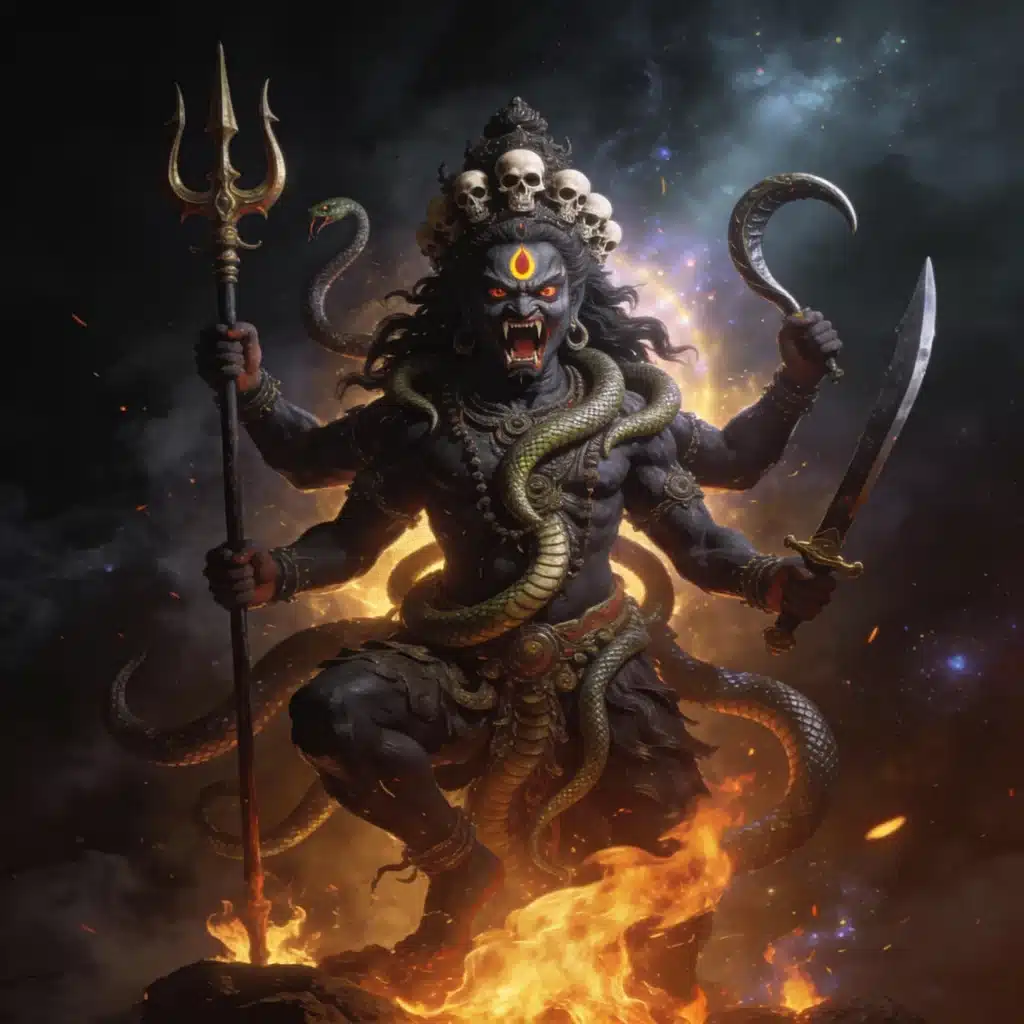
Of all the forms in which the sacred is approached, few are as arresting, or as misread, as the one honoured in Kāla Bhairava Pūjā. Dark, fierce, garlanded with skulls, attended by his dog, he can seem at first glance a figure of terror rather than devotion. Yet he is held to be Śiva himself in a particular aspect, the keeper of time and the guardian of truth, and the deeper teaching insists on something that takes a moment to absorb: that his fierceness is not cruelty but care, the sternness of a protector, and that beneath the awesome form is mercy. To understand his worship is to grasp why one reveres rather than merely fears him.
His very name carries his nature. Kāla means both time and the dark, and points to his governance of time itself, the force that carries all things to their appointed end; and Bhairava names the fierce and awesome. He is the lord of time in its sternest aspect, before whom no falsehood stands and from whom no debt is hidden. And yet, as we shall see, even this is turned to comfort: that the one who keeps watch over time and truth is, for the sincere, not a terror but a refuge. This is the figure his worship approaches.
Why a Fierce Form
The first question a newcomer asks is why the sacred should take so fearsome a shape at all. The lineage’s answer is that some things are guarded best by sternness. Truth, justice, the right ordering of time, these are not gentle matters; they make uncompromising demands, and a keeper of them who was all softness would keep nothing. The fierce form is the face of a love that will not flatter, a care stern enough to be trusted, the sternness of one who holds the line that must be held. The fierceness is in service of protection, not its opposite.
There is a deep psychological truth in this that any honest person recognises. The forces that most need a guardian, the keeping of one’s word, the facing of what one would rather avoid, the reckoning with time and mortality, are precisely the ones that gentleness alone cannot hold us to. Bhairava is the sacred in the aspect that does hold us to them, firmly, without indulgence, and therefore truly for our good. To worship him is not to placate a terror but to take refuge in exactly that uncompromising care, to stand willingly under the gaze that will not let one deceive oneself. His sternness, rightly understood, is a mercy.
His fierceness is not cruelty but care: the sternness of a guardian who holds the line that must be held. Beneath the awesome form is mercy.
The Story of His Coming
An old sacred story tells how this form came to be, and it turns, fittingly, on truth. In the telling, a dispute arose among the great powers over who was supreme, and the supreme reality manifested as a boundless pillar of fire to settle it. One disputant accepted the truth with humility; another, in his pride, spoke a falsehood, claiming to have seen what he had not. And from the sacred response to that falsehood arose the fierce form, to answer the breaking of truth with a sternness equal to its gravity. He is, from his very origin, the guardian who arises when truth is transgressed.
The story carries a further turn that is the heart of its teaching. Having acted, even in the cause of justice, Bhairava is shown bearing the weight of his own deed, wandering until that weight is lifted by grace at the sacred city. The meaning is profound: even the executor of justice is not above the moral order but bound by it, and the resolution of all such weight is finally a matter of grace. One need not read the tale as history to feel its force; it says that truth is guarded with utter seriousness, that consequence binds even the sacred agents of justice, and that mercy waits at the end of the reckoning. That is the figure his worship honours.
The Lord of the Sacred City
In that same story Bhairava finds the lifting of his burden at the great sacred city on the Ganges, and so becomes its eternal guardian, the keeper of its gates and of its sacred field. The city is held to be a place of singular grace, never abandoned by the divine, where even death is met not merely as an ending but as a passage, and Bhairava presides over this as its stern and faithful watchman, watching over its threshold and its dying with the same uncompromising care that is his nature everywhere.
This teaching about death and the sacred city is among the loveliest the lineage holds, and it is best received reverently rather than analysed. The conviction is that in a place so charged with grace, and under the watch of so faithful a guardian, even the great reckoning of death is met not with terror but with release; that the weight a soul carries can be set down. Whether or not one shares the belief, the spirit of it is worth honouring: that the fierce keeper of time is, for those who turn to him, finally a giver of peace at the hardest passage of all, and that his sternness and his mercy are, in the end, the same thing seen from two sides.
Śaṅkara’s Hymn and What It Sees
The most beloved text of his worship is a hymn of eight verses attributed to the great teacher Śaṅkara, sung wherever this fierce form is honoured. It describes him with vivid and tender precision, the dark figure, the crescent moon, the trident and drum, the garland of skulls, the faithful dog at his side, and ends each verse with the same loving refrain, urging the heart to worship the lord of the sacred city again and again. There is great affection in it; the awesome guardian is approached not with dread but with the warmth one brings to a protector one trusts utterly.
One image in the hymn repays dwelling on. The garland of skulls he wears is read by the lineage not as a token of death but as the letters of sacred speech itself, the whole alphabet of holy sound worn about him, declaring that all language, all prayer, all sacred utterance is held within his keeping. The image turns the fearsome into the profound: what looked like a wreath of bones is in truth the garland of the living word. So the hymn teaches the eye to see past the fierce surface to the depth beneath, which is precisely what the whole of his worship asks of the heart. The wider family of such devotional rites is treated in the account of Pūjās and Homas.
A Deeper Reading
The Śaiva schools of Kashmir take this seeing past the surface further still. In their reading, Bhairava names not only an awesome guardian over against us but the deepest nature of consciousness itself, and the fiercest figure of the sacred turns out to be the truest face of our own inmost awareness when it recognises its own unbounded character. This is a delicate teaching, easily caricatured, but its sense is straightforward: that what looks like an external power to be approached is in the end the very ground of the seeker, met as if from outside until recognised within.
One need not enter into the technical philosophy to feel the gentleness this carries. It means that his worship is not the appeasement of a stranger but the slow turning toward a reality that was never really other; the fierce form, met faithfully, becomes at last the recognition of one’s own true face beneath the masks fear and habit lay over it. The hymn’s loving refrain, sung daily by devoted hearts for over a thousand years, points toward exactly that recognition: the awesome one we worship is, in the deepest reading, what we most truly are.
His Worship, and the Weight of Time
The worship itself is grave and beautiful. He is honoured with the offerings of devotion and with the bathing of his sacred image, his name is repeated, and his hymn is sung; the offerings traditionally associated with him, dark and simple, suit his austere nature. He is often turned to by those passing through hard and heavy seasons of life, the times associated by the lineage with the slow, testing influence of Saturn, the planet of time’s discipline. As lord of time, Bhairava is held to preside over precisely such seasons, and his worship is a way of meeting them rightly.
It is worth being clear and honest about this, free of any promise of magical relief. The lineage does not offer his worship as a switch that lightens a hard season on demand; it offers it as a way of standing rightly within one, turning toward the keeper of time in trust rather than fear, asking for the steadiness to bear what time brings and the protection of one who watches over its weight. A heavy season understood as the discipline of time, and met under the care of its guardian, is a different thing from one merely suffered, and that change of relationship, not a guaranteed change of circumstance, is what the worship genuinely offers. Where one wishes first to understand the shape of such a season, the lineage’s own reflective counsel is set out in the account of a Vedic horoscope reading.
In Europe
His worship is whole wherever it is kept. Though he watches over a particular sacred city, he is held to be an aspect of the supreme reality itself, present everywhere, and the rite kept in Vienna or Rome is as true as anywhere, conducted by a qualified priest with the same sacred name, the same bathing of the image, the same singing of his hymn. Time presses on a life in Europe exactly as it does anywhere, and the keeper of time keeps his watch under every sky; to turn to him from a European city is no less fitting than to turn to him from the banks of the Ganges.
For anyone drawn to this fierce and faithful form far from his old shrines, then, there is no distance that signifies. What the rite asks is not a particular place but a particular posture of heart: the willingness to stand under the gaze that will not flatter, to meet the weight of time in trust rather than dread, and to take refuge in a care stern enough to be relied upon. That posture can be taken up anywhere, and the guardian it turns to is, the lineage promises, faithful to meet it.
What looked like a garland of skulls is the garland of the living word. His whole worship teaches the heart to see past the fierce surface to the mercy beneath.
bhīta-bhakta-rakṣakaṃ
kāśī-kṣetra-pālaṃ bhaja kāla bhairavam
“Protector of the devotee who turns to him in fear, guardian of the sacred field, worship Kāla Bhairava.”
FROM THE KĀLA BHAIRAVA AṢṬAKAM OF ŚAṄKARA
The line from Śaṅkara’s hymn that names him the protector of the devotee who comes in fear holds the whole of his worship in a phrase. For that is the turn the entire lineage makes: the fierce one, before whom one might tremble, is precisely the one who shelters those who come to him trembling. The terror is for what is false; the protection is for the sincere. To worship Kāla Bhairava is to learn that the sternest watchman is, for the honest heart, the safest refuge, that the gaze which will not let us deceive ourselves is the very gaze under which we are most truly kept. Beneath the dark form and the garland of skulls is this single tender promise, that the one who keeps watch over time and truth keeps watch, above all, over those who turn to him, and will not let them be lost.
The understanding described here rests on the Śaiva literature of the lineage; the hymn is the Kāla Bhairava Aṣṭakam attributed to Śaṅkara, gathered with related texts at Sanskrit Documents, with the Śiva Purāṇa available through WisdomLib and scholarship on the Śaiva schools through the Oxford Centre for Hindu Studies.
© 2026 AUSTRIAVIENNAPUJA.COM — SANĀTANA DHARMA IN EUROPE
Preserving authentic Vedic transmission across the European continent