Vivāha | Three Frances
Planning Indian Weddings in France: Three Frances, One Marriage
On preparing a Vedic marriage in France: the three quite different parts of the country a family might choose, what each gives and asks, and the honest practicalities that turn a vision into an unhurried, well-kept gathering.
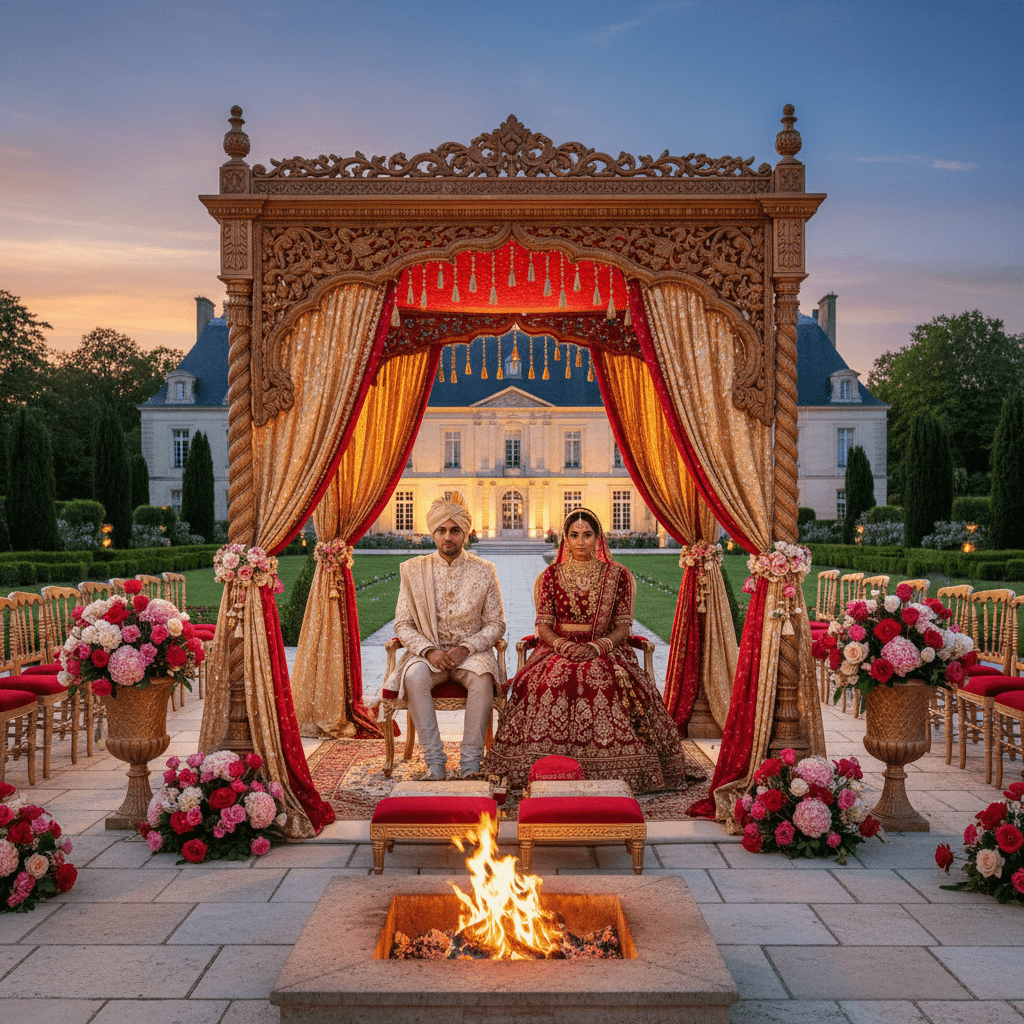
A family approaching planning Indian weddings in France faces less a single choice than three. The country contains three quite different worlds suited to a layered Vedic gathering, and the most useful thing this page can do is set out their distinct characters, so that the choice rests on what a family actually wants rather than on the photograph that happened to catch their eye. Each of the three suits a particular priority. None is best; the right one for you depends on what kind of marriage you are imagining.
A few practical truths sit beneath all three. The whole undertaking rewards patience: properties book ahead, the right priest needs notice, and the legal side has a shape that suits early attention rather than late. Settle the season, the part of the country, and the priest’s auspicious window first, in roughly that order, and the rest falls into place around them. With that said, the three Frances themselves.
The First France: Loire Châteaux and Provençal Mas
There is the France of the great château country, the Renaissance estates of the Loire and the honey-stone houses of Provence, and this is what most families picture when they imagine a marriage here. The properties are self-contained: a principal house, formal gardens that take the open-air ceremony naturally, ancient halls for the evening, and rooms enough for the whole gathering to live on the estate across several days. The Provençal mas offers the same self-contained quality at a quieter, more domestic scale, with lavender and olive groves replacing the formal allées.
This is the option for the family wanting grandeur, seclusion, and continuity, a place where the whole programme unfolds across one property without anyone shuttling between hotel and venue. The cost is real, particularly in the Loire, and worth weighing honestly; but for the family that wants this particular quality, nothing else in Europe quite matches it. The deeper meaning of the rite all this prepares for is set out in the page on the Vivāha Pūjā.
Three quite different worlds, each suited to a layered Vedic gathering. None is best; the right one is the one that fits what you actually want.
The Second France: The Côte d’Azur
There is the south coast, the Côte d’Azur from Cap Ferrat through Antibes to Cannes, and this is the France of reliable summer weather and Mediterranean light. The villas here are coastal: terraces over the sea, gardens descending toward the water, the easy beauty of the Riviera. For families wanting outdoor ceremonies with no real weather risk between May and September, the south offers the surest skies in the country.
Two honest cautions. Pricing at the height of summer sits at the top of the European range, and worth checking against budget before falling in love with any particular villa. The strict late-night noise rules along the whole Riviera need to be confirmed against the music plans, since most properties cut amplified sound at twenty-two hundred and this affects the evening programme. Settle both early in writing and the south becomes uncomplicated; ignore them and they surface late as needless friction.
The Third France: Paris and Île-de-France
There is Paris and its surroundings, where private mansions and historic estates host gatherings with high elegance and unmatched ease of travel. International guests fly directly to Charles de Gaulle or Orly and arrive at the venue within an hour, without secondary transfers, which makes Paris the most logistically gentle option for a gathering drawn from many continents. The properties of the Île-de-France, in Versailles, Fontainebleau, and the wider countryside, extend the choice to estates of greater scale set just outside the city.
Paris suits the family with guests scattered across the world, since the easy access removes a layer of strain that elsewhere in the country can press on elderly relatives in particular. It suits less the family wanting deep seclusion or unhurried countryside atmosphere, which the other two parts of France give more naturally. For the broader comparison of how France sits among European choices, the survey of Hindu wedding destinations in Europe sets each beside the others.
The Sacred Fire
Whichever part of France a family chooses, the sacred fire is the single practical detail most worth settling early and in writing. Most country estates and Provençal mas accommodate an open-air fire in their gardens with sensible safety provision; the south coast villas usually do the same. Indoor fire is more restricted under French rules and needs explicit written permission, proper ventilation, and a safe contained vessel. The single most useful thing a family can do before signing any contract is to confirm in writing exactly what arrangement the property will permit, in both indoor and outdoor form against weather contingency.
The priest handles the fire’s setting directly with the venue, and a priest experienced with celebrations across the continent will know the right questions to put and the safe ways to lay the fire in a European property. It is not a difficulty so much as a detail to settle early. The wider account of the fire and its meaning is set out in the page on Homa and the sacred fire.
The Legal Side, Plainly
A clear word on the law, since it causes worry that can easily be set aside. French civil law recognises only the civil marriage at the town hall as creating legal status; a religious ceremony of any tradition is a separate observance without civil effect by itself. For couples not resident in France, the civil registration is far simpler done at home before travelling, since a French civil marriage requires one party to establish a month of continuous residence, along with translated and apostilled documents and the publication of banns.
The honest point: the legal step has to happen somewhere, and a Vedic rite in France does not by itself produce legal recognition wherever you live. Plan for both, settle the registration early at home, and the French celebration is then purely the wedding you came for, free of administrative shadow.
How the Days Themselves Unfold
A multi-day celebration in any of the three Frances takes roughly the same shape. The music evening welcomes the gathering on the night of arrival; the henna afternoon fills a garden with colour the following day; the morning of turmeric prepares the bride and groom in their separate quarters; and then the marriage itself, two to three unhurried hours under the canopy before the sacred fire, with the seven steps at its heart and the priest translating each gesture so that every guest, knowing the tradition or not, can follow what is happening. The feast and celebration follow in the evening, and on the final morning the bride’s leave-taking closes the arc.
A self-contained estate, the chief virtue of the château country in particular, lets this whole sequence flow on one property from the first evening to the last morning, with the gathering held together rather than scattered. This continuity is among the most-prized qualities of a destination celebration well kept, and the part of France that best supplies it is the part that will suit a family wanting that quality most.
Three quite different worlds. The right one is not the most photogenic but the one that fits what your gathering most wants.
iha priyaṃ prajayā te samṛdhyatām
asmin gṛhe gārhapatyāya jāgṛhi
“May joy be increased here through your children; in this home, watch over the household hearth.”
ṚGVEDA 10.85 — A BLESSING ON THE NEW HOUSEHOLD
The old blessing on the new household points beyond the wedding itself to the long life it founds, which is the truer subject of all this preparation. A French celebration kept well, in whichever of the three settings best suits the family that holds it, sends a couple into that life from a place of unhurried beauty and gathered love. Whether the canopy is raised in a Loire garden, a Provençal courtyard, on a Riviera terrace, or beneath the high ceiling of a Paris mansion, the rite is the same rite, the verses the same verses, and the gathering the same circle of those who matter most. The country supplies a setting of unusual quality; the family, the priest, and the careful preparation supply everything else; and the watchful joy the verse asks for begins, as such joy should, on a day prepared with patience and held with love.
The verse cited here is from the marriage hymn of the Ṛgveda, with the wedding texts gathered at Sanskrit Documents and scholarship on the rite through the Oxford Centre for Hindu Studies.
© 2026 AUSTRIAVIENNAPUJA.COM — SANĀTANA DHARMA IN EUROPE
Preserving authentic Vedic transmission across the European continent