Engaging the Priest | A Practical Guide for Couples
Hindu Priest in Europe: A Couple’s Guide
The questions a couple genuinely asks when arranging a Vedic rite abroad, answered in order: how the priest travels to you, what the Puja requires and who provides it, how the fire and the sequence adapt to a European venue, and what to settle before anyone is engaged.
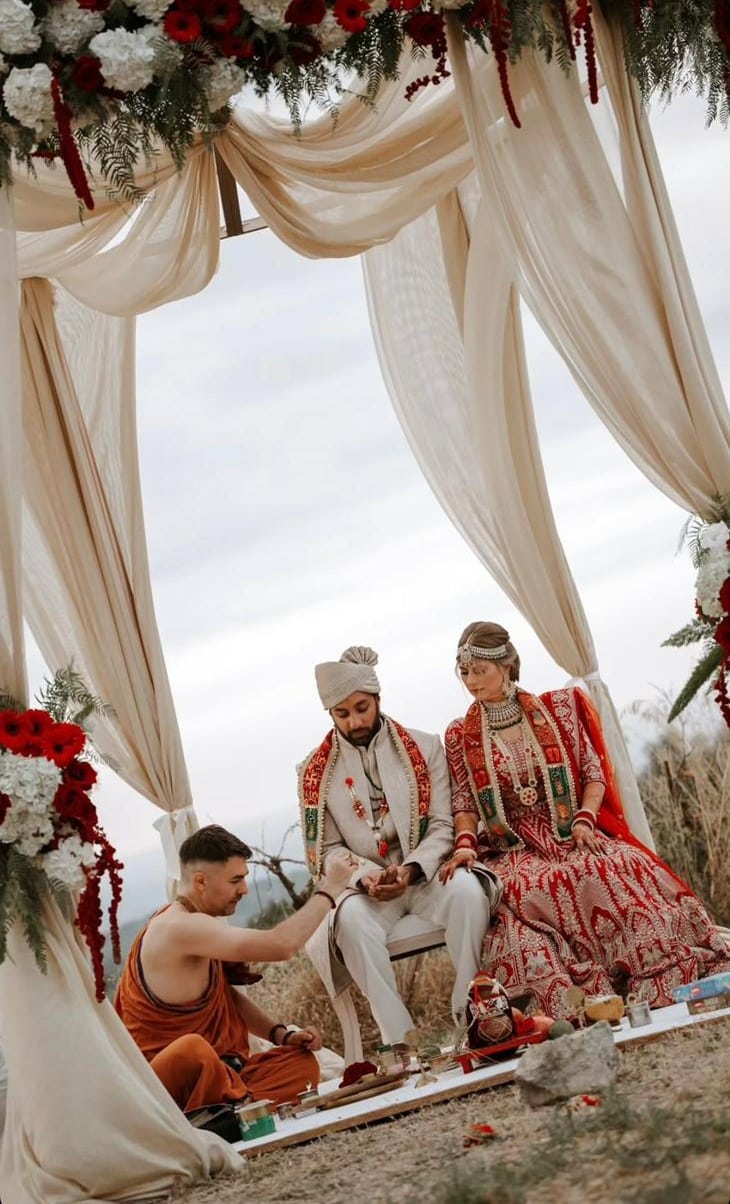
A Vedic wedding conducted at a European destination, the fire kept beneath the mandap.
Engaging a Hindu priest in Europe raises a set of practical questions that the romance of a destination ceremony tends to leave unanswered. Will the priest actually come to our city. What do we need to buy, and what does he bring. Will the hotel let us light a fire indoors. Do we still need a registry office. These are not lesser questions than the spiritual ones; they are the questions on which the spiritual ones depend, because a rite that cannot be performed correctly on the day is no rite at all. What follows is a plain account of how the work is arranged, set out in the order a couple usually meets it.
Engage the Priest First, Then Build the Day
The single most useful piece of advice precedes every other decision: settle the officiant before the venue, the date, or anything else. A great many difficulties that couples discover late, a venue that forbids an open flame, a date that falls outside an auspicious window, a room with no ventilation for the smoke of the offerings, would never have arisen had the priest been consulted at the start. The officiant is the one person who knows what the rite requires of the room, the hour, and the materials, and building the day around that knowledge is far cheaper than discovering it after deposits are paid.
It helps to understand whom you are engaging. A priest who conducts a Vedic rite is the Ṛtvij, the qualified officiant who stands before the fire on your behalf, and the force of the ceremony is held to travel through his correct knowledge of the Mantras, his accurate pronunciation, and the unbroken line through which he received them. This is why the office cannot be filled by a willing relative reading from a sheet. A couple who grasp this engage a learned officiant first and treat his counsel as the foundation for the rest. What that line of transmission actually consists of is traced in the account of the lineage behind a Hindu priest, and the background of the priest you are considering, his training and the rites he conducts, is worth examining directly; the profile of Pandit Sahadev sets out one such background.
How the Priest Travels to You
For a priest based centrally in Europe, most capitals and major cities are within a short flight or a few hours by train, and this practical fact is what makes a genuine Vedic rite possible across the continent without importing an officiant from India at great cost and with the attendant fatigue and jet lag on the very day that demands precision. A priest who works regularly across Europe will quote travel as part of the engagement and will arrive a day ahead where the rite is significant, both to rest and to see the site before it must be used.
When you discuss travel, raise three things plainly. First, who arranges and bears the cost of transport and a night’s accommodation, so that there is no awkwardness later. Second, whether the priest will visit or at least study the venue before the day, because a site seen for the first time an hour before the ceremony is a site that may surprise everyone. Third, what the priest needs carried versus what he carries himself, since the answer affects baggage on a flight. A priest who treats these as your problem alone has not understood that the smooth conduct of the rite is part of his office.
A priest seen at the venue the day before is worth more than any reassurance given over the telephone. The site, not the brochure, decides what the rite will need.
What the Puja Actually Requires
The materials of a Vedic rite are collectively the Pūjā Sāmagrī, and the most common anxiety couples carry is that they will somehow assemble the wrong things or miss something essential. A competent priest removes this anxiety by providing a written list well in advance, dividing it clearly into what he brings, what you source locally, and what must simply be correct. The division below is typical, though every priest refines it to his own practice.
What the Priest Carries
The items that are hard or impossible to source reliably in a European city are carried by the priest: the sacred thread and the protective wrist thread (Kalāva or Mauli), specific powders such as Kumkum and Haldi, camphor (Karpūra) for the lamp and the Ārati, particular dried materials and resins burned as offerings into the fire, and frequently a portable fire vessel, the Havana Kuṇḍa, where the venue cannot supply one suitable for a contained flame. These are the things that a couple cannot improvise and that a serious officiant never assumes will be available on arrival.
What You Source Locally and Fresh
The fresh and bulky items are sourced near the venue, because they cannot travel well: flowers and garlands, fruit, a fresh coconut, rice, clarified butter (ghee), water for the sacred vessel (Kalaśa), and the seating and low table on which the rite is laid out. A good list specifies quantities and gives acceptable substitutes for what a particular country may not stock, so that a missing item in one city does not become a crisis. The fuller picture of what these rites involve and the offerings they use is set out in the account of Pūjās and Homas.
What Cannot Be Substituted
Two things admit no substitution at all. The first is the sacred fire itself, Agni, who in the Vedic understanding is the witness before whom the vows are sworn and the mouth through which the offerings reach the powers invoked. No electric lamp, screen, or symbolic flame can stand in his place, because the rite is performed before a witness and the correctly kindled flame is that witness. The meaning of that fire and the offerings made into it is treated in the account of Homa and the Vedic fire. The second is the Mantra, which is not decorative recitation but the instrument that consecrates the rite, and which therefore requires the qualified officiant to wield it. Everything else can flex to circumstance. These two cannot.
Adapting the Rite to a European Venue
The most frequent practical obstacle in Europe is the fire, because the rite requires a live flame and many venues are cautious about one. The obstacle is almost always solvable, but only by raising it early and in writing. Below are the situations couples meet most often.
Rooftops, Terraces, and the Wind
Outdoor settings are the most natural for a fire and the most exposed to wind, which in coastal and elevated sites rises sharply in the afternoon. The fire is established in a contained vessel placed against the prevailing breeze, and the canopy, the Maṇḍapa, is oriented and partly screened so the flame holds steady. A priest who has worked outdoors reads the day’s conditions and adjusts the placement; this is craft, not improvisation, and it is one reason the site should be seen in advance.
Hotel Ballrooms and the Indoor Flame
Indoor venues remove the wind but introduce smoke detectors, ventilation, and the venue’s own fire policy. The contained flame of a Vedic rite is modest, but the offerings produce fragrant smoke, and a ballroom’s automatic detection system must be accounted for, sometimes by isolating a zone with the property’s facilities team. The single non-negotiable step is the venue’s written permission for a contained open flame, obtained before the booking is confirmed rather than assumed. Reputable hotels that host international weddings are usually familiar with the request; the work is in securing it in writing, not in winning the argument.
Gardens, Beaches, and Heritage Sites
Private gardens and villa grounds are often the easiest, since the owner can simply consent. Beaches add sand, wind, and local bylaws, and in the dry southern summer the risk of wildfire means the contained fire must be coordinated with local authorities; in the worst weeks this is the deciding factor in choosing a date. Protected heritage and archaeological sites, however beautiful, will not generally permit a ceremony with a live fire, and a couple should treat any planner who promises otherwise with suspicion. The honest path is to hold the rite at a lawful venue and reserve the famous monument, where photography permits exist, for portraits alone.
The Question of the Civil Marriage
Most European states recognize as legally binding only the civil marriage performed before a state registrar. The Vedic rite is the religious and spiritual consecration of the union; on its own it does not generally produce a marriage that a European state or your home country will register in law. The arrangements for a civil ceremony abroad vary considerably from one country to the next and frequently involve apostilled documents, sworn translations, residence or notice periods, and both partners’ physical presence, so the specifics must be checked with the relevant authority or a qualified professional rather than assumed. This is general information and not legal advice.
In practice, most couples find it simplest to complete the legal marriage quietly at home before they travel, which leaves the day abroad free to be the Vedic rite and the celebration, unburdened by paperwork. This is the arrangement most often recommended, because it lets the ceremony abroad be what it is meant to be rather than a hurried appendage to a registry appointment.
How Long the Ceremony Takes, and What Is Essential
A full traditional Vivāha conducted in its complete form can run for several hours, and many couples marrying abroad, with guests unaccustomed to the length and a schedule that includes a reception, wish to know what can be shortened and what cannot. The answer is that the rite has an irreducible core that a learned priest will not abbreviate: the opening declaration (Saṅkalpa) that names the place and the persons, the establishment and consecration of the fire, the joining of hands (Pāṇigrahaṇa), the offerings into the flame, and above all the seven steps (Saptapadī) by which the marriage is sealed. Around that core, certain elaborations can be reduced or set aside without harming the validity of the rite. The full sequence and the meaning of each act are set out in the account of the Hindu wedding rituals.
The right way to manage this is a frank conversation with the priest in advance, in which he explains which acts are essential and which are elaboration, and helps you shape a ceremony that respects both the tradition and the day’s practical limits. A priest worth engaging will also explain the meaning of each act aloud as it is performed, in a language your guests understand, so that the ceremony is intelligible to those who traveled for it rather than a sequence of unexplained gestures. The wider family of consecrations to which the wedding belongs, and the logic that makes each one more than ceremony, is treated in the study of the sixteen Saṃskāras.
What to Ask Before You Engage Anyone
Ask about training and lineage, and how the Mantras were learned. Ask whether the priest will explain each act aloud in a language your guests follow. Ask how the fire is established and kept against wind or indoors, and whether he provides a written Sāmagrī list dividing what he brings from what you source. Ask whether he will see the venue before the day, and how travel and accommodation are arranged. Settle the legal marriage at home before you travel. The clarity of the answers tells you more about an officiant than any photograph.
Arranged in this order, with the officiant engaged first and the day built around what the rite genuinely needs, a Vedic ceremony anywhere in Europe can be conducted with the same completeness and the same weight it would carry at home. The practical work is real, and none of it is automatic. But none of it is beyond a couple who ask the right questions early and a priest who treats the logistics of the fire as part of his office rather than someone else’s concern.
agnim īḷe purohitaṃ
yajñasya devam ṛtvijam
“I praise Agni, the chosen priest, the divine officiant of the sacred rite.”
ṚGVEDA 1.1.1 · THE OPENING VERSE OF THE VEDA
The very first verse of the oldest Scripture names the fire and the officiant together, the flame and the one qualified to tend it. The pairing is not accidental. To engage a priest is to engage the keeper of that fire, and the practical care taken in the arranging is itself part of the reverence the rite asks for.
Primary and academic sources: the Pāraskara Gṛhya Sūtra on the domestic rites and their materials, the Manusmṛti with the commentary of Medhātithi, Sanskrit Documents for the textual corpus, and the Oxford Centre for Hindu Studies.
© 2026 AUSTRIAVIENNAPUJA.COM · SANĀTANA DHARMA IN EUROPE
Preserving authentic Vedic transmission across the European continent