Purohita | The Swiss Cantons
Twenty-Two Temples, and Why a Priest Still Travels
Who the Hindus of Switzerland actually are, why a country full of temples still needs a household priest, how the fire is handled across twenty-six cantons, and the one article of the Civil Code that fixes the order of your wedding.
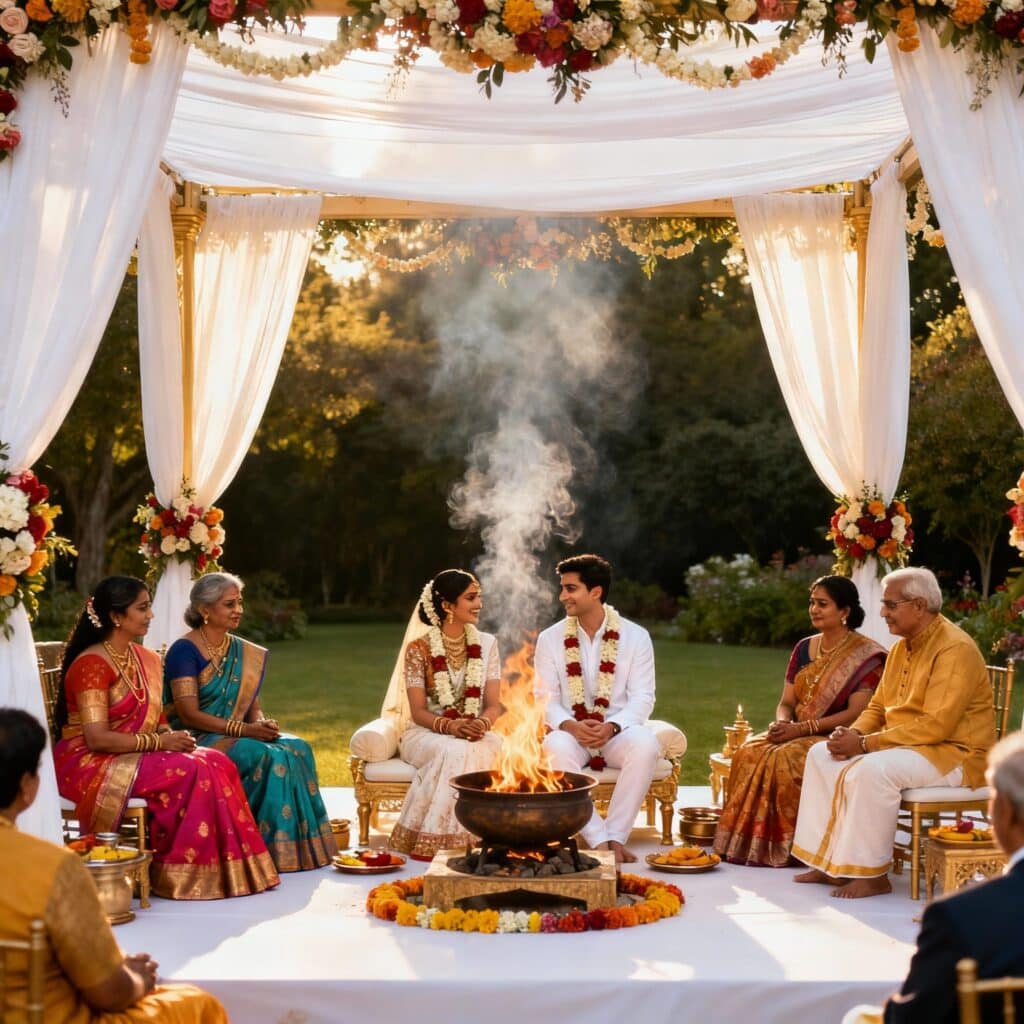
The fire established where the family is, which is what the Gṛhya rites have always asked.
Engaging a Hindu Pandit in Switzerland is usually described as a problem of distance: a scattered community, no temple, a priest who must travel. Half of that is right and half of it is not, and the half that is wrong is worth correcting first, because it changes what a family should actually be looking for.
Switzerland has temples. It has roughly twenty-two of them. What it has rather less of is priests who conduct the domestic rites in the home, and those are two different offices rather than two grades of the same one. This page sets out who the community is, why that distinction matters, how the sacred fire is handled across a country of twenty-six separate cantonal jurisdictions, and the provision of Swiss law that decides the sequence of a wedding before any other planning begins.
Who the Hindus of Switzerland are
Around fifty-four thousand people in Switzerland identify as Hindu, roughly six in every thousand of the population. The overwhelming majority, something on the order of forty-two thousand, are Sri Lankan Tamils who arrived as refugees and labor migrants through the nineteen-eighties and nineties, and their tradition is predominantly Śaiva. Alongside them sit perhaps eight thousand Indian Hindus, several thousand adherents of international guru organizations, and a number of Swiss practitioners. Zurich holds the densest concentration, with something like twenty thousand Tamils in that canton alone, followed by Bern, Basel and the western cantons.
This is a very different picture from the one usually painted, in which the community is described as a professional Indian diaspora attached to pharmaceuticals in Basel, finance in Zurich and the international agencies in Geneva. That layer is real and it is served, but it is the smaller part by a wide margin. Any account of Hindu Switzerland that does not begin with the Tamil Śaiva community has begun in the wrong place.
Temple and household are different offices
From the nineteen-nineties onward the Tamil community built its own religious infrastructure, and it built quickly: some twenty-two temples across the country, often in converted factories and warehouses. The Sri Sivasubramaniar temple at Adliswil in the canton of Zurich, founded in 1994, is the largest and best known, and others followed at Glattbrugg, Dürnten and elsewhere. These are functioning temples with resident priests and a full annual cycle of festivals. Notably, the Indian Hindu population founded cultural associations rather than temples, which tells you something about how the two communities have organized themselves.
A temple priest keeps the temple’s rites. The Saṃskāras are Gṛhya rites, kept at the household fire by a Purohita who comes to the family. Neither substitutes for the other.
Here is why a country with twenty-two temples still needs a traveling priest. Temple worship follows the Āgamic pattern: an installed image, a consecrated precinct, a fixed daily cycle, conducted by an Arcaka or Kurukkaḷ whose office belongs to that temple and that deity. The rites a household keeps belong to an entirely different stream. The Saṃskāras and the domestic observances are Gṛhya rites, set down in the Gṛhya Sūtras, kept at the household fire and conducted by a Purohita who comes to the house. They were never temple rites and were never meant to be. A family in Zug keeping a Nāmakaraṇa, or an Indian household in Basel with no temple of its own tradition within reach, is not badly served by geography; it needs a different officiant, and always did. The full account of the household rites is set out in the treatment of the sixteen Saṃskāras.
The cantons, and what each holds
The German-speaking north around Zurich, Winterthur and Zug carries the largest share of households, Tamil and Indian both, and the greatest density of temples. Basel adds a substantial professional population tied to the pharmaceutical and chemical industries. Bern holds a long-settled Tamil community and the federal administration. In the French-speaking west, Geneva and Lausanne combine an international and diplomatic layer around the United Nations agencies with a settled residential population, and Vaud extends it along the lake.
Beyond the cities lies the other kind of occasion entirely. The lake and mountain country around Lucerne, Lugano and the Bernese Oberland receives a steady season of destination weddings each year at historic villas, mountain hotels and country estates, with families gathering from across Europe. A priest working Switzerland moves between the two registers through the year: a naming kept quietly in a Zurich flat on a Saturday morning, and a canopy raised above a lake for two hundred guests a month later.
What a household calls a Purohita for
Across the years a household calls on a Purohita for the rites of childhood: the naming of a newborn, the first feeding, the first ceremonial haircut, and where a family keeps it, the Upanayana that opens formal study. There is the Vivāha, the most elaborate observance of all, kept before the established fire with both households gathered. There is the blessing of a new home on entering it, and there are the rites of remembrance by which a household honors its dead.
Beyond these passages a family may wish to keep seasonal observances, the worship of particular Devatās at their festivals, and fire offerings undertaken for protection or in thanksgiving. All of these are kept in the Swiss home or garden by a priest who brings the Mantras and the greater part of the materials to the household. None requires a return to Bhārata. What makes an observance whole is the qualified officiant, the correctly spoken Mantra with its accent intact, the consecrated fire, and the intention declared in the Saṅkalpa, which names the exact ground and hour and so draws that ground into the rite. All four travel.
The fire, across twenty-six jurisdictions
Switzerland has no single national rule on open flame at events. Fire safety and building regulation sit largely with the cantons and communes, which means the answer to whether a contained fire may be lit differs by where you are standing, and a permission granted in Zug tells you nothing about Vaud. This is the practical peculiarity of the Swiss setting and the reason the question must be put to the specific property rather than answered in general.
In practice, country estates, chalets and mountain hotels accommodate a contained fire in a garden or courtyard without much difficulty, given sensible provision: a vessel raised off the ground, a cleared area, water at hand, and the property’s own watch. Indoors is stricter everywhere, and an apartment or hotel ballroom requires explicit written permission, real ventilation for the smoke of ghee and wood, and attention to the smoke detection the building carries. Get the permission in writing before the contract is signed, naming the exact place agreed, and name the covered fallback too. Materials are well provisioned through the Indian shops of Zurich, Geneva and Basel, supplemented by what the priest carries. The meaning of the offering itself is set out in the account of Homa and the sacred fire.
Article 97, and why it fixes your order
This is the provision that decides the shape of a Swiss wedding, and very few families planning one have heard of it. Article 97 paragraph 3 of the Swiss Civil Code states that no religious wedding ceremony is permitted prior to the civil ceremony. Not merely that the religious rite lacks legal effect, which is true everywhere in Switzerland, but that it may not come first. A religious marriage celebrated before the civil one is treated as void.
This is worth stating against its neighbor for contrast. Germany carried the same prohibition until 2009 and then abolished it, so a family there may hold the Vedic rite whenever it wishes. Switzerland did not follow, and the rule stands. The consequence is direct: the civil marriage before the Zivilstandsamt, or the office of the état civil or the stato civile, must be completed first, and only then may the Vivāha be kept.
For couples resident in Switzerland the sequence is straightforward. Open the preparatory procedure at the registry office of your commune, complete the civil marriage, and hold the Vedic ceremony afterward, whether the same day or weeks later. For couples traveling in, the Swiss civil route means apostilled documents, certified translations and a residence connection, so the practical answer is almost always to register at home before flying, which also satisfies the sequence Article 97 requires, since a marriage validly concluded abroad is recognized in Switzerland. Requirements change and should be confirmed with the relevant Zivilstandsamt or a qualified professional rather than taken from any page, this one included; what is written here is general information and not legal advice. How the position differs country by country is set out in the account of Hindu wedding legal recognition in Europe.
Reaching the cantons
Switzerland is among the easiest countries in Europe in which to bring a properly trained priest to a household, precisely because it is small, central and superbly connected. The rail network reaches nearly every town with a reliability few countries match, so the journey from Zurich to Geneva, or Basel to Lucerne, or out to a Bernese Oberland estate, carries none of the uncertainty distance introduces elsewhere. From a base elsewhere in central Europe the country is a short flight or a comfortable train away.
That reach matters because the nearest available officiant is not always the right one, and a country this well connected lets a family weigh a priest on his formation and his fitness for the particular rite rather than on proximity alone. For a significant occasion the priest arrives a day ahead, both to rest and to see an unfamiliar property before it must be used. The practical points, who bears travel and lodging, what he carries against what is sourced locally, are worth settling plainly in the first conversation rather than left to be discovered.
Choosing whom to engage
A priest is invited into the home for the hours a family remembers for the rest of its life, so the choice deserves more than picking whoever is nearest. Ask how he was trained, since real formation in this tradition is long, oral and received from a teacher who received it in turn, and the line of that transmission is something a qualified man describes without hesitation. Ask which stream he serves, since a temple Kurukkaḷ and a domestic Purohita hold different offices and a family should know which it is engaging. Ask whether he has worked across European properties, because handling halls, fire permissions and unfamiliar venues is a learned skill distinct from knowing the rite.
And ask whether he will explain each stage as it comes. In Switzerland this matters more than almost anywhere, because a great many households now include a second generation raised here with little Sanskrit, and mixed households in which one partner meets the tradition for the first time. Giving the Mantra in its proper form while making its sense available as the rite unfolds is faithful to the tradition rather than a concession to unfamiliarity, since the older teaching enjoins the understanding of a rite as well as its keeping. The wider work of the priest across the continent is described in the account of the Vedic Pandit in Europe.
A community with temples of its own and households that still need the fire brought to them. The two are not the same work.
sahṛdayaṃ sāṃmanasyam avidveṣaṃ kṛṇomi vaḥ
anyo anyam abhi haryata vatsaṃ jātam ivāghnyā
I make you of one heart, of one mind, free of hatred. Love one another as the cow loves the calf she has borne.
ATHARVAVEDA 3.30.1 · THE HYMN OF CONCORD
The Sāmanasya Sūkta is addressed to a household rather than to an individual, and its request is modest and very hard: that the people under one roof be of one heart and hold no grudge. That is what every observance kept in a home is finally in service of, and it is why the rites belong in the house rather than at a distance from it. A flat in Zurich, a chalet above the Bernese valleys, a villa on Lake Lucerne or Lake Geneva, becomes for the hours of an observance a place of full sacred dignity. The Swiss cantons hold many such roofs now, and going to them is the work rather than an interruption of it.
The verse cited above is from the Sāmanasya Sūkta of the Atharvaveda; on the domestic rites in their textual form, the Pāraskara Gṛhya Sūtra; with primary texts gathered at Sanskrit Documents and scholarship on Hindu communities in Switzerland and on the household rites through the Oxford Centre for Hindu Studies.
© 2026 AUSTRIAVIENNAPUJA.COM · SANĀTANA DHARMA IN EUROPE
Preserving authentic Vedic transmission across the European continent