The Vivāha Rite | Conducted Above the Caldera
What a Couple Is Actually Commissioning
Why the Vivāha makes a household rather than marking one, the qualification that decides whether the rite carries, what a caldera terrace does to an open fire, and the ordered acts through which the marriage is brought into being.
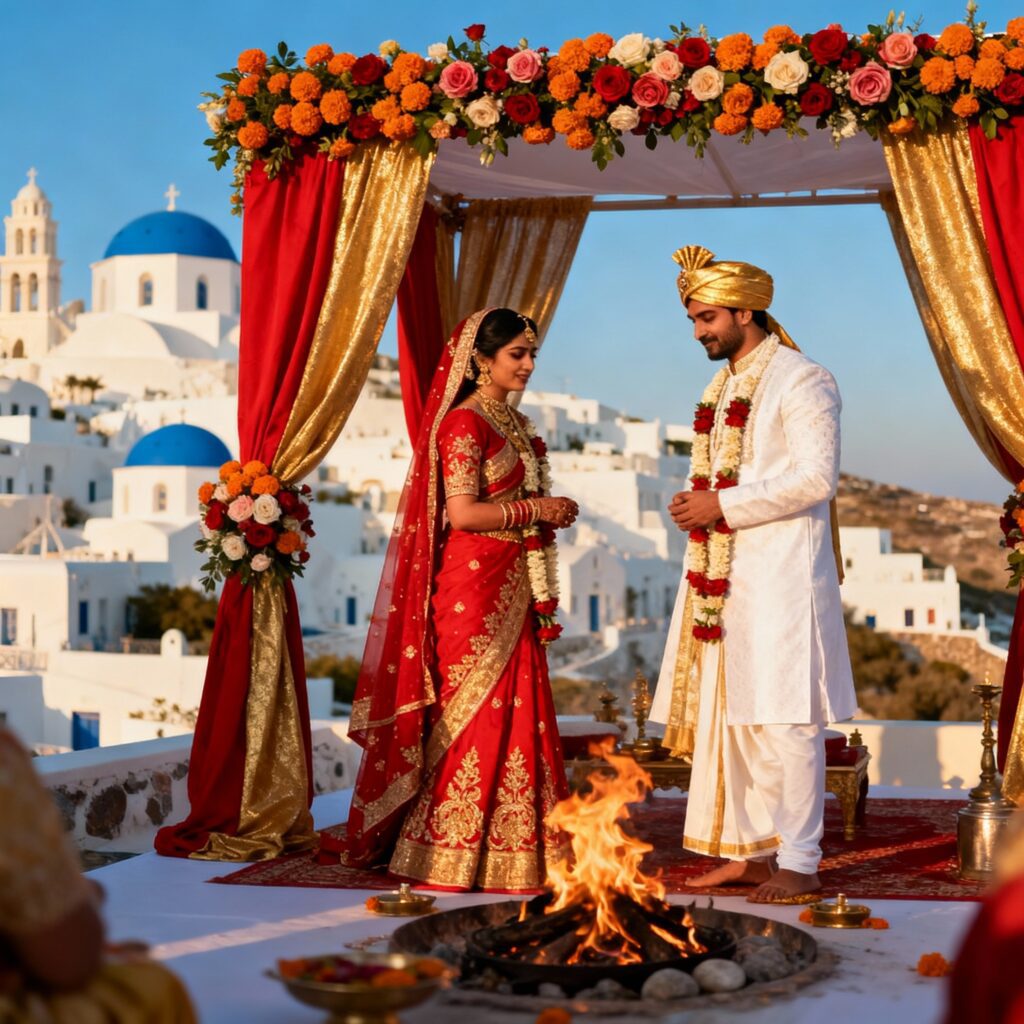
The island lends its beauty freely. The rite at the center of the day is older than the island.
When a family engages a Hindu Pandit in Santorini, the thing being asked for is easy to misname. The villa is booked, the photographer retained, the caterer briefed, and somewhere in that list the priest appears as one supplier among several, the person who will speak the Sanskrit while the cameras work. That placement misunderstands what is being commissioned. The villa, the meal and the photographs surround the day. The priest performs the one act of the day that is not surrounding anything: the rite that turns two unmarried people into a married pair. Everything else on the island can be arranged by anyone with taste and a budget. The Vivāha cannot, and the reason is worth setting out before a single chair is rented.
Vivāha is a making, not a celebration
The Sanskrit term for the wedding is Vivāha, and the tradition does not file it under celebration. It files it under Saṃskāra, a consecration, one of the sixteen that mark the thresholds of a life. The word is built from sam, complete or well-formed, and kāra, a making, and it carries a claim the modern wedding trade never makes about itself: that the rite does not record a change but produces one. A naming rite does not announce a name already in use; it confers the name. An initiation does not certify learning already possessed; it begins it. By the same logic the Vivāha does not bless a couple who are already a couple. It makes them one where before there were two.
What emerges is not merely a married man and a married woman but a single new entity the tradition calls the Gṛhastha, the household. The household is the unit that keeps a fire, performs the year’s observances, raises whatever comes next, and pursues the recognized aims of a human life together rather than singly. A couple commissioning a priest for Santorini are, whether they have framed it this way or not, commissioning the founding of that household. This is why a rite missing an essential part, the proper fire, the correct order, a qualified officiant, the seven steps, is not counted a weak wedding but no wedding, because the making has not occurred. The doctrinal placement of the rite among the consecrations is given in the study of the sixteen Saṃskāras.
The flowers can be ordinary and the marriage is untouched. The officiant can be unqualified and there is, in the strict sense, nothing there at all.
The qualification that makes the rite carry
A priest who conducts a Saṃskāra is, more precisely, the Ṛtvij, the qualified officiant who stands before the fire on the householder’s behalf. The tradition treats this qualification as load-bearing rather than honorary. The force of the rite is held to travel through the officiant’s correct knowledge of the Mantras, his accurate pronunciation with the accent intact, his command of the sequence, and the unbroken line of transmission by which he received all three. A wedding read aloud from a printed handout by a well-meaning relative is not a simpler version of the same thing. It is a different thing, because the channel through which the consecration is meant to pass has not been opened.
This bears hardest on a destination wedding, where the temptation to economize on the officiant is real and the consequence is invisible until it is too late to repair. A couple who grasp this engage a learned officiant precisely so that what is performed on a clifftop in the Cyclades carries the identical weight it would carry in a courtyard at home. What that work involves in practice, the travel, the consecration of an unfamiliar site, the fitting of the rite alongside the civil paperwork, is set out in the account of the Pandit’s work across Europe.
What a caldera terrace asks of the fire
The rite does not begin with the first Mantra. It begins with the preparation of the ground, and Santorini makes that preparation harder than almost any mainland site. Three things about the island decide it. The first is wind. The meltemi blows from the north across the Aegean through July and August, sometimes for several days without easing, and the caldera rim adds its own lift in the late afternoon as the rock releases the day’s heat. An open flame on an unscreened west-facing terrace at five o’clock is not a hypothetical difficulty; it is the ordinary condition. The canopy must be sited and the fire screened with that in view, or the ceremony is conducted around a flame nobody can keep steady.
The second is ground. Santorini’s caldera villages are built in terraces cut into rock, and the celebrated terraces of Oia, Imerovigli and Fira are frequently smaller than the photographs suggest. A Maṇḍapa wants an open square of roughly three to four meters in each direction, clear of furniture and parapets, with the vedi where the fire is established, the seats of the couple, the place of the priest, and room for the parents who perform the Kanyādāna. Ask for a floor plan with dimensions rather than an assurance that there is plenty of space. Ask too about the steps, since many of these properties are reached only by long flights cut into the cliff, which presses hardest on exactly the elderly relatives whose presence matters most.
The third is supply. Nothing needed for the rite is sold on the island. The fire vessel, the ghee, the grains, the wood, the vessels for water, the materials for the offerings are either carried by the priest or ordered well in advance and shipped, and an omission discovered an hour before the Muhūrta cannot be repaired by a trip into town. A priest who treats the logistics of the fire as somebody else’s problem has not understood that the fire is the rite. The questions worth putting to him are concrete: how the flame is established and held against the meltemi, what he brings rather than assumes, and how the enclosure is laid out on a site he will see for the first time the day before. The answers reveal more about an officiant’s seriousness than any description of his lineage. The meaning of the offering itself is set out in the account of Homa and the sacred fire.
The Saṅkalpa and the kindling of Agni
The Vivāha is not a single gesture but an ordered passage through several distinct acts, each with its own purpose, performed in a sequence the priest holds without deviation. Knowing the shape of that hour lets a couple recognize what is happening as it happens rather than waiting through it for the part they have heard about.
It opens with the Saṅkalpa, the formal declaration in which the priest names the moment, the place, the persons and the purpose of what is about to be done. It is here that Santorini enters the ceremony by name, the actual ground drawn into the rite by the spoken word rather than treated as a backdrop. Then Agni is kindled by Mantra. In the Vedic understanding Agni is not a symbol of warmth or passion but the witness before whom the vows are sworn and the mouth through which every offering reaches the powers invoked. This is why no lamp, screen or concealed gas effect can stand in its place. The vows are sworn before a witness, and the correctly kindled flame is that witness.
Kanyādāna and the taking of the hand
In the Kanyādāna the bride’s family formally gives her into the marriage, an act the texts treat with great gravity as the entrusting of one life into the keeping of another. There follows the Pāṇigrahaṇa, the taking of the hand, in which the groom grasps the bride’s hand to a Ṛgvedic verse that asks for a shared life into old age. The gesture is among the oldest preserved in the tradition, and it states plainly what the rite is for: not a transaction completed but a companionship begun.
The offerings and the circling of the fire
Offerings are then made into the flame, grain and ghee given to Agni with Mantra, among them the Lāja Homa in which the bride’s brother pours the parched grain into her hands and she offers it forward. The couple circle the fire together in the Agni Pradakṣiṇā, keeping the flame to their right as the tradition prescribes. Each circuit is joined to its own intention, and the couple move as a pair around the witness who binds them, the physical turning enacting the turning of two lives now ordered around a common center.
The Saptapadī, where the marriage is sealed
The Saptapadī, the seven steps taken together, is the act the older authorities hold to complete the marriage. The Manusmṛti and the Gautama tradition locate the binding moment at the seventh step itself, and a careful priest keeps the entire sequence intact precisely because the tradition rests the union on the completeness of the rite rather than on any single isolable instant. With the seventh step the two who began the hour as separate persons end it as a married pair, and what was performed cannot be undone by changing one’s mind, because a making has taken place and not merely a promise.
The recited vow and the lived vow
Each of the seven steps is joined to a vow, and they are commonly heard as a string of pleasant words: for nourishment, for strength, for prosperity, for happiness, for offspring, for the seasons in their turning, and for lifelong friendship. Heard as words they pass in a moment. Understood rightly they are not words at all but the articulated terms of the marriage, a program for the decades that follow. The vow for nourishment becomes the long commitment to provide for one another. The vow for the seasons becomes the resolve to hold steady through the alternations of ease and difficulty every long marriage contains. The seventh, for friendship, gathers up the rest into the daily resolve to remain one another’s closest companion.
This is the sense in which the wedding is the foundation and the marriage is the building raised on it. The tradition’s older word for the wife, Saha-Dharma-Cāriṇī, she who walks together in the path, names the same idea from another angle: husband and wife are not two parties to a contract pursuing parallel interests but companions in one undertaking. The particular division of household roles described in the old texts belonged to a particular social world, and couples today distribute responsibility as their own lives require. What endures beneath the arrangement is the counsel that a household sustained by mutual support rather than rivalry will weather what one lacking it will not, and that counsel travels intact into any century.
Electing the hour above the Aegean
The time at which the rite is performed is not chosen for the light alone, though the Santorini afternoon offers light a photographer dreams of. The tradition elects an auspicious Muhūrta, a window calculated from the lunar day and the positions of the heavenly bodies as seen from the place of the rite, within which the consecration is held to proceed most favorably. Note that last point, since it is often missed: the window is computed for Santorini’s own horizon and not borrowed from an Indian almanac.
A couple drawn to the famous descent of the sun over the caldera should raise this early with the priest, because the elected hour and the desired hour do not always coincide, and reconciling them is real work rather than a formality. A learned officiant will neither dismiss the wish for the view nor sacrifice the Muhūrta to it, but find, where one exists, the hour that honors both. Where they cannot be reconciled he will say so plainly, because the validity of the rite is not a matter on which an honest priest negotiates. The wider practical picture of keeping the rite in Greece, including the civil step, is set out in the account of the Hindu priest in Greece.
What remains when the guests go home
The photographs will be extraordinary, and they should be. But every photograph taken on Santorini is a photograph of the foundation, not of the building. The guests fly home, the villa is returned, the flowers are cleared, and what remains is the one thing the day was actually for: a household that did not exist that morning and exists now, founded by fire and Mantra and seven steps walked at the appointed hour.
A couple who keep this clearly in view find that the practical arrangements fall into their proper places without strain, because they have correctly identified the center around which everything else is arranged. That is the whole of what it means to engage a priest for Santorini in the serious sense: to ensure the act at the center of the day is performed by one qualified to perform it, with the fire rightly established against the wind, the sequence kept whole, and the seven steps walked in full.
Every photograph taken on the caldera is a photograph of the foundation. What was built that day is not in any of them.
sam añjantu viśve devāḥ sam āpo hṛdayāni nau
saṃ mātariśvā saṃ dhātā samu deṣṭrī dadhātu nau
May all the gods and the waters join our two hearts together; may the wind, the ordainer and she who guides make us one.
ṚGVEDA 10.85.47 · THE MARRIAGE HYMN OF SŪRYĀ
The verse asks the gods and the waters and the wind to do the joining, which is a strange request to make at a wedding until you notice what it implies. The couple are not described as joining themselves. Something is being done to them, and the rite is the means by which it is done. That is the difference between a ceremony that celebrates a decision two people have already made and a Saṃskāra that accomplishes something they cannot accomplish alone. On a terrace above the caldera, with the meltemi in the awnings and two hundred people watching, the same verse asks the same thing it has asked for three thousand years, and the answer does not depend on the view.
Primary and academic sources: the Manusmṛti with the commentary of Medhātithi, the Pāraskara Gṛhya Sūtra on the domestic rites, Sanskrit Documents for the textual corpus, and the Oxford Centre for Hindu Studies.
© 2026 AUSTRIAVIENNAPUJA.COM · SANĀTANA DHARMA IN EUROPE
Preserving authentic Vedic transmission across the European continent