Pandit | A Vedic Wedding Here
A Hindu Pandit in Crete: Vedic Rites in the Aegean South
A practical and honest guide to keeping a Vedic wedding in Crete: the two halves of the island, whom it suits, getting your guests there, the multi-day shape such a wedding takes, the sacred fire and the law, and what to settle before any deposit is paid.
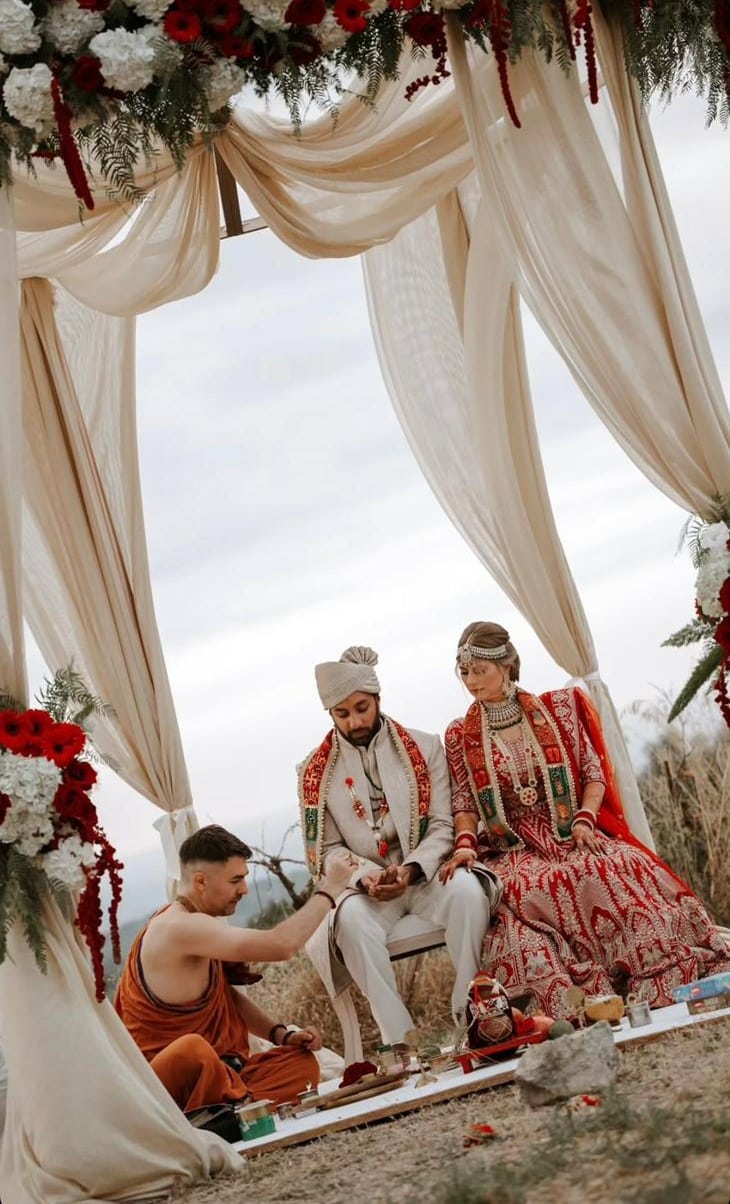
The Vivāha kept beneath the mandap, on a hillside above the south Aegean.
If you are considering Crete for a Vedic wedding, this page sets out what you should know before any planning begins: the character of the place, the two distinct halves of the island, whom it suits and whom it does not, how your guests and the ceremony’s materials actually reach it, and the few practical matters worth settling early. The aim is plain, useful information to help you decide whether the south Aegean is right for the gathering you have in mind.
A first word of honesty. The island naturally holds smaller gatherings of perhaps fifty to a hundred and twenty guests rather better than very large ones. The properties available are mostly mid-sized, the road network is unhurried, and the lodging around any single venue has practical limits. If you are planning a celebration of three or four hundred, Santorini, mainland Greece, or the great venues of Italy or France will serve you better. If the gentler scale is what you want, read on, because at that size Crete gives back more than its modest reputation suggests.
The Place
Crete is the largest land mass of Greece, set in the south Aegean, long and mountainous, deeply rural across most of its length. The Venetian harbors of Chania and Rethymno, the Ottoman quarters threading through the old towns, the Byzantine churches in the hills, and beneath them the palaces of the Minoan world give the island an unusual depth of layered history. A Vedic ceremony kept here joins a long inheritance of sacred places without trying for it; the ground has held ceremony of one kind or another for several thousand years, and it carries that weight quietly.
The weather is reliably warm and dry from May through October. The shoulder months of May, June, September, and early October give the best conditions for an outdoor ceremony: warm enough for guests to be comfortable, not so fierce as high summer, and gentler on both pricing and crowds. July and August are hot and busy, and a wedding in those weeks is best set for the evening, when the heat softens and the light over the water turns. The deeper meaning of the rite all this prepares for is set out in the page on the Vivāha Pūjā.
A long history of sacred places, weathered into a deep welcome. Smaller gatherings find a generous home here; larger ones do not.
West and East
The island divides for practical purposes into two distinct sides, and the choice between them shapes a great deal of what follows. The west, around Chania and the Akrotiri peninsula, is quieter and more traditional, with old harbors, mountain villages, and restored estates set among olive groves. Properties here tend toward the intimate and boutique, with a settled and unhurried atmosphere. If you are drawn to seclusion and a more rural mood, and your gathering is on the smaller side, the west will suit you.
The east, around Heraklion and stretching toward Agios Nikolaos and Elounda, offers a wider range of larger contemporary properties and resort estates. Logistics are easier here, since Heraklion’s airport handles more direct flights and the venue infrastructure is more developed. If you want polished comfort alongside the celebration, or your party runs toward the upper end of what the island holds well, the east will serve you better. The wider survey of how this destination sits beside other choices on the continent is set out at Hindu wedding destinations in Europe.
Getting Your Guests There
The logistics of reaching Crete are the part couples most often underestimate, and they are worth thinking through before a venue is chosen. The island has two main airports, Heraklion in the east and Chania in the west, both of which take direct flights from a number of European cities through the season but fewer outside it. A guest list gathered from across Europe and beyond will mostly route through Athens and connect onward, which adds a leg to the journey and a little to the planning. The ferry from the mainland is an option for those who prefer it, an overnight crossing from Piraeus, though most guests will fly.
Accommodation is the other consideration. The boutique scale that makes the west so appealing also means the lodging around any single venue is limited, and for a multi-day celebration the party may need to be spread across nearby properties and moved between events, which is its own small piece of planning. Choosing a venue with enough rooms on or near the grounds, or a cluster of properties within easy reach of one another, saves a great deal of difficulty later. None of this is an obstacle; it is simply work that is lighter when done early, and a venue chosen with the guest logistics in mind rather than for its photographs alone tends to give the smoothest few days.
The Shape of a Crete Wedding
A Vedic wedding in Crete is rarely a single afternoon. The distance most guests travel, and the gentle pace of the island itself, lend the occasion naturally toward a program of two or three days, with the preliminary rites and a celebratory evening framing the Vivāha at its center. This suits both the tradition, which has never imagined the wedding as a single compressed event, and the setting, which rewards an unhurried gathering over a rushed one. Guests who have flown a long way settle into the place across a couple of days rather than arriving and departing in a single rush.
The Vivāha itself, the heart of the program, runs unhurried at around two hours when kept in full, the sequence moving from the welcome and the invocation through the giving of the bride, the offerings into the fire, and the seven steps that seal the marriage. The surrounding evenings, a henna gathering, a celebratory dinner under the stars, arrange themselves around that center. A Pandit familiar with the destination will help shape the days so the essential rite is given its full weight while the celebration around it unfolds at the island’s own pace.
The Island Table
A practical point that works unusually well in your favor here. Cretan cooking is among the most vegetable-centered in the Mediterranean, built on olive oil, wild greens, pulses, grains, and cheese rather than on meat, and a great many of its everyday dishes are vegetarian without any adaptation at all. A kitchen on this island does not have to be persuaded into a meatless menu or asked to work around its own traditions; it is already cooking that way for much of the year, and the produce it draws on is local, seasonal, and very good.
For a family that wants a Sāttvika table, this removes a difficulty that arises in many destinations. Most couples still bring an Indian caterer for the dishes the celebration properly calls for, and let the estate kitchen supply the Cretan elements alongside, the two sitting together comfortably. The one matter to settle early is whether the property requires its own catering partner or permits an outside caterer, since this varies and shapes what is possible; confirm it in writing before the contract is signed.
The Sacred Fire
The sacred fire is the heart of a Vedic wedding and the one practical matter worth settling early. Most outdoor estates accommodate a contained open fire in their gardens or courtyards without difficulty, particularly outside the hottest weeks of midsummer. The single seasonal caution worth knowing is wildfire risk, which runs high across the Greek south from late June into early September; in those weeks the Pandit and the venue together coordinate the fire’s setting with the local authorities, and the matter is manageable rather than prohibitive.
Confirm the arrangement in writing before any contract is signed, and the matter is settled. The canopy under which the marriage is kept asks an open space of three or four meters in each direction, indoors or out, with the gathering arranged around it. A terrace looking toward the sea, a restored courtyard, an olive grove cleared for the occasion, all serve. The materials the rite needs are sourced through caterers and suppliers who work the region regularly, supplemented by what the Pandit carries, and there is no real difficulty in assembling what is required.
The Legal Step, Plainly
A plain word on the law, since this causes worry that can easily be set aside. Greece recognizes only the civil marriage performed before a registrar as carrying legal status. The Vedic ceremony is a separate observance and does not by itself produce legal recognition. For non-Greek couples the Greek civil process means apostilled documents and certified translation, which is workable but adds layers, and most foreign visitors find it simpler to complete the legal registration at home before travelling.
The honest point: the legal step must happen somewhere, and the Vedic rite alone does not produce recognition wherever you live. The specifics of the Greek civil process change from time to time and should be confirmed with the relevant authority rather than assumed; this is general information and not legal advice. Plan for both, settle the legal matter in good time, and the wedding itself carries no anxiety about it. The wider context of the older teachings kept fully and faithfully far from the homeland is set out at Sanātana Dharma as a way of life.
Choosing a Pandit
A few gentle questions in a first conversation reveal a great deal about whom you are engaging. Ask how the Pandit was trained, since genuine training is long and is received from a teacher who himself learned from a teacher. Ask whether he has worked across European venues before, since experience matters greatly in handling the practical details of an estate kitchen, an outdoor canopy, and the sacred fire on an exposed terrace. Ask whether he will explain each part of the ceremony to the gathered guests as it unfolds, since many will be unfamiliar with what they are seeing, and ask whether he will see the venue, or at least study it, before the day.
A Pandit worth engaging answers such questions gladly, and treats the practical arrangements, the fire, the materials, the shape of the days, as part of his own office rather than the family’s burden. The wider role of the Pandit across the continent is set out at the Vedic Pandit in Europe.
Smaller gatherings, weathered settings, a deeper sense of where the celebration is being kept. For the right couple, the south Aegean gives back more than its modest scale suggests.
samrājñī śvaśure bhava
samrājñī śvaśrvāṃ bhava
“Be a queen in the home of your new father, a queen in the home of your new mother.”
ṚGVEDA 10.85.46 · FROM THE MARRIAGE HYMN
The old blessing on the bride entering a new household speaks to what the whole ceremony is finally for: not the chosen destination, however lovely, but the life that begins on the chosen day. A celebration kept gently in the south Aegean, on a scale that suits the place, will give that life a beginning of unusual depth. Choose well between west and east, plan the guests’ journey early, settle the fire and the legal step in good time, find a Pandit you trust through honest conversation, and the rest will follow as it should.
The verse cited here is from the marriage hymn of the Ṛgveda, with the wedding texts gathered at Sanskrit Documents and scholarship on the rites through the Oxford Centre for Hindu Studies.
© 2026 AUSTRIAVIENNAPUJA.COM · SANĀTANA DHARMA IN EUROPE
Preserving authentic Vedic transmission across the European continent