Janma Nakṣatra | The Moon’s Mansion
Where the Moon Stood at the Hour of Birth
The twenty seven Nakṣatras, the lunar mansions from which a Vedic reading takes its bearings: what the Moon’s mansion at birth governs, how it seeds the sequence of periods, and why it gives a child its name.
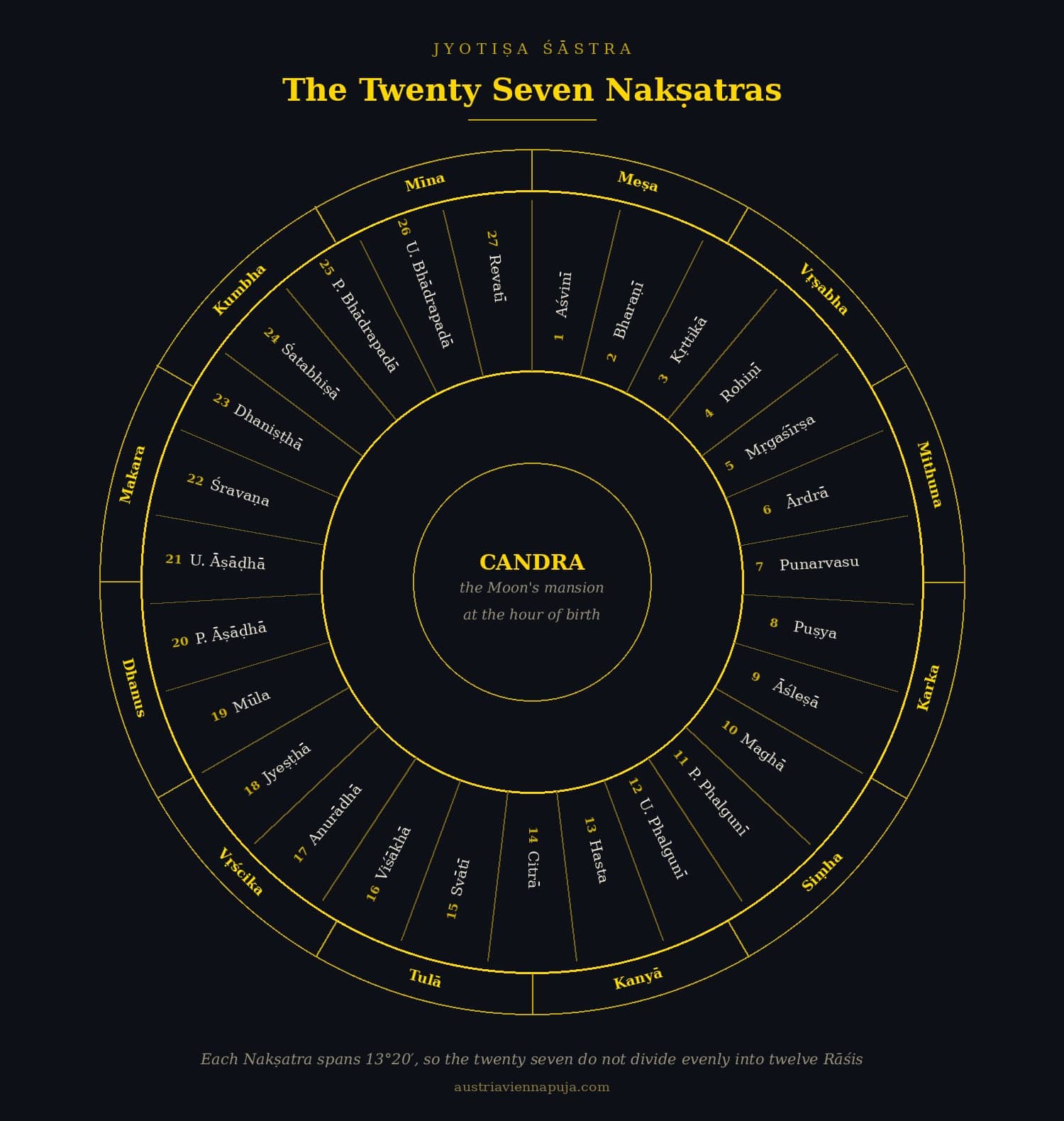
The twenty seven Nakṣatras of the Vedic zodiac, each spanning thirteen degrees and twenty minutes, set against the twelve Rāśis.
A birth chart reading in the Vedic tradition does not begin where a Western reading begins. It begins with the Moon, and more precisely with the segment of sky the Moon occupied at the hour of birth: the Janma Nakṣatra, the birth star or lunar mansion. Before a reader has considered a single house or planetary aspect, this one placement has already fixed the sequence of periods the person will live through, supplied the syllable by which the tradition would name them, and given the first account of their temperament.
This is the oldest layer of the discipline and the one most distinctively Vedic. The enumeration of the Nakṣatras is preserved in the Saṃhitā literature, well before the horoscopic astrology of the later Horā texts took its mature form. What follows sets out what these twenty seven divisions are, how they are constructed, and the four distinct offices the Janma Nakṣatra performs. The reading of houses, lords, and divisional charts belongs to the separate account of the Vedic horoscope reading.
Why the Tradition Reads Candra Before Sūrya
Ask a European what their sign is and they will give the Sun’s. Ask the Vedic tradition and it will give the Moon’s, and the difference is not arbitrary. The tradition assigns to Candra the Manas, the feeling and receptive mind, the faculty through which experience is registered before it is reasoned about. Sūrya signifies the self as it stands and acts; Candra signifies the self as it receives. For an account of temperament, of how a person actually meets what happens to them, the tradition considers the second the more revealing.
There is a practical dimension too. The Moon completes its circuit in roughly twenty seven and a third days, passing through one Nakṣatra a day, while the Sun takes a month to cross a single sign. A solar placement is shared by everyone born within a month of a person. A lunar mansion is shared by those born within about a day, and the quarter of a mansion narrows it to about six hours. The Moon simply carries more information per unit of time, which is why a reading that starts from it starts from a finer instrument.
The Twenty Seven Divisions and Their Arithmetic
The zodiac of three hundred and sixty degrees is divided into twenty seven equal Nakṣatras, each spanning thirteen degrees and twenty minutes. They run in fixed order from Aśvinī at the beginning of Meṣa through to Revatī at the close of Mīna. Because twenty seven does not divide evenly into twelve, the Nakṣatras do not align with the boundaries of the Rāśis: a mansion may sit wholly within one sign or straddle two, and the diagram above shows this misalignment plainly. It is not an imperfection in the scheme. The two divisions answer to different measures, one lunar and one solar, and the tradition keeps both.
The Pādas: Four Quarters to Each Mansion
Each Nakṣatra is further divided into four Pādas or quarters of three degrees and twenty minutes each. This yields one hundred and eight divisions across the zodiac, and here the arithmetic becomes elegant: one hundred and eight divided by twelve gives nine, so each Rāśi contains exactly nine Pādas. Those nine are the nine divisions of the Navāṃśa, the ninefold divisional chart. The Pāda system and the Navāṃśa are therefore not two schemes but one, approached from the lunar and the solar side respectively, which is part of why the Navāṃśa carries such weight in classical assessment.
The tradition also preserves a twenty eighth mansion, Abhijit, positioned between Uttarāṣāḍhā and Śravaṇa. It is not used in the ordinary division of the zodiac, since that would break the equal spacing, but it retains a place in certain Muhūrta calculations and in the older Vedic literature. Its survival alongside a scheme that has no room for it is one of the marks of a genuinely ancient system rather than a tidy later construction.
The Nakṣatra as the Seed of the Daśā Sequence
The first and most consequential office of the Janma Nakṣatra is that it determines the entire sequence of life periods. In the Viṃśottarī scheme, each of the twenty seven mansions is assigned a lord, the nine Grahas each ruling three mansions distributed evenly around the circle. The period running at the moment of birth is the one belonging to the lord of the Nakṣatra the Moon occupied, and the portion of that period already elapsed is measured by how far through the mansion the Moon had travelled.
From that single determination the whole span follows. The nine periods run in fixed order and fixed length, totalling one hundred and twenty years, and every subsequent statement a reader makes about timing rests on this calculation. Two people born on the same day in the same city, with the Moon in the same mansion but at different degrees within it, will enter the sequence at different points and live through markedly different schedules. This is the sharpest reason accurate birth data matters, a matter treated practically in the account of the Vedic consultation and the recovery of a birth hour.
One placement, fixed in a few hours of a single day, sets the schedule of a hundred and twenty years. Nothing else in the chart carries that weight.
The Nakṣatra and the Naming of a Child
The second office belongs not to astrology but to the Saṃskāra system, and it is the point at which Jyotiṣa enters directly into the ritual life of a family. In the Nāmakaraṇa, the naming rite performed in the days after birth, the tradition assigns to each Pāda of each Nakṣatra a syllable, and the child’s name is traditionally begun with the syllable belonging to the Pāda the Moon occupied at birth. One hundred and eight Pādas yield one hundred and eight syllables, and the name a person carries through life is drawn from the position of the Moon at the moment they entered it.
This is worth pausing over, because it shows what the tradition understood a name to be. Not a label chosen for its sound or its associations, but a sonic marker aligned with the person’s own cosmic position, spoken over them with Mantra at a moment the tradition considers formative. Many families in Europe now choose a name and use the Nakṣatra syllable as a second or ritual name, which the tradition accommodates. The rite itself, and how it is conducted for families here, is set out in the account of the Nāmakaraṇa naming ceremony.
The Nakṣatra in the Choosing of a Moment
The third office is calendrical, and it is the oldest use of the scheme. In selecting an auspicious time, the mansion the Moon occupies on the day in question is among the first things weighed. The tradition classifies the twenty seven into groups by character: those counted fixed and enduring, suited to foundations, construction, and things meant to last; those counted swift, suited to travel and to matters begun and finished quickly; those counted soft, suited to marriage, music, and the making of friendships; those counted fierce, suited to matters requiring force and unsuited to gentle undertakings.
A practitioner selecting a date for a wedding or a household rite therefore looks for a day on which the Moon occupies a mansion whose character suits the undertaking, and then weighs that against the birth mansion of the person principally concerned. The full framework within which this selection operates is treated in the account of Vedic astrology in Europe.
The Fourth Office: The Reading of Temperament
The office people usually come for is the last of the four, and it is the one to hold most lightly. Each Nakṣatra carries a body of traditional association: a presiding deity, a symbol, an animal, a governing Graha, and a general disposition. Rohiṇī, the Moon’s own preferred mansion, is associated with growth, fertility, and beauty. Jyeṣṭhā, the eldest, carries seniority and the burdens that attend it. Mūla, the root, is associated with what must be dug out and begun again from the foundation.
These descriptions have real value and they also invite the crudest misuse of the whole system, which is the sorting of people into twenty seven types. A competent reader treats the birth mansion as one substantial input among several, weighing it against the Lagna, the condition of the Moon itself, and the running period, and declines to build a personality verdict on it alone. Where a description of a Nakṣatra fits a person closely, that is worth noting. Where it does not, the honest conclusion is that other factors in the chart predominate, not that the person has failed to be what their birth star said.
Taken together, these four offices explain why a birth chart reading in the Vedic tradition opens where it does. The mansion is not a preliminary detail to be noted and set aside. It has already determined the timetable before the reader has looked at a single house, already supplied the name the person answers to, and already given the first and often the most accurate account of how they receive what happens to them. A reader who treats it as one item in a list has inverted the structure of the discipline.
This is also why a reading conducted without the Nakṣatra, working only from sign placements and aspects, is not a Vedic reading in any meaningful sense whatever it is called. The lunar framework is the part that distinguishes the tradition from every other astrological system, and it is the first thing dropped when the practice is diluted.
Establishing the Birth Mansion for a European Birth
One technical matter deserves stating for anyone born in Austria or elsewhere in Europe. The Moon moves through a full mansion in roughly a day and through a Pāda in about six hours, so an uncertain birth hour is far more damaging here than it is for the slower placements. A person confident of their date but vague about the hour may still have their mansion identified with reasonable security, but the Pāda, and with it the naming syllable and the exact entry point into the period sequence, may not be recoverable without the hour.
The calculation must also be made from the sidereal zodiac and from the true coordinates and clock reckoning of the European birthplace. A Nakṣatra derived from tropical positions is simply the wrong mansion, usually by two. This is ordinary competence rather than a difficulty, but it is the point at which software defaults and casual calculation most often go astray, and it is worth asking a practitioner which reckoning they have used. The training that stands behind such work is described in the account of the Vedic lineage of a Hindu priest in Austria.
The mansion the Moon occupied names you, schedules you, and describes you. It does not decide you.
dvā suparṇā sayujā sakhāyā samānaṃ vṛkṣaṃ pariṣasvajāte ।
tayor anyaḥ pippalaṃ svādv atty anaśnann anyo abhicākaśīti ॥
Two birds, companions ever, cling to the same tree. One eats the sweet fruit; the other, eating nothing, looks on.
MUṆḌAKA UPANIṢAD 3.1.1 · ALSO ṚGVEDA 1.164.20
The verse marks the limit of everything described above. The Nakṣatra scheme is a precise instrument for describing the bird that eats: the temperament that meets experience, the schedule by which experience arrives, the name spoken over a life at its beginning. It has nothing whatever to say about the second bird. That the Vedic tradition built so exact a science of the first while holding, in the same body of texts, that the second is untouched by any of it, is the proportion in which the whole discipline is meant to be held.
The Nakṣatra enumeration is preserved in the Saṃhitā literature and elaborated in the classical Horā texts, principally the Bṛhat Parāśara Horā Śāstra, with source texts gathered at Sanskrit Documents and scholarship on the Vedāṅga tradition available through the Oxford Centre for Hindu Studies.
© 2026 AUSTRIAVIENNAPUJA.COM · SANĀTANA DHARMA IN EUROPE
Preserving authentic Vedic transmission across the European continent