
Kāla Bhairava and the Keeping of Time
The Guardian of Time, and Why His Form Is Fierce
The Purāṇic account named plainly, the offense he carried and where it was released, the eight forms, the observance and its day, and what his worship does and does not promise.
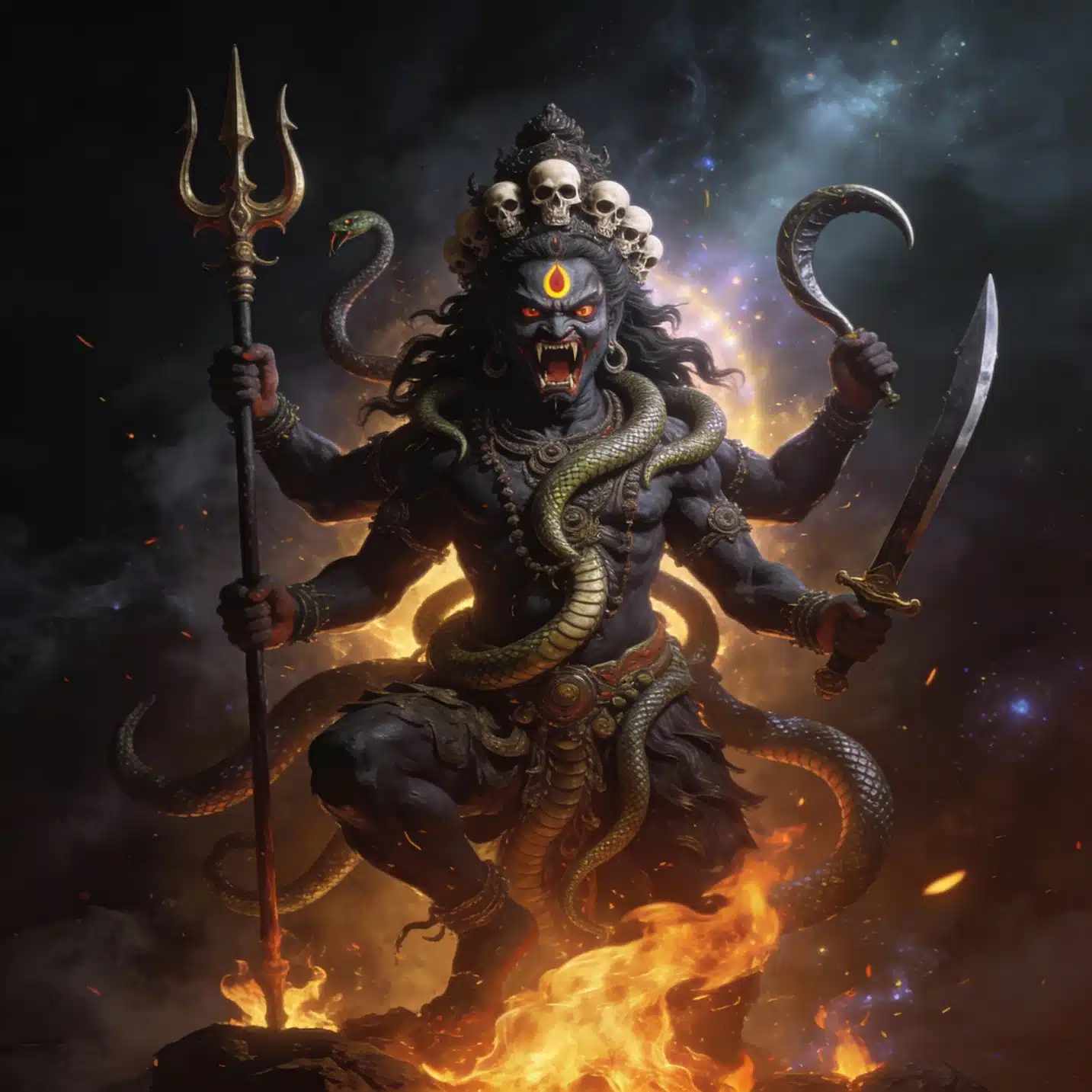
The fierce form, with the dog that attends him and the emblems the Aṣṭakam describes.
Written by Pandit Sahadev, Vedic priest and pandit in charge of ceremonies at Radha Govinda Math, Traiskirchen
Few forms are as arresting or as misread as the one honored in Kāla Bhairava Pūjā. Dark, garlanded with skulls, attended by a dog, he can look at first like a figure of terror rather than devotion. He is Śiva in a particular aspect, the keeper of time and the guardian of truth, and the teaching insists on something that takes a moment to absorb: that the fierceness is not cruelty but a sternness in the service of protection.
Accounts of him are usually written vaguely, gesturing at an old story without naming it. That does him no service. What follows names the sources, the offense he carried, the place where it was released, the eight forms, his day in the calendar, and what his worship honestly offers.
What the name holds
Kāla carries both senses at once, time and blackness, and the tradition means both. He governs time as the force that brings everything to its term, and he is dark in form. Bhairava is glossed in several ways: from a root indicating fear, as the one who is terrible; and in the devotional etymologies as bharaṇa, ramaṇa and vamana, the one who sustains, delights and withdraws the world, which makes the name a compressed statement of the three cosmic functions rather than a description of menace.
The two readings are not in tension. He is the sacred in the aspect that holds a line, and what needs holding is not held gently. Truth, the keeping of one’s word, the reckoning with time and mortality: these make uncompromising demands, and a guardian of them who was all softness would guard nothing. The fierce form is the face of a care that will not flatter.
The Liṅgodbhava and the lie
The account is preserved in the Śiva Purāṇa and in the Liṅga Purāṇa, and it is called the Liṅgodbhava, the arising of the pillar.
Brahmā and Viṣṇu disputed which of them was supreme. Śiva appeared between them as a shaft of fire without visible beginning or end, and each set out to find one limit of it, Viṣṇu taking the form of a boar to seek the base and Brahmā the form of a swan to seek the summit. Neither found an end. Viṣṇu returned and acknowledged as much.
Brahmā did not. He returned claiming to have reached the top, and produced as witness the ketakī flower, which had fallen from the pillar and which he suborned to confirm the claim. The falsehood, told about the supreme reality and supported by a corrupted witness, is what the account treats as intolerable. From Śiva’s response to it, Bhairava arose.
Brahmahatyā, and why he carries a skull
What Bhairava then did is the part most accounts decline to state, and stating it is the whole point of the episode. He severed the fifth head of Brahmā, the head that had spoken the lie.
The act incurred Brahmahatyā, which the Dharma literature classes among the gravest of all offenses. The severed skull adhered to his hand and could not be released, and he wandered as a Kapālin, a bearer of the skull, begging with it as his bowl, under the prescribed expiation for that offense.
The doctrinal weight here is considerable and it is why the story is told at all. The agent of justice, acting in the cause of truth against a genuine falsehood, is not thereby placed above the moral order. He incurs the consequence of what he did, and he serves the expiation. A tradition that wanted a simple avenging figure would not have written this. What it wrote instead is a guardian who is himself bound by the law he guards, which is a considerably harder and more interesting claim.
The executor of justice serves the penalty for the act of justice. The tradition could have exempted him and deliberately did not.
Kapālamocana and the release at Kāśī
He wandered until he reached Kāśī, and there the skull fell from his hand. The site is called Kapālamocana, and the name states exactly what happened: the release of the skull. It remains a place of pilgrimage in the city.
Having found release there, he stayed as the city’s guardian. This is why the account ends where it does and why his principal shrine stands where it stands. The narrative arc is offense, wandering, expiation and release, and the place of release becomes the seat of his permanent office.
The consolation in this is not sentimental. What the account says is that the weight of a deed is real, that it is carried and not waved away, and that it is nonetheless finally released. A tradition that took either half of that alone would be either merciless or slack. It holds both.
Why Kāśī, and what he keeps there
He is Kāśī Kṣetrapāla, guardian of the sacred field of the city, and the office is administrative in a way that surprises people. The tradition holds that no one departs the city at death without his leave, and that he administers there the reckoning a soul carries, which is why he is sometimes called the magistrate of Kāśī.
Pilgrims are traditionally counselled to present themselves at his shrine on arriving in the city and again before leaving, since the guardian of a place is acknowledged when one enters it. The custom is small and it says something precise about what a Kṣetrapāla is: not a deity one visits for a favor but the one whose ground one is standing on.
The eight Bhairavas
Kāla Bhairava is not a single isolated form. The Āgamic and Purāṇic sources enumerate the Aṣṭa Bhairava, eight forms set at the eight directions, with Kāla Bhairava counted first among them.
The names in the common enumeration are Asitāṅga, Ruru, Caṇḍa, Krodha, Unmatta, Kapāla, Bhīṣaṇa and Saṃhāra, with Kāla Bhairava presiding over the set, and lists vary somewhat between transmissions. Each holds a direction and each is worshipped in the temple traditions that keep the full scheme, particularly in the Tamil country where the eight are installed at the eight quarters of a city or temple complex.
The arrangement matters for understanding what he is. A guardian is by definition positioned, and eight guardians at eight quarters is a system of enclosure rather than a set of alternative deities. He is worshipped at thresholds because thresholds are what a guardian keeps.
The dog at his side
Every newcomer notices the dog, and it is worth explaining rather than passing over. The śvāna is his vāhana, and dogs are fed at his shrines as part of his worship.
The choice is deliberate and it is a statement. The dog was regarded in the older Dharma literature as among the most impure of animals, excluded from ritual space, and it is precisely this creature that the tradition places at the side of Śiva in this form. The guardian who bears the gravest offense on his own hand is attended by the animal held lowest, and the pairing says what the whole Kapālin iconography says: that this form of the sacred occupies exactly the territory that ordinary purity excludes.
Its watchfulness is the other reading, and both are held together. A dog keeps watch at a threshold and does not sleep through an approach, which is what a Kṣetrapāla does.
The garland, and what it actually is
The garland at his neck is read by the tradition as the Mātṛkā, the letters of the Sanskrit alphabet, worn as a wreath. What appears to be a token of death is the whole of articulate sound.
The reading is not a softening applied later to make the image palatable. The Tāntric conception of the alphabet as the substance from which the manifest world is composed runs through the Śaiva literature, and a deity wearing the letters is a deity holding what everything is made of. The garland states that all speech, all Mantra and all sacred utterance stand within his keeping, which is a very specific claim about the office of a guardian of truth.
Śaṅkara’s Aṣṭakam
The Kāla Bhairava Aṣṭakam attributed to Śaṅkara is eight verses in an ornate meter, and it is the central text of his worship, sung wherever this form is honored.
Each verse describes him, the dark form, the crescent, the trident and the drum, the serpent, the garland, the dog, and each closes with the same refrain urging the heart to worship the lord of Kāśī. The refrain returning eight times is the structure doing the devotional work: the hymn does not argue its way to affection, it simply returns to the same address until the address is habitual.
One verse names him the protector of the devotee who comes to him in fear, which is the whole theology of the form in a phrase. The terror is for what is false. The shelter is for the one who arrives afraid. The wider family of such rites is treated in the account of Pūjās and Homas.
Bhairava in the Kashmir Śaiva reading
The non-dual Śaiva schools of Kashmir take the name considerably further, and this is where the fierce form turns out to be something other than a deity over against the worshipper.
In the Vijñāna Bhairava Tantra, and in Abhinavagupta’s commentarial tradition, Bhairava names the ultimate reality and the nature of consciousness itself. The Vijñāna Bhairava opens with the Goddess asking what the essential nature of Bhairava is, and the answer given across its verses is a series of means by which consciousness recognizes itself, none of them iconographic. The fierce figure and the ground of awareness are the same, met as if from outside until recognized within.
This is a delicate teaching and easily caricatured, and the plain sense of it is this: the worship is not the appeasement of a stranger. It is a turning toward what was never other, approached through a form until the form is seen through.
Kāla Bhairava Aṣṭamī
His day is Kāla Bhairava Aṣṭamī, the eighth tithi of the dark fortnight of Mārgaśīrṣa, falling in November or December, and held to be the day of his manifestation. Bhairava Aṣṭamī recurs monthly on the eighth of each dark fortnight, and the Mārgaśīrṣa one is the principal observance.
The observance is nocturnal, which follows from what he is. A vigil is kept through the night, the Aṣṭakam is recited, the image is bathed and offered to, and dogs are fed. In the customary practice the offerings are simple and dark in character, and the whole is austere rather than festive.
Households outside Bhārata should note that the tithi is computed for the location, so the eighth of the dark fortnight falls at Vienna’s own reckoning rather than an Indian one, and the vigil is timed accordingly.
The rite, and an honest word on Śani
The worship follows the ordinary shape: the image is bathed, offerings are made, the name is repeated, the Aṣṭakam is sung. Where a fire offering is made, it follows the same sequence as any other.
He is very often approached by people passing through a hard transit of Śani, on the reasoning that the lord of time presides over the seasons that time imposes, and the association is old and legitimate. It is also the point at which a great deal is oversold, so it is worth being plain.
The tradition does not offer his worship as a mechanism that lifts a difficult period on demand. What it offers is a way of standing within one: turning toward the keeper of time in trust rather than dread, and asking for the steadiness to bear what the period brings. A hard season met under that relation is a different thing from one merely endured, and that change of relation, rather than a guaranteed change of circumstance, is what is genuinely on offer. Anyone selling more than that is selling. The reasoning behind why remedies work the way they do is set out in the account of why Śani remedies fail.
Keeping his worship in Europe
He watches a particular city and he is not confined to it. He is an aspect of the supreme, present wherever he is addressed, and the rite kept in Vienna or Rome is entire: the same name, the same bathing of the image, the same hymn, conducted by a qualified officiant whose formation is described in the account of the lineage a priest stands within.
Two practical points. The tithi for Bhairava Aṣṭamī is computed locally, as noted above. And feeding dogs, which is part of his customary worship, transfers to a European city without difficulty and is worth keeping rather than dropping as an Indian particularity.
Time presses on a life in Vienna exactly as it presses anywhere, and the reckoning it brings is not lighter for the latitude. What the rite asks is not a place but a posture: the willingness to stand under a gaze that will not flatter, and to meet the weight of time in trust rather than dread. That can be taken up anywhere.
What looks like a garland of skulls is the garland of the letters. His whole worship teaches the eye to look past the fierce surface to what is actually there.
bhukti mukti dāyakaṃ praśasta cāru vigrahaṃ ।
bhaja’haṃ bhavāni pati bhairavaṃ kāśīnāthaṃ ॥
Giver of enjoyment and of liberation, of praised and beautiful form: I worship Bhairava, lord of Bhavānī, lord of Kāśī.
Kāla Bhairava Aṣṭakam · Attributed to Śaṅkara
Notice what the verse calls him. Beautiful of form, and giver of both worldly enjoyment and liberation, which is not how one describes something to be placated. The hymn is not managing a terror. It is addressing, with evident affection, a figure the poet plainly finds lovely, and it does so in the same breath as naming him lord of the city where the reckoning of the dead is administered. Those two things sit together without strain in the tradition, and holding them together is the whole of what this form asks a devotee to learn.
For further study: on the Liṅgodbhava and the origin of the fierce form, the Śiva Purāṇa and the Liṅga Purāṇa; on Bhairava as the nature of consciousness, the Vijñāna Bhairava Tantra; with the Kāla Bhairava Aṣṭakam and related hymns at Sanskrit Documents and scholarship on the Śaiva schools through the Oxford Centre for Hindu Studies.
© 2026 AUSTRIAVIENNAPUJA.COM · SANĀTANA DHARMA IN EUROPE
Preserving authentic Vedic transmission across the European continent